Buy American Act vs. Berry Amendment for Industrial Buyers
One is a price preference a foreign offer can still win on cost. The other is a flat prohibition with no price escape at all. Confusing the two is how a quote that looked compliant turns into a cure notice.
Introduction
"Buy American" gets used in sourcing conversations as a catch-all for every domestic-content rule in federal procurement. It is not one rule. The two restrictions most often confused with each other are the Buy American Act and the Berry Amendment, and they are different statutes, enforced by different agencies, covering different items, measured by different tests, with different ways out.
Getting them backwards is expensive in a specific way. A buyer who treats the Berry Amendment as a stricter flavor of Buy American will assume a price analysis can save a foreign item. It cannot. A buyer who treats the Buy American Act as absolute will reject a quote that was lawfully compliant and pay more than they had to. This article sets out what each one actually requires, where they land on the same assembly, and what to confirm before anyone signs a certification.
What the Buy American Act Actually Requires
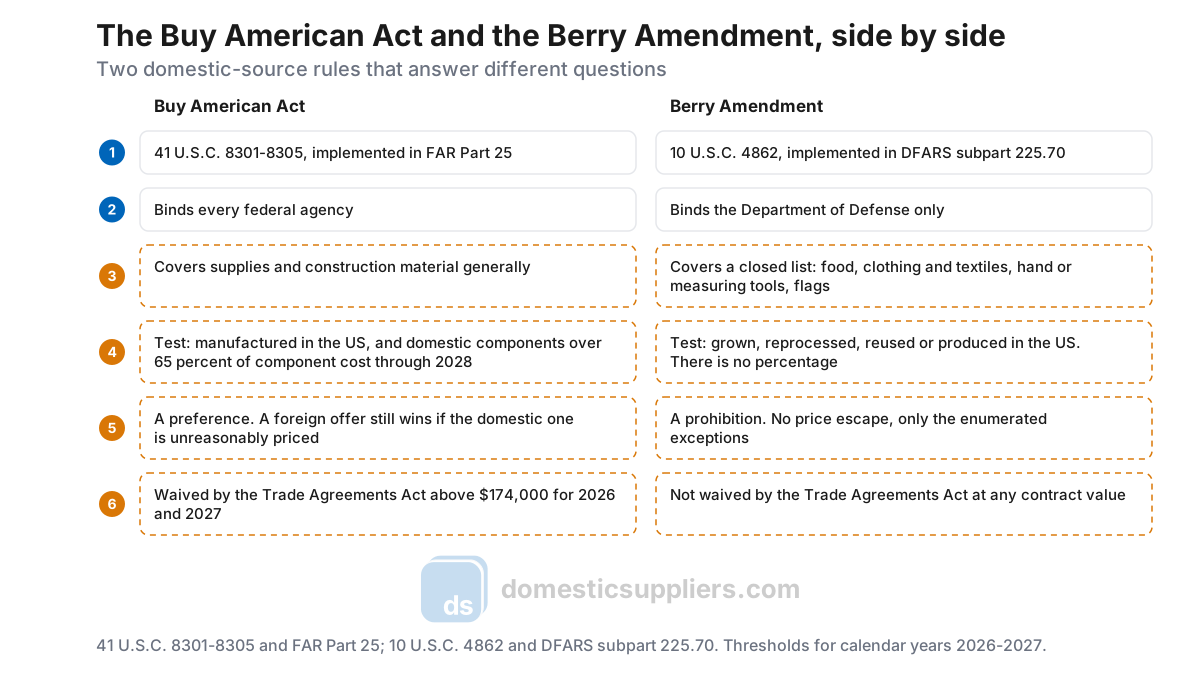
The Buy American Act is 41 U.S.C. 8301 through 8305, implemented in FAR Part 25. It applies to every federal agency, not just the Department of Defense, and it attaches to supplies acquired for public use inside the United States above the micro-purchase threshold.
For a manufactured end product, it is a two-part test:
- The end product must be manufactured in the United States.
- The cost of its domestic components must exceed a stated percentage of the cost of all its components.
That percentage is 65 percent for items delivered in calendar years 2024 through 2028, and it rises to 75 percent for items delivered starting in calendar year 2029. It was 60 percent before 2024, and 55 percent before that, which is why older supplier documentation and older internal checklists frequently cite a number that is no longer correct.
Notice what the test does not ask. It does not ask where the metal was melted. It does not ask where the design originated or where final test was performed. It asks where manufacturing happened and what share of component cost is domestic. Those are accounting questions answered off a bill of materials, not metallurgy questions answered off a mill cert.
There is one carve-out worth knowing before you build a component cost model you did not need. For commercially available off-the-shelf items, the component test is waived under FAR 25.101(a)(2). A COTS item has to be manufactured in the United States to qualify as domestic, but you do not have to prove the 65 percent. If the item on your line is genuinely COTS, that is the end of the analysis.
The most important structural fact about the Buy American Act is that it is a preference, not a ban. If no compliant domestic offer exists, or the domestic offer costs unreasonably more, the agency can buy foreign. FAR 25.106 sets the evaluation factor: 20 percent is added to the price of a low foreign offer, or 30 percent when the competing domestic offeror is a small business. The Department of Defense applies 50 percent under DFARS 225.502. So at DoD, a foreign item that is more than half the price of the domestic alternative still wins, legally, under a clause that says "Buy American" on its face.
What the Berry Amendment Actually Requires
The Berry Amendment is 10 U.S.C. 4862, recodified in recent years from 10 U.S.C. 2533a, and it is implemented in DFARS subpart 225.70 with the clause at DFARS 252.225-7012, Preference for Certain Domestic Commodities. It binds the Department of Defense only. A civilian agency contract has no Berry obligation at all.
It covers a short, closed list of commodities: food; clothing and the materials and components of clothing; tents, tarpaulins and covers; cotton and other natural fiber products; woven silk and silk blends; synthetic and coated synthetic fabric; canvas products; wool; hand or measuring tools; and flags. If the item you are quoting is not on that list, Berry does not reach it, no matter how sensitive the end use.
The standard for the items it does reach is that they be grown, reprocessed, reused, or produced in the United States. There is no percentage. There is no component cost model. It is a domestic-origin requirement stated in absolute terms, and the usual shorthand for it — 100 percent — is closer to right than any threshold you could substitute for it.
And there is no price preference. The Department of Defense cannot buy a noncompliant Berry item because it is cheaper, no matter how much cheaper. The only way a noncompliant item gets bought is through one of the enumerated exceptions in DFARS 225.7002-2: acquisitions not exceeding $200,000, with athletic footwear for service members entering the armed forces carved back in; a domestic nonavailability determination; perishable food for overseas use; commissary resale; and a short list of others.
The Mistake That Costs Money
The confusion runs in one direction most of the time: people treat Berry as "Buy American, but stricter." That framing is wrong in a way that produces real sourcing errors, because it implies the two rules cover the same goods at different intensities. They do not overlap much at all.
A machined aluminum bracket is not a Berry item. There is nothing in the Berry list that reaches it. It can absolutely be a Buy American Act concern, and the analysis there is the 65 percent component cost test.
A hand tool going into a DoD contract is a Berry item, and the Buy American price preference analysis is irrelevant to it. You do not get to argue that the domestic version costs 60 percent more. There is no factor to apply.
A titanium fastener is neither. Specialty metals used to live inside the Berry Amendment, and Congress moved them out into their own statute, 10 U.S.C. 4863, implemented at DFARS 252.225-7008 and 252.225-7009. The test there is where the metal was melted or produced, which is a third test again, unrelated to either of the first two. When somebody tells you a titanium part "fails Berry," they are citing the wrong restriction, and the fix they propose will usually be the wrong fix.
What the Trade Agreements Act Waives, and What It Does Not
Above a dollar threshold, the Trade Agreements Act displaces the Buy American Act entirely for designated-country end products, which are then treated the same as domestic ones. For calendar years 2026 and 2027, that threshold is $174,000 for supply and service contracts and $6,708,000 for construction, per FAR 25.402. The U.S. Trade Representative set the current figures effective January 1, 2026, and the FAR picked them up effective March 13, 2026.
This is why a large contract can be less restrictive than a small one. Below the threshold you are in Buy American Act territory with the 65 percent component test. Above it, a part made in any designated country is treated as if it were domestic, and the component test never runs.
The Trade Agreements Act does not waive the Berry Amendment. Not at any value. A Berry item sourced from a designated country is noncompliant on a $2 million contract exactly as it is on a $300,000 one. It does not waive the specialty metals restriction either. If your compliance process treats "above the TAA threshold" as a general release from domestic-source obligations, it will quietly produce violations on the DoD side.
Where Both Land on the Same Assembly
Consider a portable test set ordered by a DoD program office: an aluminum enclosure, a padded carry bag with a shoulder strap, a small kit of hand tools, and titanium fasteners through the chassis.
That one line item runs three separate tests. The enclosure and the electronics inside it are Buy American Act questions, resolved by component cost. The carry bag and strap and the hand tools are Berry items, resolved by domestic origin with no percentage and no price relief. The titanium fasteners are a specialty metals question, resolved by where the metal was melted. Three tests, three different kinds of evidence, three different clauses in the contract, and a single supplier certification that is probably signed as though it were one question.
This is the practical reason to read the clause list in the solicitation rather than the summary at the top. The clauses tell you which tests are live. The summary tells you what the contracting officer believes is live, which is not always the same thing.
The Exceptions, and Who Gets to Invoke Them
On the Buy American Act side, the exceptions are nonavailability, unreasonable cost, public interest, items for resale, items acquired for use outside the United States, and acquisitions at or below the micro-purchase threshold. On the Berry side, the main ones in practice are the $200,000 acquisition threshold and a domestic nonavailability determination.
One point gets missed constantly. A nonavailability determination is a government act. It is made by the agency, on the record, following its own procedure. A supplier telling you "there is no domestic source for this" is not an exception. It is a request that somebody go get one. If your file contains a supplier email asserting nonavailability and nothing from the contracting officer, you do not have an exception, you have correspondence.
Enforcement Got Sharper in March 2026
Executive Order 14392, signed March 13, 2026, is titled Ensuring Truthful Advertising of Products Claiming To Be Made in America. Most of the commentary about it has focused on the consumer advertising side, but one section is squarely about procurement: agencies overseeing Multiple Award Schedules, government-wide acquisition contracts, and other indefinite-delivery, indefinite-quantity vehicles are directed to periodically review and verify American-origin claims attached to products sold through them. Where a contractor or vendor is found to have misrepresented origin, the agency is to remove the products from procurement availability and refer the matter to the Department of Justice, which may pursue a False Claims Act action.
Nothing in that order changes the Buy American Act content test or the Berry Amendment standard. What it changes is the expected lifespan of a certification. The working assumption used to be that an origin certification is checked at award, if it is checked at all. The new assumption should be that it can be audited later, by an agency that did not run the original competition, with a referral path that ends somewhere unpleasant.
What to Ask a Supplier
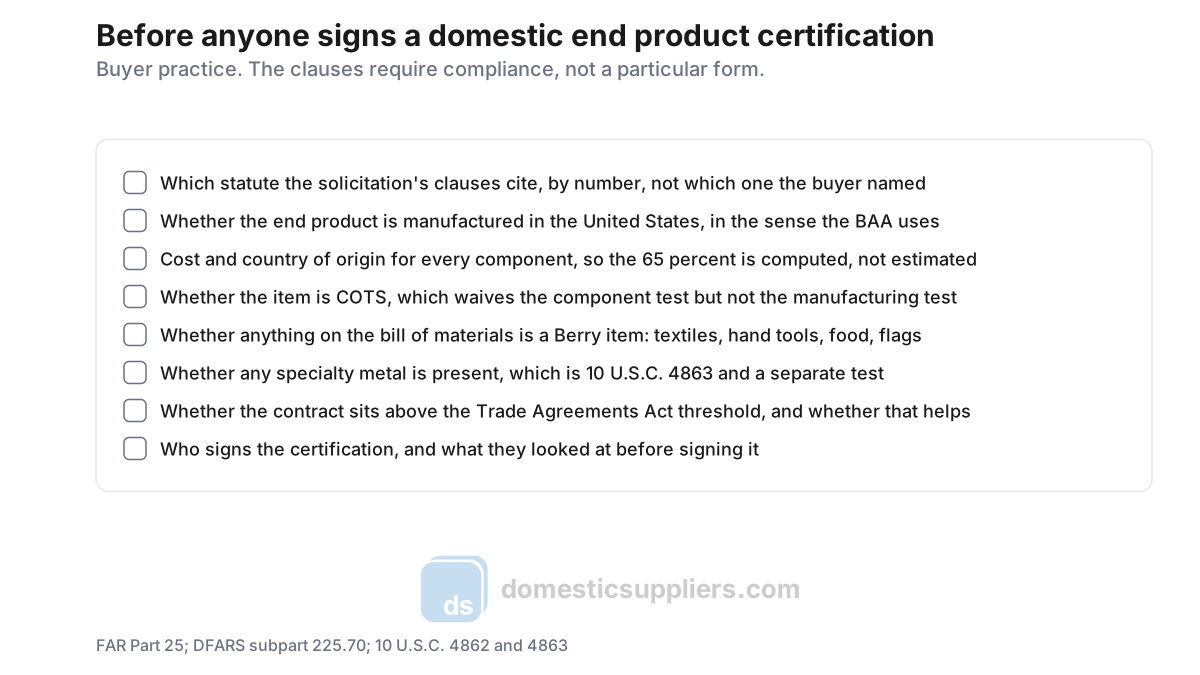
Ask which clause they are certifying to, by number. "We are Buy American compliant" is not an answer; FAR 52.225-1 and DFARS 252.225-7012 are different promises.
Ask for the component cost breakdown behind a Buy American Act certification, with country of origin per line. If the supplier cannot produce one and the item is not COTS, the certification was an estimate.
Ask, separately, whether anything on the bill of materials is a textile, a hand or measuring tool, or a flag, and whether any part is titanium, zirconium, or a listed steel, nickel or cobalt alloy. Those two questions pull the Berry and specialty metals exposure out of a bill of materials that a Buy American analysis would have walked straight past.
Conclusion
The Buy American Act is a government-wide price preference with a percentage test, a COTS carve-out, and an escape hatch when the domestic offer costs too much. The Berry Amendment is a DoD-only prohibition on a short list of commodities, with no percentage, no price relief, and no trade agreement waiver. They are not two settings on the same dial. Read the clause numbers in the solicitation, run each test against the bill of materials separately, and do not let one certification signature stand in for three different questions.