What a Certificate of Conformance Must Include
A certificate of conformance proves that somebody signed a statement, not that anybody measured a part. What makes one useful is how precisely it points at the parts in the box, and most fail there rather than at the signature.
Introduction
Open a box of parts, pull the paperwork off the top, and about half the time the certificate of conformance reads something like this: "We hereby certify that all parts supplied on the above order conform to all applicable specifications and drawings." Company letterhead, a signature, a date. Nothing else.
That document is worthless, and not because anyone is lying. It is worthless because it cannot be tied to anything. It does not say which parts, which revision, which lot, or which requirements. Two years later, when a field failure sends somebody back through the records, there is no way to establish that this certificate covers those parts, and a certificate that cannot be matched to a shipment certifies nothing at all.
A certificate of conformance is a statement, not evidence. Nobody measured anything because you received it. Its entire value is in identification: how precisely it points at the parts in the box, and how honestly it declares what it does not cover. Almost every bad certificate fails on identification, and almost none fail on the signature.
This article covers what the document is, the six fields it has to carry, the one field that fails more than all the others combined, how it differs from the documents that actually show conformance, what the government version requires, who is allowed to sign, and what to put on a purchase order so you get a usable one.
What the Document Is
A certificate of conformance, written C of C, CoC, or sometimes certificate of compliance, is a written statement signed by the supplier that the items delivered meet the requirements of the order.
It exists because inspecting everything is not economic. Somewhere in every supply chain there is a decision to accept product on the strength of a supplier's word rather than on the strength of an inspection, and the certificate is the artifact of that decision. The federal acquisition rules say this out loud, which is unusual and useful. Acceptance on a certificate of conformance is permitted when it is in the government's interest and either small losses would be incurred in the event of a defect, or the contractor's reputation or past performance makes it likely the supplies will be acceptable and defective work replaced, corrected or repaired without contest.
Read that twice, because it is the clearest statement anywhere of what you are doing when you take a certificate. You are trading inspection for a combination of low consequence and known behavior. If neither of those holds, the certificate is the wrong instrument and you want an inspection report.
That also explains why a certificate is a poor thing to argue with later. It commits the supplier, it does not prove the part. Which is fine, as long as everyone understands what has been bought.
The Six Fields
Strip away the letterhead and a usable certificate carries six things. Five of them are identification, and that is the point.
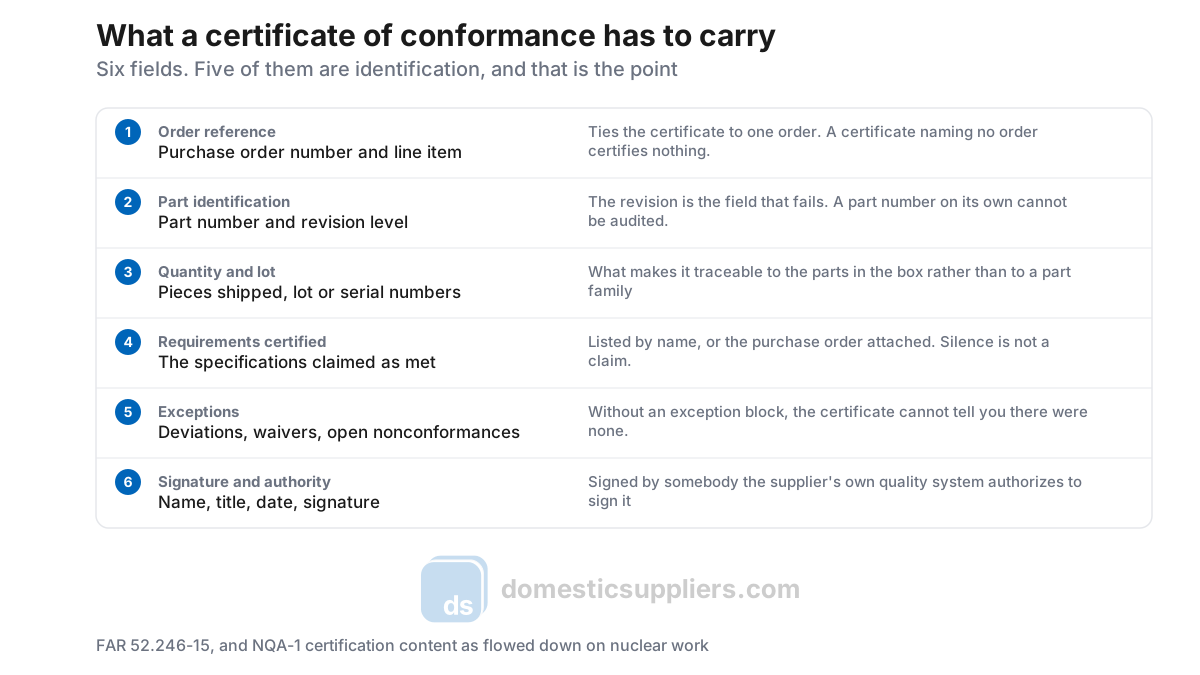
The structure is not invented. It is close to what nuclear work has demanded for decades, where the flow-down to a subcontractor typically requires the certificate to reference the purchase order number, identify the items being certified traceably to what was delivered, identify the specific procurement requirements certified as met, identify any approved changes or deviations and describe any requirements that were not met, and be signed by a person the supplier's own approved certification system defines as having authority to sign.
That is a demanding list and it is also the right one for a commercial order. Four features of it are worth pulling out.
The certificate names an order, not a customer. "Acme Aerospace" at the top of the page is marketing. "PO 44821, line 3" is traceability.
It identifies what was delivered, not what is sold. Lot numbers, serial numbers, heat numbers, date codes: whatever your system uses to tell one shipment from the next. A certificate that applies equally to every shipment of that part number ever made is a brochure.
It names the requirements. Either list the specifications, or attach the purchase order and certify against it. A certificate that says "conforms to all applicable requirements" without saying which ones has left the definition of "applicable" to the person who signed it.
It declares exceptions. This is the field people leave off, and it is the one that makes the rest trustworthy. If there is no place on the form for deviations, waivers and open nonconformances, then a clean certificate and a certificate hiding a concession look exactly alike. Put the block on the form and write "none" in it.
The Revision Field
Of everything on that list, part revision is where certificates fail most often, and it fails quietly.
The part number is almost always right. The revision is missing, or stale, or copied from the quote rather than read off the drawing the parts were actually made to. The shop built to Rev F, the purchase order called out Rev G, the certificate says "Rev F" or says nothing, and nobody reads it until there is a reason to.
This matters more than it sounds because a certificate with no revision cannot be falsified or confirmed. It is compatible with every possible version of the part. That is not a documentation problem, it is a traceability failure: the point of the record is to let a future reader determine what was supplied, and a record that is true no matter what was supplied cannot do that.
Three practical habits fix it. Put the revision in the purchase order line text, not only in the attached drawing file name. Require the certificate to restate both the part number and revision rather than reference the purchase order generally. And when a revision moves mid-order, treat the split as two lots with two certificates, because one certificate covering both revisions is a certificate covering neither.
What Actually Shows Conformance
The useful mental model is two columns. One column is documents that assert. The other is documents that demonstrate. They are not substitutes, and most disputes over certification are really somebody holding a document from the left column and expecting it to behave like one from the right.
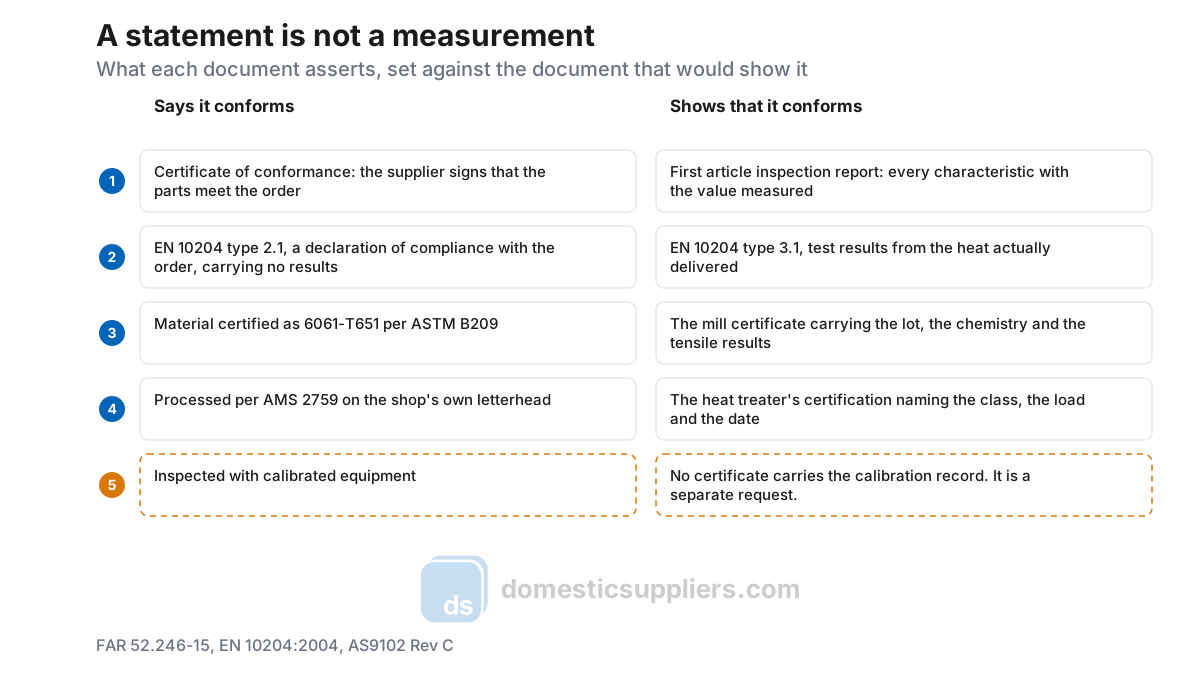
The European metals standard makes the distinction cleanly enough to borrow. EN 10204 separates a declaration of compliance with the order, which carries no test results at all, from an inspection certificate carrying results from the material actually delivered. Those are two different documents with two different names, and a buyer who asks for the first and expects the second has only themselves to invoice.
The same split runs through everything else you are likely to be handed. A certificate of conformance asserts; a first article inspection report demonstrates, characteristic by characteristic. A line on a shop's certificate saying the material is 6061-T651 asserts; the mill certificate carrying the lot number, the chemistry and the tensile results demonstrates. A line saying the parts were processed to a heat treating specification asserts; the processor's own certification naming the class, the load and the date demonstrates.
And then there is the row that does not pair at all. A certificate that says parts were inspected with calibrated equipment points at nothing. Calibration records are a separate artifact of a separate system, and no certificate of conformance carries them. If you need them, ask for them by name, and expect the answer to be a calibration certificate with a traceability statement rather than a line on a C of C.
The Government Version
If you supply the federal government, the certificate is not yours to design. The clause at FAR 52.246-15 gives the wording, and it is more specific than most commercial certificates by a wide margin.
The certificate states that on a given date the contractor furnished the supplies or services called for by a named contract number, via a named carrier, on an identified bill of lading or shipping document, in accordance with all applicable requirements. It then certifies that the supplies or services are of the quality specified and conform in all respects with the contract requirements, including specifications, drawings, preservation, packaging, packing, marking requirements, and physical item identification such as part number, and are in the quantity shown on the acceptance document.
Three things in there are easy to miss.
Preservation, packaging, packing and marking are certified. A commercial C of C almost never mentions them. Under this clause they are inside the certification, which means a shipment that conforms dimensionally and is packed wrong is a nonconforming shipment.
The shipment itself is identified. Carrier and bill of lading. This is the strongest version of the identification principle: the certificate is tied not just to an order but to a specific physical movement.
Using it requires written authorization. The clause applies when the cognizant contract administration office authorizes it in writing, in place of source inspection. It is not a default and it is not the contractor's election.
Two protections survive the certificate, and both are worth knowing in commercial work too. The government's right to inspect is not prejudiced by having accepted a certificate. And defective supplies can be rejected within a reasonable time after delivery by written notice, with the contractor replacing, correcting or repairing at its own expense. A certificate buys the supplier faster acceptance. It does not buy finality.
Who Is Allowed to Sign
The signature is the least interesting field, with one exception: the authority behind it has to be real.
A certificate should be signed by a person the supplier's own quality system identifies as having the authority to sign it, by name and title, with a date. Not "Shipping". Not a stamp with no owner. The reason is practical rather than ceremonial. If the certificate turns out to be wrong, the next question is who made the determination and on what basis, and a document with no identifiable signatory cannot answer it.
Electronic signatures are fine where the quality system covers them. A typed name in a controlled system with access control is stronger evidence than an illegible scrawl on a scan, and most registrars treat it that way.
The one thing to watch is who the signer works for. A distributor's certificate restating a manufacturer's claim is a distributor's certificate. It certifies that the distributor believes the material is what the manufacturer said it was, which is a weaker statement than it appears and a well-known weak point in counterfeit avoidance. The aerospace standards for counterfeit avoidance, AS5553 for electronic parts and AS6174 for everything else, both expect certificates and supporting documentation to be examined for authenticity and for applicability to the materiel actually delivered, rather than taken at face value. If the chain matters, require the manufacturer's certificate to pass through unaltered alongside the distributor's.
What to Put on the Purchase Order
The certificate you receive is the certificate you specified. Shops send what the order asks for, and an order that says "C of C required" will get the one-line letterhead version, correctly.
A workable clause names six things: the purchase order number and line, the part number and revision, the quantity and the lot or serial identification, the specifications being certified, an explicit statement of deviations or "none", and the name, title and date of an authorized signatory.
Then decide separately what evidence you want behind it, because that is a different request. Material certifications traceable to the heat or lot. Special process certifications from the processor, not the shop. A first article inspection report if the part is new or the revision moved. Calibration traceability if the measurement is the thing you care about. Each of those has a price, and all of them are cheaper to specify at the request for quote than to discover you needed after the parts have shipped.
Last, say where the paperwork goes and when. "With shipment" is the default assumption and it is often wrong: certificates that travel in the box get thrown out with the box. If you want them emailed ahead of delivery, or uploaded to a portal, or both, write it down.
Conclusion
A certificate of conformance is the supplier's signature on a claim, not a record of anything measured. It earns its place by being specific: the order and line, the part number and revision, the quantity and lot, the requirements certified, the exceptions declared, and a named person with the authority to sign. The revision field is where these fail most often, and a certificate that cannot be tied to a revision cannot be tied to anything. When you need demonstration rather than assertion, ask for the document that carries measured values, and remember that calibration records are not on any certificate and have to be requested on their own.