US CNC Machining Cost per Hour: 2026 Benchmark
There is no national CNC shop rate, and the number a shop quotes you is mostly a statement about its own utilization. Here is the buildup from figures that are actually published.
Introduction
Ask ten US machine shops for a rate and you will get ten numbers, and the spread between the lowest and the highest will be wider than anything you can explain with wages, electricity or the price of a machine. That is not because some of them are lying. It is because a shop rate is not a price. It is a quotient, and almost nobody tells you the denominator.
A shop rate is total annual cost divided by the hours the shop expects to sell. Costs are the part everybody argues about and the part that varies least: two shops of the same size in the same county pay their machinists within a few dollars of each other. The denominator is where the real variation lives. A shop that plans on selling 2,000 spindle hours per machine and a shop that plans on selling 1,300 will quote rates 50 percent apart on identical cost structures, and the second shop is not more expensive. It is busier with setup, or has more variety, or is honest about the hours it loses.
So the useful question is not what the average rate is. There is no survey of US shop rates you can cite, and anyone quoting one to the dollar is quoting an estimate somebody made up. The useful question is what the inputs cost in 2026, how they get divided, and what to ask a shop so that two quotes become comparable.
This article builds the rate from figures that are published: Bureau of Labor Statistics wage and compensation data, the BLS Quarterly Census of Employment and Wages for machine shops specifically, the producer price index for the industry, and EIA electricity prices. Where a number is an assumption rather than a measurement, it is labelled.
What Is Actually Published
Three federal datasets cover this industry and none of them reports a shop rate.
QCEW counts establishments, employment and payroll for NAICS 332710, machine shops, from unemployment insurance filings, which makes it a near-census rather than a survey. In 2025, the United States had 18,389 private machine shop establishments employing 255,112 people, with total annual wages of $18.2 billion. Average pay was $71,186 a year, or $1,369 a week.
OEWS reports wages by occupation. The May 2025 estimates, released in May 2026, are the current ones.
PPI tracks the prices shops actually charge, as an index rather than a level. It will tell you how much rates moved; it will not tell you what they are.
That is the whole public picture. It is enough to build a floor and a sensitivity, which is more than a made-up average gives you.
Two numbers from QCEW are worth holding onto. Between 2024 and 2025, machine shop establishments fell from 18,734 to 18,389 and employment fell from 259,277 to 255,112, while the average weekly wage rose 4.3 percent. Capacity is leaving the industry at the same time labor is getting more expensive, which is the structural reason rates are not going back down.
What Labor Costs in 2026
The BLS OEWS estimates for May 2025 put the mean hourly wage for machinists at $28.52, with a median of $28.24 and mean annual earnings of $59,320 across 287,050 people. For comparison, the average annual wage across all US occupations in the same release was $69,770, so a machinist is paid below the national average wage, which surprises most buyers who assume a skilled trade sits above it.
The adjacent occupations matter for a quote, because they are different people at different rates.
CNC tool operators, 169,450 of them, average $26.11 an hour.
Machinists, 287,050, average $28.52.
Tool and die makers, 56,930, average $32.14.
CNC tool programmers, 28,500, average $34.72, which is 33 percent above the operator rate.
That last gap is the one that shows up on your quote. Programming is done by the most expensive hour in the building, it happens before any chip is cut, and on a short run it can be a larger line than the machining.
None of those wages is what the shop pays. The BLS Employer Costs for Employee Compensation release for June 2026 puts total compensation in manufacturing at $48.62 per hour worked, of which wages and salaries are $32.50, or 66.9 percent, and benefits are $16.12, or 33.1 percent. In other words the manufacturing burden runs about 1.50 times the wage, and the figure is per hour worked, so it already accounts for paid leave.
Apply that to the machinist mean and you get roughly $42.70 per attended hour as the fully burdened cost of the person standing at the machine. That is the floor. Nothing else in the buildup can be smaller, and every published rate has to clear it by a wide margin.
Where the Shop Is
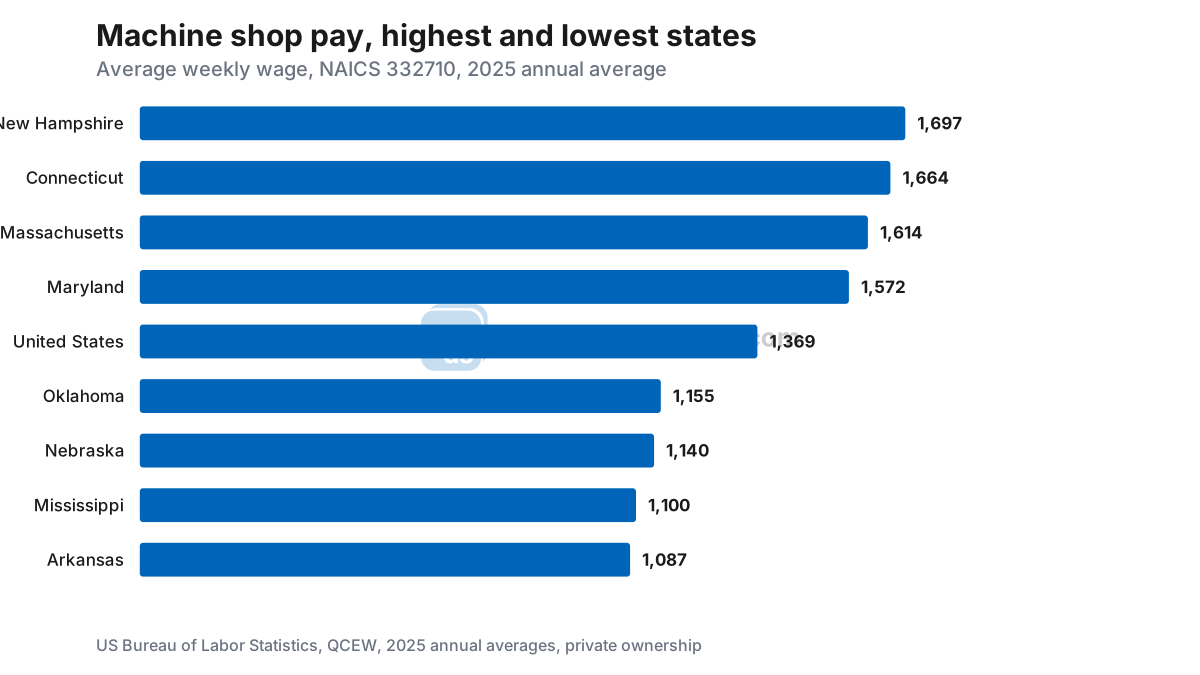
Of the 38 states with at least a thousand machine shop employees, New Hampshire pays the most at $1,697 a week and Arkansas the least at $1,087. That is a 56 percent gap in payroll per employee for the same industry code, and it is the single largest geographic driver of a rate.
The familiar manufacturing states sit closer to the middle than their reputations suggest. Ohio is $1,308 a week, Michigan $1,371, Wisconsin $1,273, Indiana $1,277. The high end is New England and the defense corridor, where shops compete for people with aerospace primes and medical device plants. California is $1,450 and Texas $1,429, both above the national average and both well below Connecticut.
Electricity varies far more in percentage terms and matters far less in dollars. The EIA Electric Power Monthly for August 2026 puts the US industrial average at 9.64 cents per kilowatthour, with New Mexico at 5.08 cents and Louisiana at 6.10 at one end, and Hawaii at 39.33, California at 24.12 and Alaska at 23.13 at the other. A 4.7 times spread between New Mexico and California sounds decisive and is not, because power is a small share of a machine shop's cost per hour. A spindle, a chiller and a compressor drawing a sustained 20 kilowatts cost about $1.02 an hour in New Mexico and $4.82 in California. Real, and nothing next to a $610 a week difference in payroll.
The Divisor Nobody Quotes
A year has 2,080 scheduled hours on a single shift. No shop sells 2,080 hours per machine, and the gap between 2,080 and what it does sell is where rates come from.
Work through it. Take off planned maintenance, holidays and the days a machine sits because the schedule has nothing for it. Call that 85 percent availability and you are at 1,768 hours. Then subtract the hours the spindle is stopped for setup, first article, fixturing, tool changes and waiting on material, none of which you are being billed for as spindle time on a typical quote. If 70 percent of the available hours end up sold, the machine bills 1,238 hours a year.
Those two assumptions are the whole argument. The same fixed cost spread over 1,238 hours instead of 2,080 is 68 percent higher per hour. Nothing else in the buildup moves the number that far.
Which tells you what varies between shops. A production shop running long jobs, lights out on a second shift, with a pallet pool, sells far more hours per machine than a prototype shop that changes setups three times a day. The prototype shop's higher rate is not margin. It is arithmetic on fewer billable hours, and the same shop will beat the production shop on a 10-piece order because it is not amortising a setup it has no way to spread.
Building the Rate
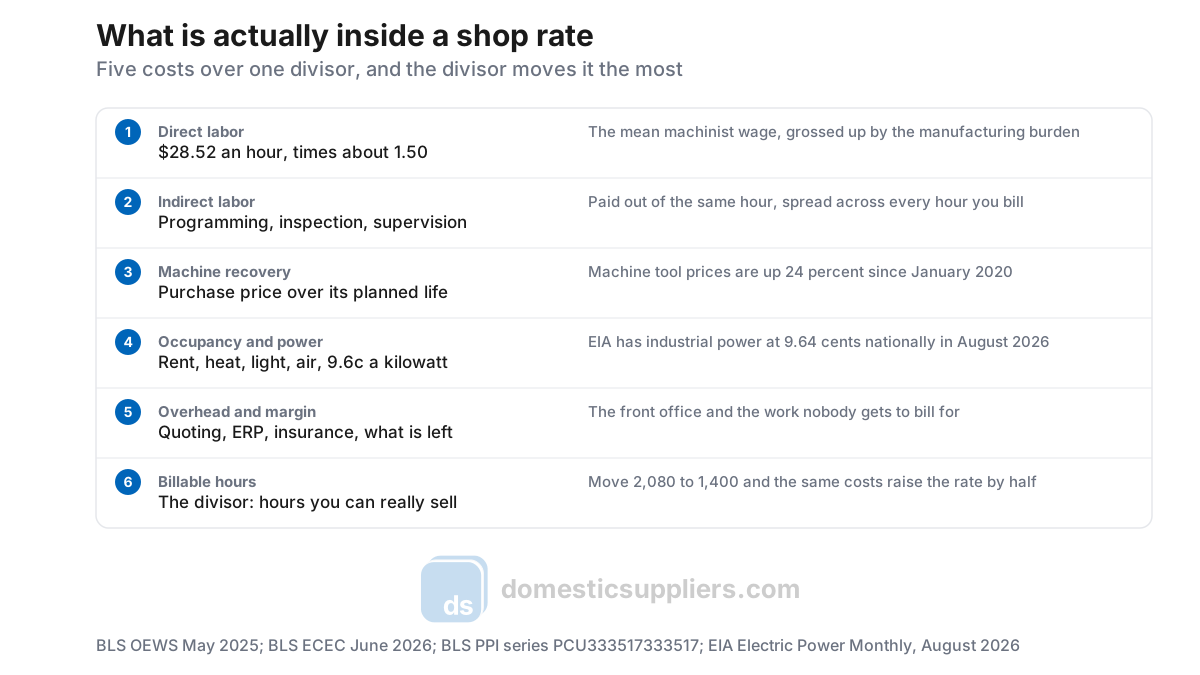
Five costs, one divisor.
Direct labor and burden. About $42.70 an attended hour at the national mean wage, more in New England, less in the Gulf states. If one operator tends two machines, the per-spindle figure halves and the shop's rate should reflect it. Ask whether it does.
Indirect labor. Programmers at $34.72 plus burden, inspectors, schedulers, maintenance, the owner who still quotes. These people are not on any job ticket and their whole cost lands on the hours that do get billed.
Machine recovery. Purchase price divided by the life the shop plans for it, divided by the hours it will bill. This is where a buyer's instinct is most wrong, because it is not a constant across shops. The PPI for machine tool manufacturing has risen about 24 percent since January 2020. A shop that bought its machines in 2018 is recovering a fundamentally cheaper asset than a shop that bought the same model last year, and that difference is permanent for the life of the equipment. It is also the reason a lower rate sometimes means older iron rather than better management.
Occupancy and power. Rent or mortgage, heat, light, compressed air and the spindle load. Small, and larger than people expect once compressed air is counted honestly.
Overhead and margin. Quoting, ERP, insurance, accounting, sales, and whatever is left at the end. Quoting in particular is a real cost that is invisible to buyers: a shop that quotes thirty jobs to win four has paid for twenty-six estimates out of the four it won.
Divide all of it by billable hours, and the rate falls out.
Why the Hours Are Not Interchangeable
A 5-axis hour and a 3-axis hour are different products and a single shop rate hides that.
The machine costs more to buy, so capital recovery per hour is higher on an asset that typically bills fewer hours because fewer jobs suit it. It needs the programmer rather than the operator, and the programmer costs 33 percent more per hour before burden. It needs better workholding, more expensive cutters, and more simulation time before the first cut. Against that, it eliminates setups: a part needing four operations on a 3-axis may need one on a 5-axis, and the comparison that matters is the total price per part, not the rate per hour.
The same logic applies in reverse to Swiss turning, where the high rate buys an unattended cycle that runs a bar to completion, and to wire EDM, where a very low labor content per hour sits against a very long cycle. A shop quoting one rate for everything is either doing one thing, or cross-subsidising, and on a mixed quote you are paying for the subsidy in one direction or the other.
What the Rate Does Not Cover
The hourly rate is one term in a quote and usually not the largest one.
Setup. Charged as a lump or amortised over the lot, and on anything under a few hundred pieces it dominates. A shop quoting a low rate and a high setup can be more expensive at your quantity than one doing the opposite.
Programming. Often a one-time charge, sometimes buried in the first order's setup. Ask which, because it changes the price of your repeat order.
Material. Marked up, and the markup is rarely disclosed. On anything in titanium, Inconel or certified plate it can exceed all the machining.
Inspection and documentation. A first article inspection, a CMM report, a certificate of conformance and material certs are hours, and on an aerospace part the inspection hours can rival the cutting hours.
Tooling and fixtures. Soft jaws, a dedicated fixture, a form tool. One-time, and yours or theirs depending on what the purchase order says.
Two quotes are only comparable at the bottom line, for your actual quantity, with the same documentation package. Comparing rates is comparing the one number both shops have the most freedom to construct.
Which Way This Is Moving
The producer price index for machine shops rose about 3.0 percent in the year to September 2026, and is up roughly 20 percent since January 2020. Over the same period the index for machine tool manufacturing is up about 24 percent. Shops are buying equipment that has inflated faster than the prices they charge for using it, while the QCEW shows their payroll per employee rising 4.3 percent in 2025 alone.
That combination explains the market you are quoting into. It is not a pricing cycle that reverses, and a shop that holds a 2019 rate in 2026 is a shop either running paid-off machines or heading somewhere you do not want your tooling to be.
How to Use This on a Quote
Four questions, asked once, make the rest of it legible.
What hours a year do you assume per machine? The number itself matters less than whether they have one. A shop that can answer has a cost model. A shop that cannot has a rate it inherited.
Is this rate attended or unattended? Lights-out hours cost the shop almost no labor, and a shop that charges the same for both is leaving its own advantage on the table or charging you for a person who is not there.
What is in the rate and what is a separate line? Specifically programming, inspection and material handling.
What does the price per part do at double and half my quantity? The answer exposes the split between setup and run time more reliably than any direct question about it.
Then compare on total price per part at your quantity. The rate is useful for understanding a shop. It is close to useless for choosing between two.
Conclusion
Labor sets the floor: $28.52 an hour for the mean machinist in the May 2025 OEWS, times about 1.50 for manufacturing burden, is roughly $42.70 per attended hour before a single other cost. Geography moves it by up to 56 percent between the highest and lowest paying states. Electricity moves it by a few dollars. Machine capital recovery depends on when the shop bought, and after a 24 percent rise in machine tool prices since 2020 that is a bigger split than it used to be. And then every one of those costs is divided by a number the shop chose: the hours it expects to sell. Ask for that number, and the rate stops being a mystery and becomes a statement about how the shop runs.