DFARS Specialty Metals: How to Source Compliant Material
A 2 percent weight threshold decides whether a single noncompliant bolt can disqualify an entire assembly. Here is how to tell if the specialty metals restriction applies to your part, and how to prove the metal is clean.

Introduction
If you buy machined or formed parts for a defense program, you have probably seen the phrase "specialty metals" in a solicitation and moved on without reading the clause. That is a mistake. The restriction is narrow, specific, and easy to violate without knowing it, because the failure usually happens upstream of you, at the mill or the distributor, not on your shop floor.
This article walks through what the restriction covers, what it does not, how it differs from the Berry Amendment, and what paperwork actually proves your material is compliant.
What Counts as a Specialty Metal
"Specialty metal" is a defined term under 10 U.S.C. 4863 and DFARS 252.225-7009, and it covers four categories only. If your material does not fall into one of these, the restriction does not apply, no matter how exotic the part looks.
- Steel with manganese over 1.65 percent, silicon over 0.60 percent, or copper over 0.60 percent, or steel containing aluminum, chromium, cobalt, molybdenum, nickel, niobium, titanium, tungsten, or vanadium above 0.25 percent.
- Nickel or iron-nickel alloys, and cobalt alloys, where the alloying elements exceed 10 percent.
- Titanium and titanium alloys, as an entire category, regardless of grade or alloy content.
- Zirconium and zirconium alloys, as an entire category.
That last point trips people up. A commercial-grade titanium fastener is a specialty metal under this definition even though titanium is common in aerospace hardware. There is no minimum alloy threshold for titanium or zirconium the way there is for steel. If the base metal is titanium or zirconium, it is in scope, full stop.
Standard carbon steel, most stainless grades, aluminum, copper, and bronze generally fall outside the definition unless they pick up one of the listed alloying elements above the stated percentage. Check your material certs against these numbers, not against a general sense of whether the alloy "sounds special."
The Melted-or-Produced Test and Qualifying Countries
Once you know the material is a specialty metal, the next question is where it was melted or produced. The clause requires that specialty metal be melted or produced in the United States, its outlying areas, or a qualifying country, as defined in DFARS 225.003.
"Melted" matters more than most buyers expect. It is not where the bar stock was rolled, forged, or machined. It is where the metal was melted, meaning the primary melt operation that created the heat. A titanium ingot melted in a non-qualifying country and then forged and machined entirely in the United States still fails the test, because the melt happened in the wrong place. This is a common point of confusion in a sourcing conversation, and it is where distributor stock quietly becomes noncompliant.
A qualifying country is not the same thing as an ally or a trading partner in the general sense. It is a specific list maintained in DFARS 225.003 tied to reciprocal defense procurement agreements. Do not assume a NATO member is automatically a qualifying country for this purpose. Confirm the specific country against the current list for every heat lot, not once per supplier.
Which End Items Trigger the Restriction
The specialty metals restriction does not apply to everything the Department of Defense buys. It attaches to specific categories of end items:
- Aircraft
- Missile and space systems
- Ships
- Tank and automotive items
- Weapon systems
- Ammunition
If the part you are quoting is not going into one of these categories, the restriction likely does not flow down to you, even if the material itself is a specialty metal. The scope is end-item driven, not material driven. This is why the same titanium fastener can require full melt traceability on one contract and need nothing more than a standard material cert on another, depending on what it is going into.
Read the contract flow-down carefully. A prime contractor will sometimes apply the restriction more broadly than the clause strictly requires, as a matter of internal risk management. When that happens, you are contractually bound to the stricter requirement even though the regulation itself would not have required it for your specific component.
The COTS Exception and the 2 Percent De Minimis Threshold
Two carve-outs matter in practice.
First, commercially available off-the-shelf items are generally excepted from the restriction. If you are buying a true COTS item, the melt-source requirement typically does not apply. But the exception has teeth taken out of it for a few categories: unincorporated mill products, forgings, castings, and fasteners that lack a domestic specialty metal certification do not get the COTS pass. If your "commercial" titanium fastener shows up without that certification, you cannot lean on COTS status to cover it.
Second, there is a de minimis threshold for noncompliant content. An end item is not automatically disqualified if it contains a small amount of noncompliant specialty metal. The limit is 2 percent: the total weight of noncompliant specialty metal in the end item cannot exceed 2 percent of the total weight of all specialty metal in that end item. This is a weight ratio calculated across the whole assembly, not a part-by-part pass/fail. A single out-of-compliance bracket can still blow the threshold if the assembly is otherwise light on specialty metal content, so do not assume one small part is automatically covered by the exception.
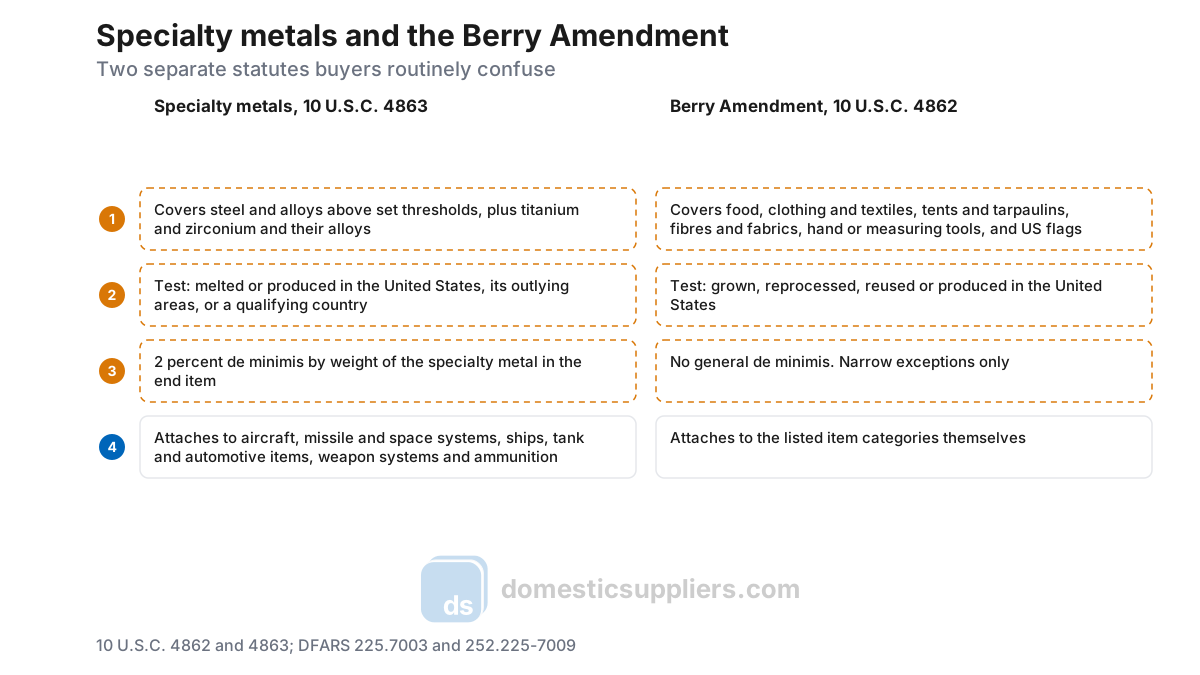
Specialty Metals vs. the Berry Amendment
Buyers confuse these two restrictions constantly, and the confusion causes real sourcing mistakes. They are separate statutes with separate scopes.
The Berry Amendment, 10 U.S.C. 4862, covers food, clothing, fabrics and fibers, hand or measuring tools, and flags. It is built around domestic growth, reprocessing, reuse, and production, with narrow dollar-value exceptions for small purchases. It does not use the melted-or-produced test, and it does not have a general 2 percent de minimis rule the way the specialty metals statute does.
The specialty metals restriction, 10 U.S.C. 4863, is a separate statute aimed specifically at the four metal categories described above, tied to the end items listed in the previous section. It uses the melted-or-produced-in-the-US-or-qualifying-country test, and it carries the 2 percent de minimis allowance.
The practical consequence: passing a Berry Amendment review does not tell you anything about specialty metals compliance, and vice versa. A domestically woven fabric component and a titanium bracket on the same assembly are evaluated under entirely different rules. Do not let a supplier's Berry Amendment certification stand in for a specialty metals melt certification. They answer different questions.
What to Require From Your Mill and Your Shop
Compliance lives in the paperwork, and the paperwork has to trace back to a specific melt, not a general assurance.
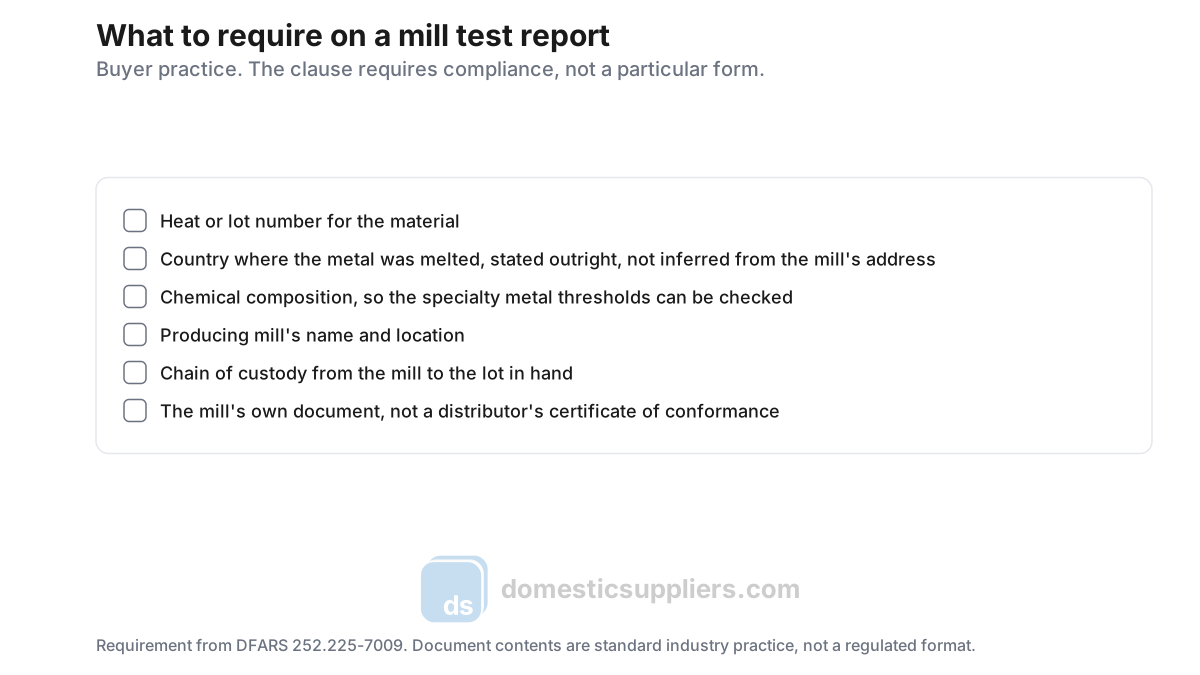
Ask your mill for a mill test report, or MTR, that identifies:
- The specific heat or lot number for the material
- The country where the metal was melted, stated explicitly, not inferred from the mill's address
- The chemical composition, so you can check it against the specialty metal thresholds yourself
- The producing mill's name and location
A certificate of conformance from a distributor or a fabricator is not a substitute for the mill's own MTR. A CoC that says "material meets DFARS requirements" without naming the melt source and country is not proof of anything. It is a statement of confidence, not traceability. Insist on seeing the mill's documentation, or a clear chain of custody back to it, before you accept the lot.
Push the same requirement down to your shop. If a machine shop is buying bar stock from a distributor on your behalf, make the melt-source documentation a condition of the purchase order, not an afterthought you ask about after the parts ship. Build it into your incoming inspection process so a missing MTR stops the lot before it goes into a machine, not after it is installed in an assembly.
Where Sourcing Goes Wrong
The classic failure is distributor stock with no traceable melt source. A distributor sells bar stock that is physically in the United States, warehoused domestically, maybe even machined domestically, and the buyer assumes that satisfies the restriction. It does not. The test is where the metal was melted, and a distributor who bought the material from a broker several steps removed from the mill often cannot answer that question at all.
A few other patterns show up repeatedly:
- Assuming titanium from an allied country automatically qualifies. It only qualifies if that country is on the current qualifying country list for this specific statute.
- Treating a COTS fastener as automatically exempt without checking whether it is one of the carved-back-in categories, such as fasteners lacking a domestic specialty metal certification.
- Calculating the 2 percent threshold per part instead of across the whole end item, which can make a borderline lot look compliant when the assembly as a whole is not.
- Accepting a generic CoC instead of asking for the mill's actual heat-specific documentation.
If you are quoting a part for a program and specialty metals language is in the solicitation, the fix is not complicated, but it has to happen before you commit to a supplier. Confirm whether your material falls into one of the four defined categories. Confirm whether your end item is on the restricted list. If both are true, get the mill test report before you place the order, not after the part is built.
Conclusion
The specialty metals restriction is narrower than most buyers assume, but it is also stricter than it looks once it applies. It covers four specific metal categories, attaches to a specific list of end items, and turns entirely on where the metal was melted, not where it was machined or warehoused. Know the four categories, know the 2 percent threshold, get the mill's own documentation, and do not let a generic certificate of conformance or a Berry Amendment certification stand in for the specific proof this restriction requires.