How Many Machine Shops Are in the US? 2026 Benchmark
NAICS 332710, counted. How many there are, which states hold them, and what the figure quietly leaves out.
Introduction
There are 17,156 machine shops in the United States. That is the count of establishments classified to NAICS 332710 in the Census Bureau's County Business Patterns, reference year 2023 — the most recent year that programme has published.
Ask how many machine shops are in the United States and you will get more than one answer. The Bureau of Labor Statistics counts 19,115 for the same industry in the same year, 11.4% higher. Neither agency is wrong. They count different units under different rules, and knowing which rule you are quoting matters more than the extra 1,959.
This piece settles the rest of it: what the code includes, why the two federal counts disagree, where the shops sit, how small most of them are, and what the number quietly leaves out.
What NAICS 332710 actually counts
NAICS is the North American Industry Classification System, the code set US statistical agencies use to sort businesses by what they produce. Code 332710 carries the official title "Machine Shops", and it is one leaf on a larger tree.
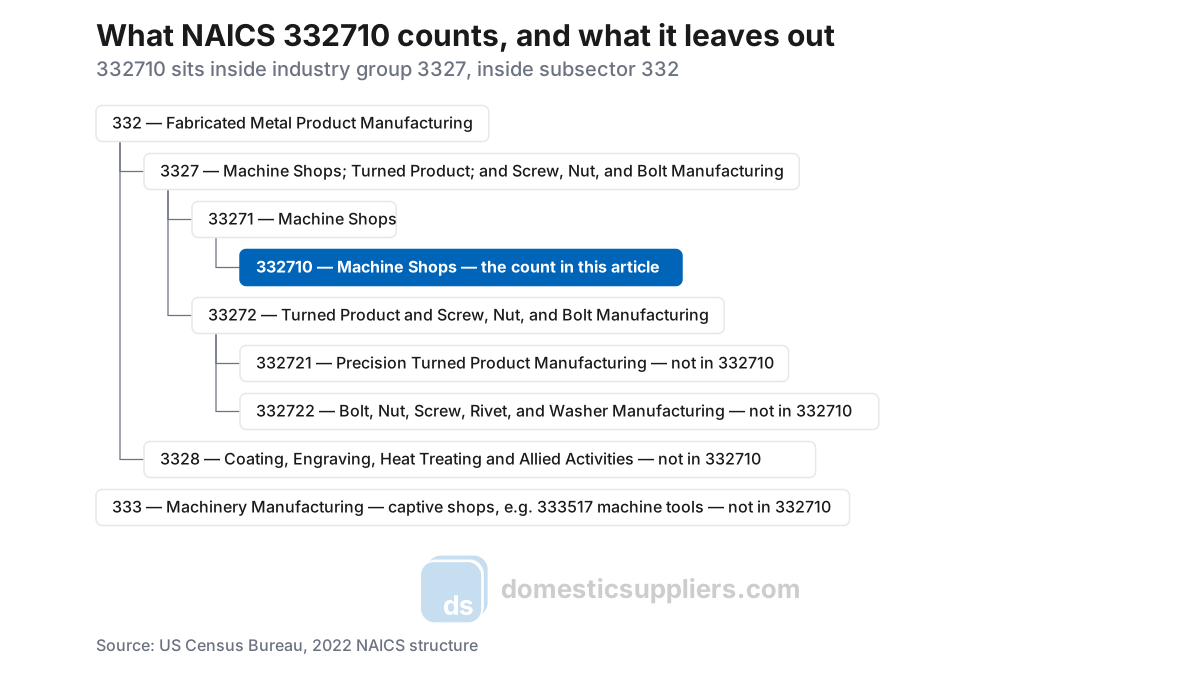
It sits inside three wider levels. Subsector 332 is Fabricated Metal Product Manufacturing. Industry group 3327 is Machine Shops; Turned Product; and Screw, Nut, and Bolt Manufacturing. Industry 33271 is Machine Shops, and it holds exactly one national industry — 332710, Machine Shops again.
That last quirk is worth knowing. Because 33271 has only one child code, the five-digit and six-digit counts are identical in every dataset. The 3327 group is bigger, at 21,774 establishments in 2023, because it also contains turned-product and fastener makers.
The official definition is narrow:
This industry comprises establishments known as machine shops primarily engaged in machining metal and plastic parts and parts of other composite materials on a job or order basis. Generally machine shop jobs are low volume using machine tools, such as lathes (including computer numerically controlled); automatic screw machines; and machines for boring, grinding, milling, and additive manufacturing.
Two phrases carry the weight: "on a job or order basis" and "low volume". A 332710 shop cuts parts to someone else's drawing, in modest quantities. The 2022 revision also names additive manufacturing, so a shop running printers next to its mills is still in scope.
One more term. The thing being counted is an establishment — a single physical location where business is conducted, not a company. A firm with three plants counts three times.
The headline number for 2026
The count comes with three numbers that give it meaning: people, payroll, and the size of the average shop.
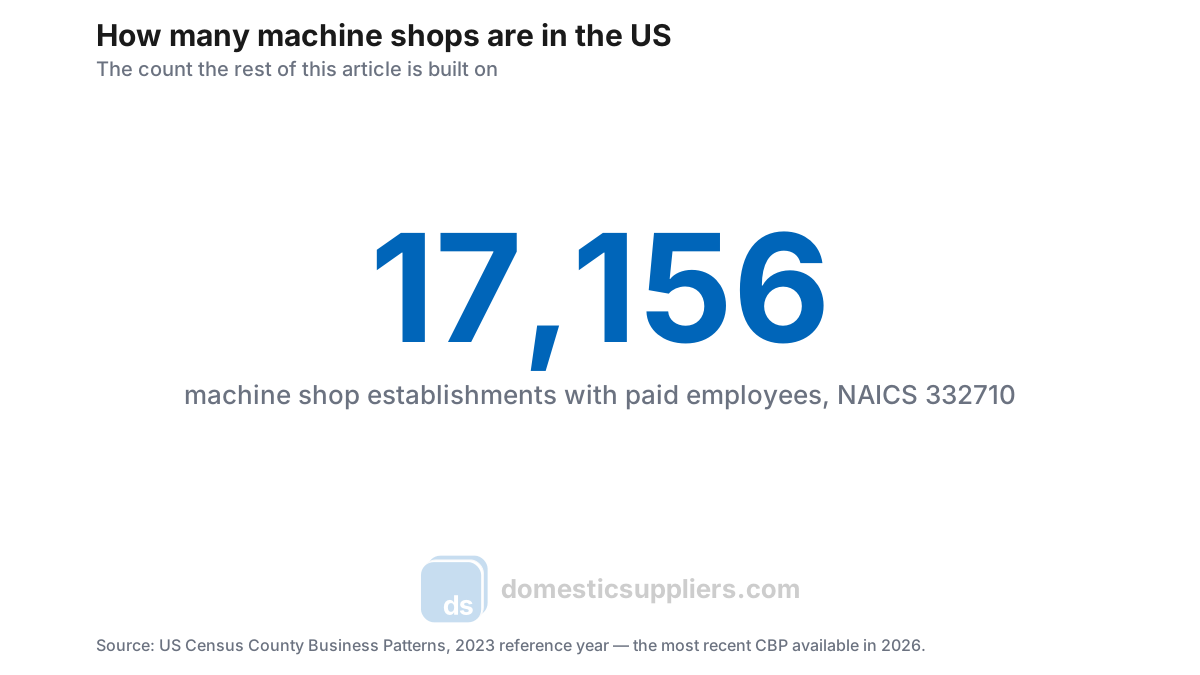
County Business Patterns puts 332710 at 17,156 establishments for 2023, employing 223,313 people, against an annual payroll of $14.23 billion. That works out to $63,715 of payroll per employee, and 13.0 employees per establishment.
Note the year. This is a 2026 benchmark built on 2023 data, the newest CBP reference year available. The number predates everything that happened in 2024 and 2025.
For this industry the lag is tolerable. The establishment count moves by a few hundred a year, not thousands, so the 2023 figure is unlikely to be far off today.
Where the figure comes from
That 17,156 is not the only count on offer. Three federal programmes count machine shops, and they are built differently, so they land on different numbers.
| Source | Reference year | Establishments | What it counts |
|---|---|---|---|
| Census County Business Patterns | 2023 | 17,156 | Establishments with paid employees, as of the week of 12 March |
| BLS QCEW | 2023 | 19,115 | Unemployment-insurance reporting units, averaged over four quarters |
| BLS QCEW | 2024 | 18,734 | Same basis, one year later |
| Economic Census | 2022 | Not retrieved | A direct census of businesses, run every five years |
The gap between the two 2023 figures comes down to the counting unit. CBP takes a snapshot of establishments with at least one paid employee during a single week in March. QCEW counts the units that file with state unemployment-insurance systems, averaged across all four quarters of the year.
Both of those rules push QCEW higher. One company that files separate UI accounts for two sites can show up as two units. A shop that opened in June or closed in February misses CBP's March week entirely but still lands in a quarterly average.
So use one or the other and say which. CBP 2023 at 17,156 is the more conservative and more widely cited figure. QCEW 2024 at 18,734 is the freshest. Averaging them produces a number that belongs to no source at all.
The 2022 Economic Census would give a third, independently derived count — it surveys businesses directly rather than tabulating administrative records. We could not retrieve a citable 332710 figure from it, so none is published here.
Machine shops by state
Those shops are not spread evenly. The industry is concentrated, but less than you might expect for manufacturing: no single state holds a fifth of it. Here are the ten largest.
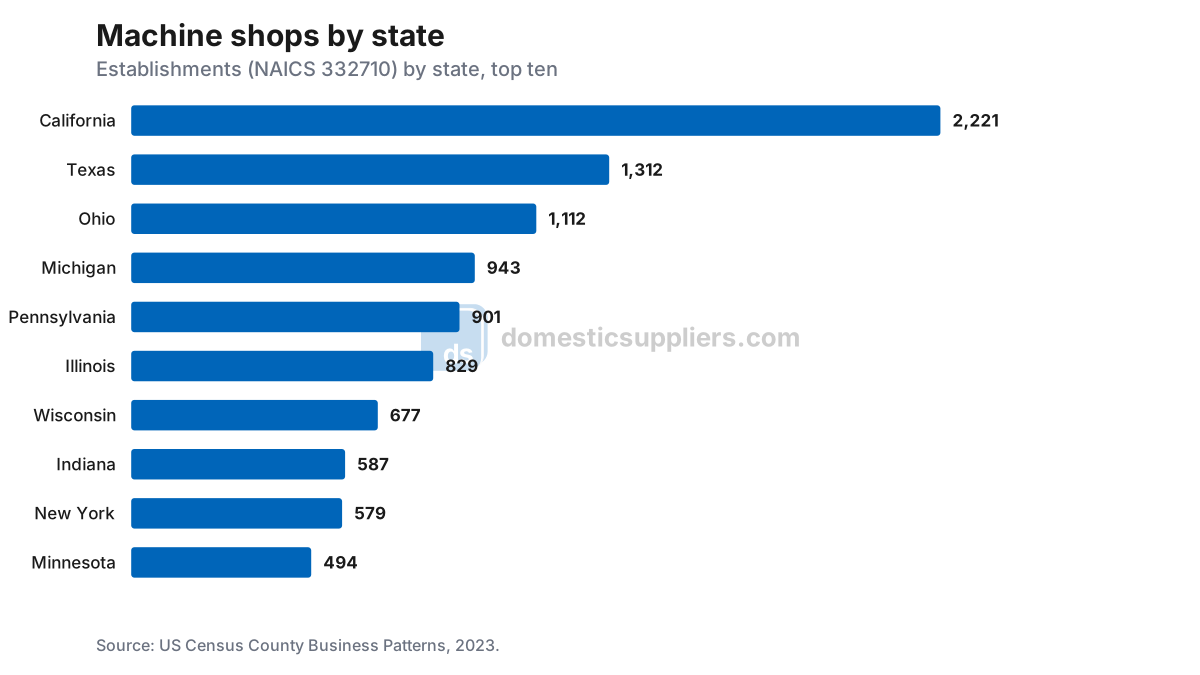
California leads with 2,221 establishments, 12.9% of the national total. Texas follows at 1,312, then Ohio 1,112, Michigan 943, Pennsylvania 901, Illinois 829, Wisconsin 677, Indiana 587, New York 579 and Minnesota 494. Florida and North Carolina come next, just off the chart at 456 and 453.
Those twelve states together hold 10,564 establishments — 61.6% of every machine shop in the country.
Shop size varies by region in a way the ranking hides. Divide each state's employment by its establishment count and Wisconsin averages 17.1 employees per shop, Michigan 14.2 and Ohio 13.3, against California's 12.5. California has the most shops; the upper Midwest has the bigger ones.
Machine shops by employee size
Size matters more than location. The distribution is the single most useful thing in the dataset, and it is heavily weighted toward the bottom.
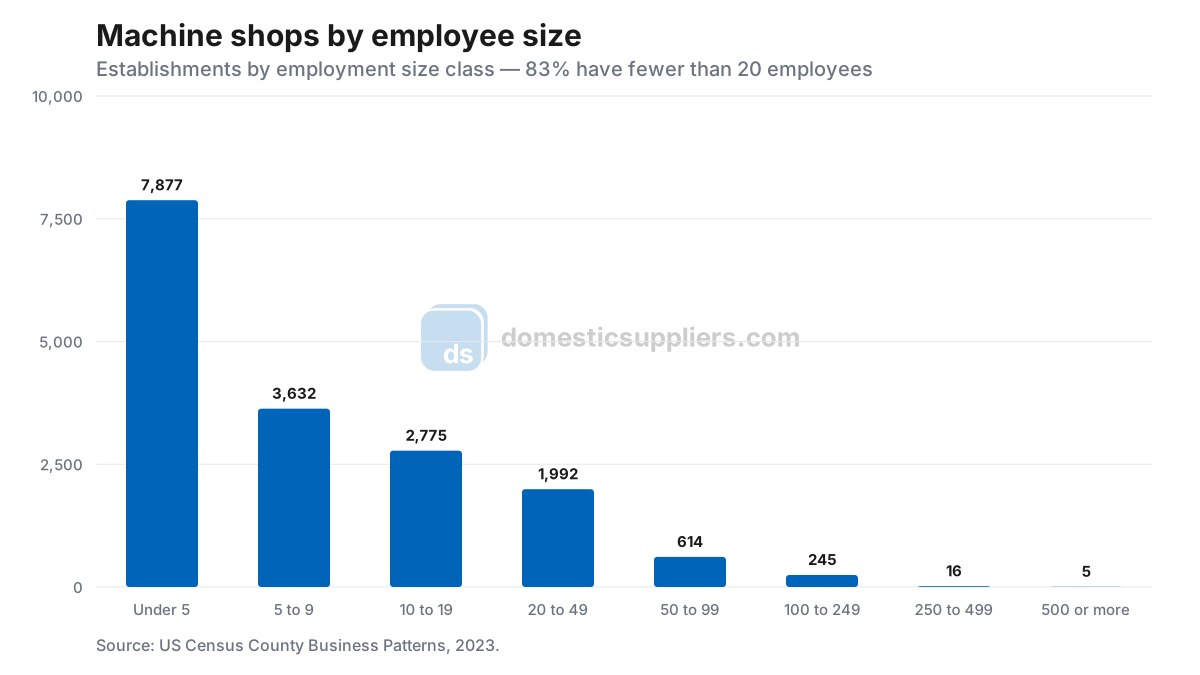
Of 17,156 establishments, 7,877 have fewer than five employees — 45.9% of the industry. Another 3,632 have five to nine, and 2,775 have ten to nineteen. Shops with fewer than 20 people account for 14,284 establishments, or 83.3% of the total. Fewer than 50 people covers 94.9%.
The top of the distribution is thin. Just 266 establishments have 100 or more employees, 1.6% of the industry. Sixteen have 250 to 499. Five shops in the entire United States employ 500 or more, and none employs 1,000.
For a buyer placing volume work, that shape sets the terms. A programme that needs sustained throughput cannot simply be awarded to a typical shop, because the typical shop is a handful of machines and a handful of people already running other customers' parts.
Practically, you either split the work across several small shops and accept the coordination cost, or you qualify against the few hundred establishments with the headcount to absorb it. Both are real strategies. What is not real is assuming 17,156 shops means 17,156 candidates for a high-volume contract.
What the code leaves out
The count also understates the field. Three things sit outside 332710, and together they are large enough to matter.
The first is the one-person shop. CBP counts only establishments with paid employees, so a sole proprietor with no payroll never appears. Census publishes non-employer data for manufacturing only down to the three-digit subsector, so there is no non-employer count for 332710 at all. What does exist: 41,542 non-employer establishments across all of NAICS 332, Fabricated Metal Product Manufacturing, in 2023. Some unknown share of those are one-person machine shops, and the share cannot be split out.
The second is captive machining. A pump manufacturer running twenty CNC machining centres to cut its own housings is classified by its primary product — the pump, somewhere in NAICS 333 — not by the machining. Those machines and those machinists are invisible to the 332710 count, even though they represent real capacity.
The third is the sibling codes. A shop turning high-volume parts off automatic screw machines or multi-spindle lathes is 332721, Precision Turned Product Manufacturing — 3,897 establishments in 2023 — even though a buyer would call it a machine shop and it may run comparable equipment. Fastener makers sit in 332722, Bolt, Nut, Screw, Rivet, and Washer Manufacturing, at 721 establishments. Stamping houses are 332119, a different industry entirely. Anodising, plating and heat treat are counted in 3328, Coating, Engraving, Heat Treating, and Allied Activities. Every one of those is a step a machined part passes through.
So 332710 is narrower than "machine shop" as a sourcing engineer uses the phrase. The 17,156 figure is a count of job-shop machining establishments with payroll. It is not a count of US machining capacity, and the population of places that will cut metal to your drawing is larger than any single code shows.
How the count has moved over a decade
The 2023 snapshot hides the direction of travel. That direction has been consistent enough that the trend tells you more than any single year.
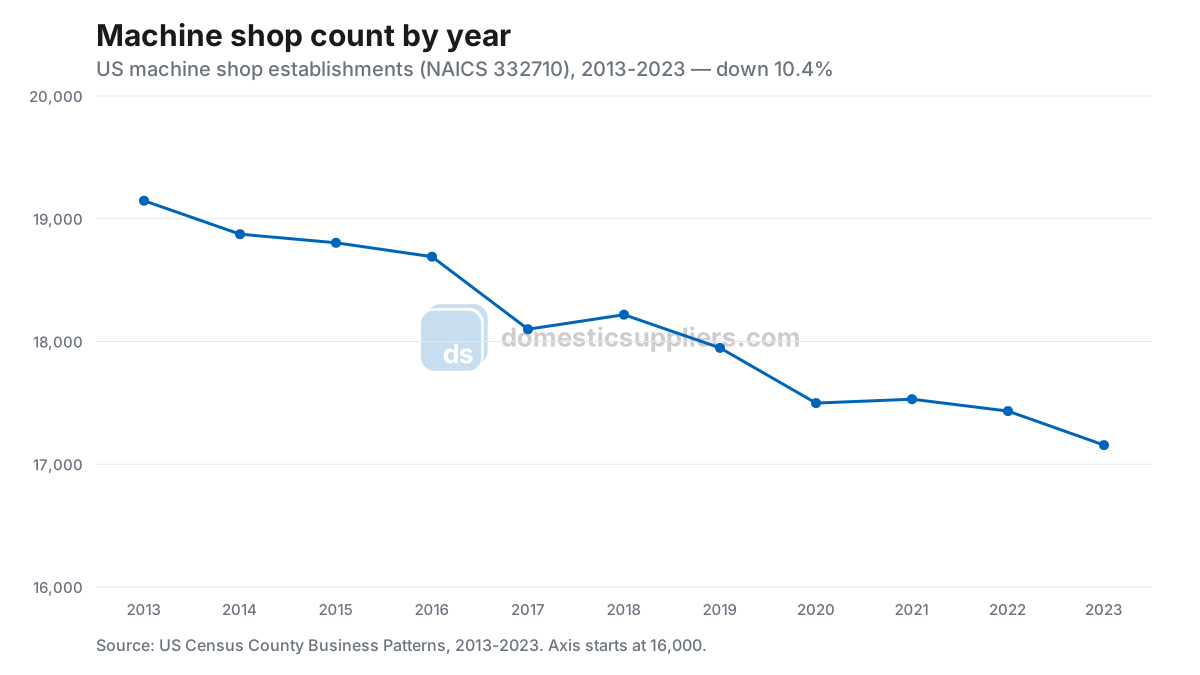
In 2013 CBP counted 19,147 machine shop establishments. By 2023 it counted 17,156 — a loss of 1,991 shops, down 10.4%. The count fell in eight of the ten year-over-year steps, rising only in 2018, by 118, and in 2021, by 32.
The series is comparable end to end. NAICS 332710 kept the same code, the same title and the same scope through the 2012, 2017 and 2022 revisions, so 2013 and 2023 are measuring the same industry.
What makes the decline interesting is that employment fell with it. Employment went from 248,297 to 223,313, down 10.1% — almost exactly the rate at which establishments disappeared. The average shop therefore did not get bigger. This is attrition, shops closing across the size range, not consolidation into larger plants.
Employment bottomed out in 2021 at 209,280 and has since recovered 6.7%, while the establishment count kept falling. The recovery went into shops that already existed rather than into new ones. Payroll tells a parallel story: up 20.3% over the decade while headcount fell 10.1%, so pay per worker rose sharply. Rising pay and unfilled jobs point the same way, though the openings data is far broader than this industry: BLS counted 522,000 open jobs across all of manufacturing in August 2026, the finest cut that series publishes.
The newest data point is not CBP's. QCEW shows establishments falling from 19,115 in 2023 to 18,734 in 2024, down 381 units or 2.0%, with employment down 1.7% over the same year. CBP's series stops at 2023, so the claim that the count is still falling rests on QCEW.
Conclusion
Use 17,156, and cite it as County Business Patterns, NAICS 332710, 2023. If your work needs the freshest year instead, use 18,734 from QCEW 2024 and name that source. The two are not interchangeable. The difference between them is a counting rule, not a correction.
Then treat the number as what it is: a denominator, not a supplier list. It tells you that 83% of those shops employ fewer than 20 people, that five employ more than 500, and that the count has fallen in eight of the last ten years.
It also sets a floor rather than a ceiling on who will machine your part. Non-employer shops, captive machining departments and turned-product houses all cut metal and none of them are in the 17,156.
For reference on how much narrower a usable list gets: domesticsuppliers.com indexes 4,741 machine shops, 27.6% of the CBP count. Any directory is a subset of the industry rather than a census of it, and the gap between those two numbers is the size of that difference.