How to Find a Contract Manufacturer in the USA
Search by process and certification, not by product. How to build a shortlist worth sending to, what the package needs, and the point at which shops stop replying.

Introduction
A contract manufacturer is a company that makes parts, or whole products, to your design and on your order. You own the drawing. They own the machines.
Most searches for how to find a contract manufacturer in the USA for a new product start with the product: you type the name of the thing you want made, and you get companies that already sell something like it. Those are competitors, not suppliers.
The shops that could make your part describe themselves by process instead — machining, stamping, sheet metal, molding, plating — and so do the federal industry codes. Search the process and you find the people with the equipment. What follows is the order of operations, from process list to RFQ package.
Define the process before you describe the product
One part is rarely one process. A machined aluminum housing with a powder-coated finish and a pressed-in threaded insert touches three industries, and usually three separate companies.
Each process sits under a different code, often in a different town. A machine shop quoting your housing sends the coating out; a finisher will not cut the part. So write the process list first — for one part it looks like this.
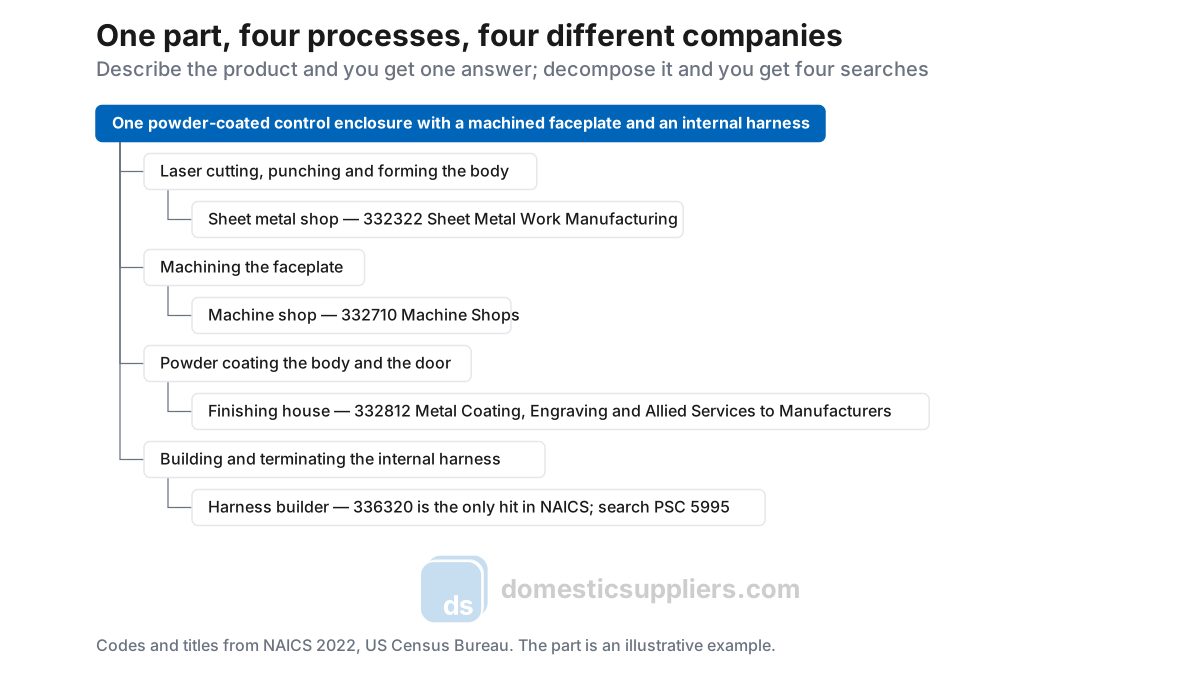
Work it in order: material, primary forming, secondary operations, finishing, inspection, assembly. Then decide which steps one supplier should own, and which you will buy yourself.
NAICS and PSC codes as search terms
Two code sets matter. NAICS, the North American Industry Classification System, is run by the US Census Bureau and classifies an establishment — one physical location — by its primary product; suppliers pick their own codes when they register in SAM.gov. A PSC, or Product and Service Code, describes the thing bought on one line of a federal contract, and the contracting officer writing the solicitation assigns it.
So a NAICS code on a SAM.gov profile is a supplier's claim about itself. A PSC on a federal award is a third party's statement about a part that actually shipped. That distinction sets the search order later.
PSC has no code for a process, though: federal buyers buy a part or a repair, never "CNC machining services". So PSC finds who delivered a part like yours, and NAICS finds who runs a process like yours.
NAICS also codes a plant by what it finishes, not by what it does:
Establishments making metal stampings and metal spun products and further manufacturing (e.g., machining, assembling) a specific product are classified in the industry of the finished product.
So a code search finds shops whose business is the process, and misses anyone running it in-house. In the table, the trap rows are the useful ones.
| Process | NAICS | Official title | Note |
|---|---|---|---|
| CNC machining | 332710 | Machine Shops | Correct code, no trap. |
| Precision turning, screw machining | 332721 | Precision Turned Product Manufacturing | Trap. Not 332710; 3,897 establishments sit here (CBP 2023). |
| Sheet metal fabrication | 332322 | Sheet Metal Work Manufacturing | Trap. Excludes stampings; sits among architectural metals. |
| Metal stamping | 332119 | Metal Crown, Closure, and Other Metal Stamping (except Automotive) | Trap. Title leads with bottle caps. Automotive is 336370. |
| Injection molding, plastics | 326199 | All Other Plastics Product Manufacturing | Trap. No dedicated code; a residual shared with dinnerware. |
| Injection molding, metal | 332117 | Powder Metallurgy Part Manufacturing | Trap. Metal injection molding sits here, not in plastics. |
| Investment casting | 331512 | Steel Investment Foundries | Trap. Steel only; aluminum falls to 331524. |
| Sand casting | 331511, 331524 | Iron Foundries; Aluminum Foundries (except Die-Casting) | No code names it. Foundries split by metal, not method. |
| Welded assemblies | 332313 | Plate Work Manufacturing | Worst trap. No welding-services code. Not 333992 — those are machine builders. |
| Powder coating | 332812 | Metal Coating, Engraving (except Jewelry and Silverware), and Allied Services to Manufacturers | Trap. The title never says it; it is clause (4). |
| Additive manufacturing | 332710 | Machine Shops | Trap. 333248 is printer builders, not print services. |
| Gears | 333612 | Speed Changer, Industrial High-Speed Drive, and Gear Manufacturing | Trap. Machinery, not fabricated metal. |
| Wire harness, cable assembly | 336320 | Motor Vehicle Electrical and Electronic Equipment Manufacturing | NAICS fails. One record mentions a harness; use PSC 5995, 6020, 6145. |
| PCB assembly | 334418 | Printed Circuit Assembly (Electronic Assembly) Manufacturing | Trap. 334412 is the bare-board fab, another company. |
| Gaskets, seals, O-rings | 339991 | Gasket, Packing, and Sealing Device Manufacturing | Trap. Not in the rubber codes at all. |
Codes and titles are verbatim from NAICS 2022, US Census Bureau.
Certifications that narrow the field honestly
With one exception, every certification you will meet certifies a management system, not a part. ISO 9001 means a documented quality system was audited, so a certified shop can still ship bad parts conformantly. What a certificate reliably tells you is the kind of customer the shop serves: AS9100 means aerospace, IATF 16949 means an automotive OEM required it, ISO 13485 means medical.
Verification differs. ISO 9001 and IATF 16949 have no usable public registry, so verify the certificate with the certification body named on it. AS9100 is the one self-serve check: IAQG's OASIS database is public, showing certificate scope and surveillance status. ISO 13485 is not an FDA clearance; FDA Establishment Registration is a separate database.
Nadcap is the exception, accrediting a process rather than a system, per process and per site, for aerospace special processes like heat treating, nondestructive testing and welding, published through the Performance Review Institute's eAuditNet. ITAR is the opposite case — registration with the Directorate of Defense Trade Controls (DDTC) is a prerequisite, not an authorization, and the list is not public, so a badge reading "ITAR registered" is self-declared.
CMMC — the Cybersecurity Maturity Model Certification — needs a date on every claim. Phase 1 took effect 10 November 2025 and still applies: Level 1 or Level 2 self-assessment on applicable contracts. On 13 July 2026 the Department of War suspended Phase 2, the third-party assessment step set to begin 10 November 2026, and stood up a reform task force. A class deviation memorandum signed 3 September 2026 directs contracting officers to strip Phase 2 requirements from solicitations and existing contracts. The review window closed 11 September 2026 with no outcome published since.
So Phase 2 is suspended, not cancelled, and the DFARS 252.204-7012 and NIST SP 800-171 obligations underneath it never were. A shop saying it needs Level 2 certification to quote is describing a deviated requirement.
The primary memoranda could not be retrieved — the DoD CIO site returned a 403 — so this chronology, current to October 2026, rests on client alerts from five law firms and an SBA notice dated 20 July 2026. CMMC status is not buyer-verifiable anyway; the record sits in SPRS.
Where to search, and in what order
The order follows one rule: prefer sources whose index was assigned by somebody other than the supplier.
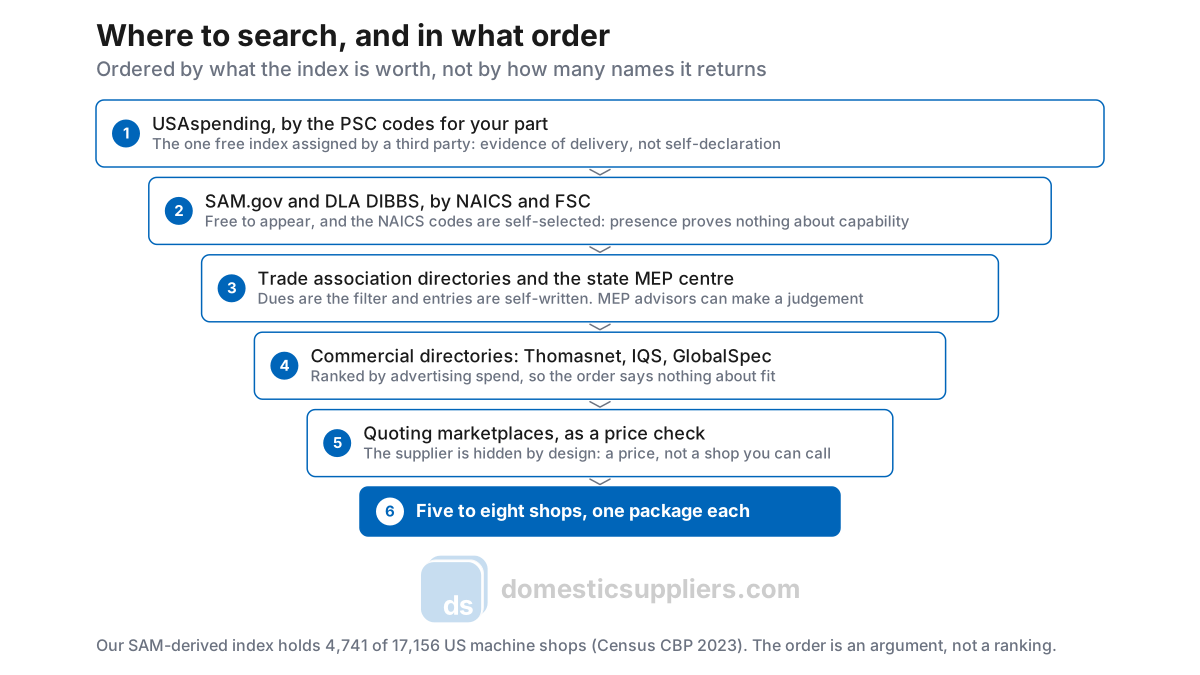
Start with the codes; every source below is indexed by them. Then search USAspending.gov by PSC — free, and the only index built on third-party evidence that a part was delivered. If the part is defense-adjacent, DLA DIBBS gives you the Federal Supply Class vocabulary, since it indexes solicitations rather than companies.
Next, SAM.gov by NAICS, the broadest free federal list. The codes are self-declared, so presence is close to zero signal, and it is partial: domesticsuppliers.com indexes 4,741 SAM.gov-registered machine shops against a Census CBP 2023 population of 17,156.
Then the self-declared lists: association directories, gated by dues, with self-published membership totals — NTMA for machining, PMPA for turned parts, PMA for stamping, FMA for fabrication, NADCA for die casting. Your state's NIST MEP center belongs here too, and it is the only source that exercises judgment instead of returning a list: 51 centers and 1,440-plus advisors, per NIST in March 2025.
Commercial directories come late on purpose. Thomasnet's figure of more than 500,000 North American suppliers is a claim about its own platform, and result order reflects advertising spend rather than fit.
Marketplaces come last, and not as a supplier search. Xometry's FY2025 Form 10-K reports 4,996 active suppliers at 31 December 2025 — the one count here filed with a regulator rather than a marketing department. But the model hides the supplier: you get a price, not a shop you can call about a tolerance problem.
Sizing the shop to the volume
Census County Business Patterns counted 17,156 establishments in NAICS 332710 for 2023: 45.9% have fewer than 5 employees, 83.3% fewer than 20, and 94.9% fewer than 50. Five in the country have 500 or more, and none has 1,000. So an RFQ written for a 200-person supplier has excluded 98.4% of the industry before it was sent, and there is no large tier to escalate to.
Mapping headcount to volume is practitioner practice, not published data; the counts are Census arithmetic, the capability claims are not. Prototypes and first articles go anywhere in the distribution, including the two smallest bands, 11,509 establishments and 67.1% of the industry. A first article is the initial part off the process, inspected feature by feature and signed off before production runs. Low volume and bridge work typically goes to the 10-to-49 band, 4,767 establishments. Sustained production with scheduled releases typically needs 50 or more: 880 establishments, 5.1%, so the population is thin.
Building a shortlist of five to eight
Five to eight is a working number. Below five, a single no-quote — a shop declining to bid at all — leaves you too little to compare. Above eight, no shop believes it has a real chance.
For each, record the process you are buying, the size band, the certifications and whether you verified them or were simply told, and whether they appear in award history under a PSC close to your part. Mix the routes you found them by, and aim for two shops per process.
What an RFQ package has to contain
An RFQ is a request for quotation: the package a shop needs to price your part. Most of it is practice, not published guidance; four items rest on something firmer.
Order quantity and EAU — estimated annual usage, what you expect to buy in a year — have to be separate numbers. NAICS defines machine-shop work as "low volume" on "a job or order basis", so a quantity with no annual usage prevents a quote.
The drawing needs its revision level on it: revision control and configuration management are explicit AS9100 requirements, so a certified shop cannot quote an unrevisioned drawing.
Name the dimensioning standard — ASME Y14.5, and Y14.41 for digital definition — and confirm the current editions. Flag export control yourself: ITAR registration is not publicly verifiable, so ask for the DDTC registration code rather than screening for it.
The rest is the practitioner standard for a quotable package, short enough to screenshot.
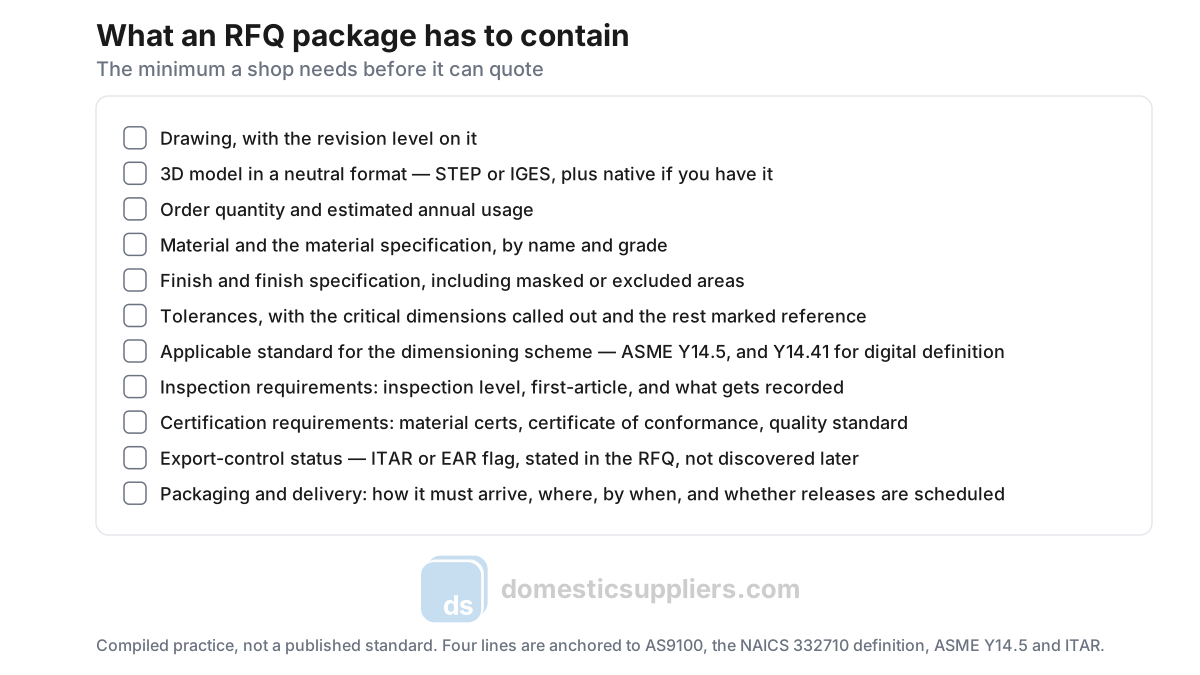
Send every shop the identical package, or the quotes will not compare.
Why shops stop replying
The sourced reason comes first. The average establishment in NAICS 332710 has 13.0 employees, and 83.3% have fewer than 20 (Census CBP 2023). A shop that size has no sales department: the person reading your RFQ is usually the owner, quoting between jobs, so an incomplete package does not get chased. It gets put down.
None of the table below is survey data. There is no published US no-quote rate, and the percentages that circulate online trace back to vendor marketing rather than any survey you can open.
| Reason the shop went quiet | The thing that was missing | Label |
|---|---|---|
| Your volume is wrong for the shop | Annual usage alongside order quantity | Partly sourced (NAICS 332710) |
| Nobody there can read the package | A revision level, and a model they can open | Partly sourced (AS9100) |
| It is not a material they run | The material specification, not just "aluminum" | Practice |
| The tolerance is outside the equipment | Which dimensions are critical, which are reference | Practice |
| The finish has to go outside | The finish spec, so the subcontract can be priced | Partly sourced (NAICS 33281) |
| The inspection burden is not priced in | Inspection level, first-article, material certs | Partly sourced (AS9100) |
| The part is export-controlled | An ITAR or EAR flag in the RFQ | Partly sourced (DDTC not verifiable) |
| The estimator never got to it | A short, complete package | Partly sourced (CBP 2023) |
Almost every row is a missing input, not a missing supplier. Silence usually means the package could not be priced, and one answer would have fixed it.
Conclusion
The order is the method: break the part into processes, turn each into a NAICS code, reach for PSC where NAICS has no home or where you want delivery evidence, then filter by certification and verify what can be verified. Search third-party-indexed sources first and marketplaces last, size the shop to your volume, and send five to eight of them the same package.
And date every regulatory claim you rely on, because CMMC moved twice in one year.