How to Verify AS9100 Certification in IAQG OASIS
OASIS is the authoritative record, fed by the certification bodies themselves. What it holds, what the result fields mean, and why the shop's own PDF is not the same answer.

Introduction
An aerospace buyer gets a PDF from a supplier claiming AS9100 certification. The file looks real. It has a logo, a certificate number, dates. But a PDF is just a file — anyone can edit a file, and even a genuine one goes stale the moment anything changes after it was issued.
There is a better way to check. The International Aerospace Quality Group, known as IAQG, runs a database called OASIS that holds the live record for every accredited AS9100, AS9110, and AS9120 certificate in the world. This article covers how to look up as9100 certification in oasis database, what the record actually shows, and where that record's limits are.
We will also say plainly what we could not verify about public access to OASIS as of October 2026. Aerospace sourcing is not a place to paper over a gap with confident-sounding steps that might not match what is actually on your screen.
What OASIS is and who runs it
OASIS stands for Online Aerospace Supplier Information System. IAQG — an industry body made up of major aerospace manufacturers across the Americas, Europe, and Asia-Pacific — built it and runs it.
IAQG wrote the 9100-series quality standards (AS9100, AS9110, AS9120) and oversees the accreditation scheme that governs who is allowed to issue those certificates. A company that wants to issue AS9100 certificates is called a certification body, or CB for short. A CB has to be accredited under IAQG's scheme before its certificate counts in this industry.
Here is the part that matters most for a buyer: entering a certificate into OASIS is not optional. It is a mandatory condition of a certification body keeping its IAQG accreditation. Every accredited AS9100, AS9110, and AS9120 certificate gets entered into OASIS by the certification body that issued it — not by the supplier, and not as a favor.
That requirement is why OASIS outranks anything a supplier hands you directly. It is not one certifier's convenience list or one supplier's private archive. It is a single, cross-certification-body record, maintained by the standards body itself, independent of any one auditor or shop.
Getting public search access
Here is what we can confirm. The current OASIS platform is called OASIS V3, and it lives at oasis.iaqg.org. If you have an old bookmark pointing at an sae.org address, that is stale — OASIS used to be hosted on SAE's site and has since moved to its current IAQG domain. Update the link before you rely on it.
Here is what we cannot confirm, and we are not going to paper over it. We could not verify, as of October 2026, whether a buyer can run a search on OASIS without first creating an account. The current URL leads to a login screen. Some sources describe OASIS as free to join, and describe being able to view a supplier's approval status, certificate copy, and audit date once logged in — but none of them says outright whether an anonymous visitor can search before logging in, and we are not going to describe a search form we have not actually seen.
There is also a mention, in IAQG's own materials, of an authentication change dated June 20, 2026, that locked certain authentication records in OASIS. We do not know the full scope of that change, or whether it affects how an outside visitor reaches search results. It is one more reason to check the live page yourself rather than trust a description written before that date.
So the honest, practical answer is this: go to oasis.iaqg.org and see what is actually in front of you. If you hit a login wall and do not want to create an account, you have two reliable fallbacks. Ask the supplier directly for their OASIS entry — a legitimately certified shop has no reason to withhold it. Or ask the certification body named on the supplier's certificate; they entered the record, and they can confirm its current status for you directly.
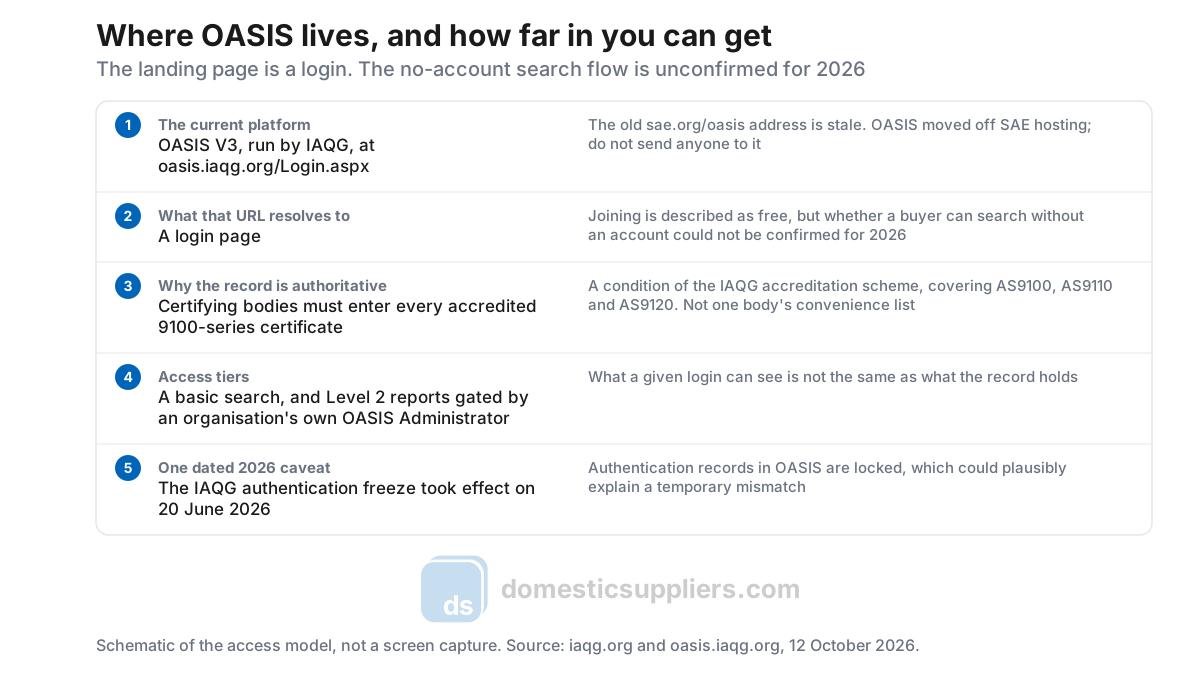
The schematic above lays out the access model as far as it can be confirmed: the current platform and its stale old address, the mandatory-entry requirement behind it, access gated in tiers by an organization's own OASIS Administrator, and the authentication freeze dated June 20, 2026. It is not a picture of any screen, because we have not confirmed what the search screen itself looks like.
Searching by company, site, or certificate number
Once you are looking at a live OASIS search screen, start with the company's full legal name, not a trading name or an abbreviation. Company name is the one search field current sources confirm, and certification records are generally filed under the legal entity — a name mismatch is a common reason a real certificate fails to turn up.
If a name search returns nothing, or returns too much, have the certificate number and the site from the supplier's own paperwork ready to check against whatever record comes up. We could not confirm that certificate number or site are separate OASIS search fields in their own right, only that a company name search is.
Site matters regardless of how you search. A multi-site company can hold separate certificates for separate locations, and a certificate issued for one plant does not speak for another plant down the road. If your supplier operates more than one site, confirm which site the certificate actually covers before you assume the whole company is covered.
OASIS also includes something worth checking even when a name search comes back clean: a Change Summary view that lists companies whose AS9100, AS9110, or AS9120 certificates were recently suspended, withdrawn, or deleted. That view is a useful cross-check on its own — a shop can appear in a normal search and still show up on a recent list of certificates that are lapsing.
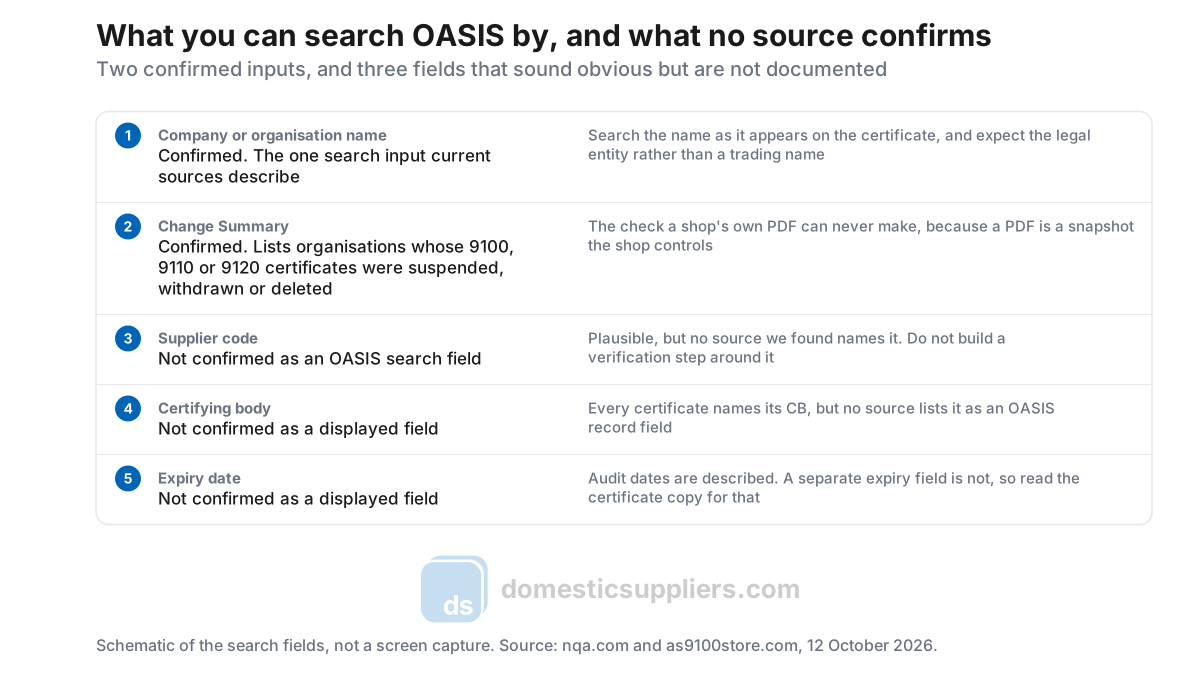
The schematic above sorts the fields people expect from OASIS into two we can confirm — company name and the Change Summary view — and three that show up in buyer expectations but that no source actually confirms as OASIS fields: a supplier code, a certifying body, and an expiry date.
Reading the record: scope, site, status, expiry
A handful of fields on an OASIS record are confirmed by the people who maintain and describe the system, and those are the fields worth reading carefully.
Scope of certification tells you what the certificate actually covers — which processes, which products, which site. A certificate scoped to sheet metal fabrication does not certify that shop for machined titanium parts, even if both happen under the same roof.
Certification status tells you whether the certificate is active, suspended, or withdrawn. This is arguably the single most useful field, because it is the one a supplier's own PDF can never update after the day it was printed.
The record also includes a downloadable copy of the certificate itself, and an audit date — the date of the most recent assessment. A certification body re-audits a certified shop on a regular surveillance schedule, meaning a periodic check that keeps the certificate valid between full recertifications, so a stale audit date is worth asking about even if status still reads active.
Two things buyers often go looking for are not something we can confirm as their own, separately labeled fields in the OASIS record: a distinct expiry date, and a distinct certification-body field. Certificates do have an issuing certification body and an expiry by nature, so it is reasonable to expect that information to be discoverable on or near the record. But we did not find a source naming them as their own displayed fields, so treat them as things to look for and confirm on screen, not as fields we are promising will be labeled that way.
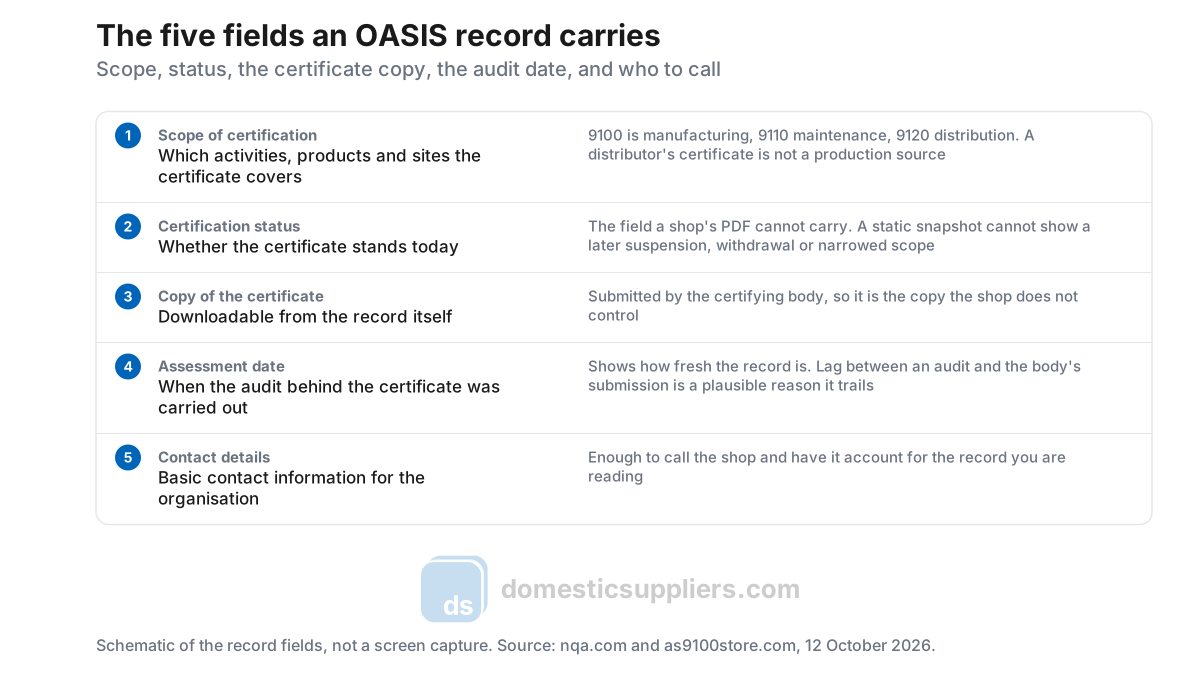
The diagram above calls out the five fields confirmed above — scope, status, the certificate download, audit date, and contact details — arranged the way a record groups them, so you know what you are looking for before you land on the real thing.
AS9100, AS9110, and AS9120
IAQG's 9100 series is not one standard. It is three, and which one a supplier holds tells you what kind of aerospace work they are actually approved to do.
| Standard | Who it's for | What a buyer should expect to see |
|---|---|---|
| AS9100 | Aerospace design and manufacturing organizations | A manufacturer-scope certificate covering production or design, tied to a site |
| AS9110 | Aerospace maintenance organizations (MRO) | A maintenance-scope certificate reflecting repair and overhaul work, not manufacturing |
| AS9120 | Aerospace distributors and stockists | A distribution-scope certificate confirming an approved stocking distributor, not a production source |
The practical upshot: do not assume AS9100 experience means AS9120 competence, or the reverse. A distributor holding AS9120 is certified to stock and handle parts correctly, not to manufacture them. A maintenance shop holding AS9110 is certified to repair and overhaul, not to run a production line. Match the standard to the work you actually need done.
Why a shop's own PDF is not the same answer
A PDF a supplier sends you is a snapshot. It was accurate on the day it was generated, and it says nothing about what happened after.
Certificates get suspended. They get withdrawn. Scope gets narrowed when a shop loses the ability to perform certain work. None of that shows up on a PDF sitting in your inbox, because nobody goes back and edits a file that has already been sent out.
OASIS is different because it is fed directly by the certification body, on an ongoing basis, as a mandatory part of staying accredited. If a certificate is suspended today, that change lands in OASIS. It does not land in the PDF the supplier sent you six months ago, and it may not even show up in a PDF the supplier sends you today if nobody has told them to regenerate it.
So the PDF still has a role. It is a convenient copy for your own files. It is just not the verification step. The verification step is checking the live record.
When a certified shop is missing from OASIS
Sometimes a supplier is genuinely certified and you still cannot find them in OASIS. That happens, and it is not automatically a red flag.
Entries can lag behind a fresh audit while the certification body works through its own submission process. A recent merger, acquisition, or legal name change can also leave a search under the old name turning up empty, while the certificate itself is current under a new one.
A real, long-running discussion thread among quality professionals is titled exactly this — "AS9100 certificate but not in OASIS" — which tells you the scenario comes up often enough to have its own name in the field, even without pinning down every possible cause here.
The right move is not to assume fraud, and not to assume everything is fine either. Ask the supplier for their certificate number and the name of their certification body, then ask that certification body directly to confirm current status. That is the same fallback that applies if you cannot get into OASIS at all, and it works regardless of why the online record does not match what you expected.
Conclusion
OASIS is the live record for AS9100, AS9110, and AS9120 certification because IAQG requires every accredited certification body to put it there — not because any one company chose to publish it. That mandatory submission is what makes it worth checking before you check anything a supplier hands you directly.
Here is what we can tell you with confidence: the system lives at oasis.iaqg.org, a record covers scope, status, a certificate copy, and an audit date, and a PDF from a supplier can never catch up to what is happening there in real time. Here is what we cannot tell you with confidence as of October 2026: the exact mechanics of searching without an account. So go look at the page yourself, and if it stops you, ask the supplier or their certification body directly. Either way, you will get a straighter answer than the PDF gives you.