How to Verify Nadcap Accreditation in eAuditNet
Nadcap accredits a process at a site, not a company. Where the list lives, which commodity code to search, and why an AS9100 certificate does not answer the same question.

Introduction
A buyer hears that a supplier is "Nadcap approved" and treats it as one fact about the company. It isn't. Nadcap approval is a statement about one process, done at one site, not a blanket qualification for everything that happens inside the building. A shop can be accredited for heat treating and have never gone through an audit for welding, and the two are not the same claim.
This article covers how to check nadcap accreditation for a supplier: what the accreditation actually covers, where the record lives, and what you can realistically do when the record sits behind a login wall. It also covers the comparison every buyer eventually has to make — Nadcap against AS9100 — because the two get confused constantly and they are not substitutes for each other.
What Nadcap accredits, and what it does not
Nadcap, short for the National Aerospace and Defense Contractors Accreditation Program, is an accreditation scheme for special processes. A special process is manufacturing work where you cannot fully verify the result just by inspecting the finished part — heat treating, chemical processing, welding, non-destructive testing (NDT), coatings, and materials testing are common examples. You cannot cut open a heat-treated bracket to check its grain structure on every part shipped, so the industry accredits the process itself: the equipment, the procedures, the people running it.
That is the detail a lot of buyers miss. Nadcap accredits a process, at a site, not a company. A supplier with three process lines — say, heat treating, welding, and NDT — might be accredited for heat treating and welding and have no Nadcap accreditation at all for NDT, because nobody ever submitted that line for audit. "We're Nadcap approved" from a sales contact tells you almost nothing on its own. The real question is which process, at which site, and whether that specific scope is current.
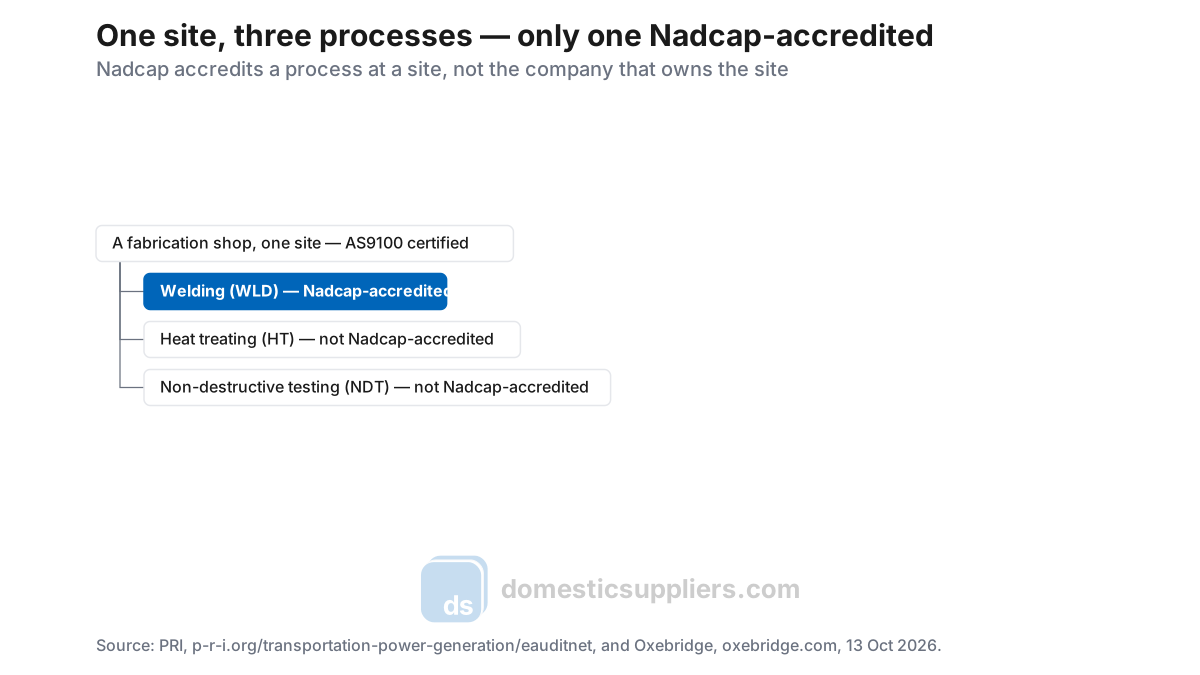
This is also why a prime's drawing calls out a process by name rather than just naming the supplier: a certificate covering the shop's heat treating line does not satisfy a flowdown requirement for welding. Checking the right scope, not just the right company name, is the actual job.
Who runs it: PRI, the primes, and the task groups
Nadcap is administered by the Performance Review Institute, PRI, an affiliate of SAE International. PRI does not invent the audit requirements alone. The scheme is industry-managed: prime contractors — the aerospace primes that buy from the supply base — subscribe to Nadcap and, through PRI, maintain the standards behind it.
Each special process has a Task Group made up of subscribing primes and other stakeholders for that commodity. The task groups write and maintain the audit criteria documents that define exactly what an auditor checks, and they stand behind accreditation decisions in that commodity. Exactly how a task group runs — voting, review cadence, escalation — is described fairly consistently across industry sources, but this is general governance description rather than a primary PRI document, so treat the mechanics as broadly accurate rather than verbatim.
One prerequisite worth knowing: Nadcap accreditation assumes the site already has a functioning quality management system, normally AS9100 or an equivalent, in place. Nadcap audits the process on top of that foundation; it does not replace it.
Getting access to eAuditNet
PRI runs the audits and accreditation decisions through a web platform called eAuditNet, at eauditnet.com. Inside it sits the Qualified Manufacturers List, or QML — PRI describes it as a searchable database of accredited companies that a buyer can use to find potential supply chain partners, at no cost.
Here is where this article has to be honest about a limit. We could not confirm that the QML can be searched anonymously, without creating an eAuditNet account. Every documented path to it — PRI's own description of the platform, a prime's supplier-facing registration guide, and PRI's own account of making the related MedAccred program's list public — routes through registering an account first. That does not mean the QML is hard to reach; a free account appears to be the standard way in. It does mean this article will not hand you a confident login walkthrough for a screen nobody on this research pass actually verified.
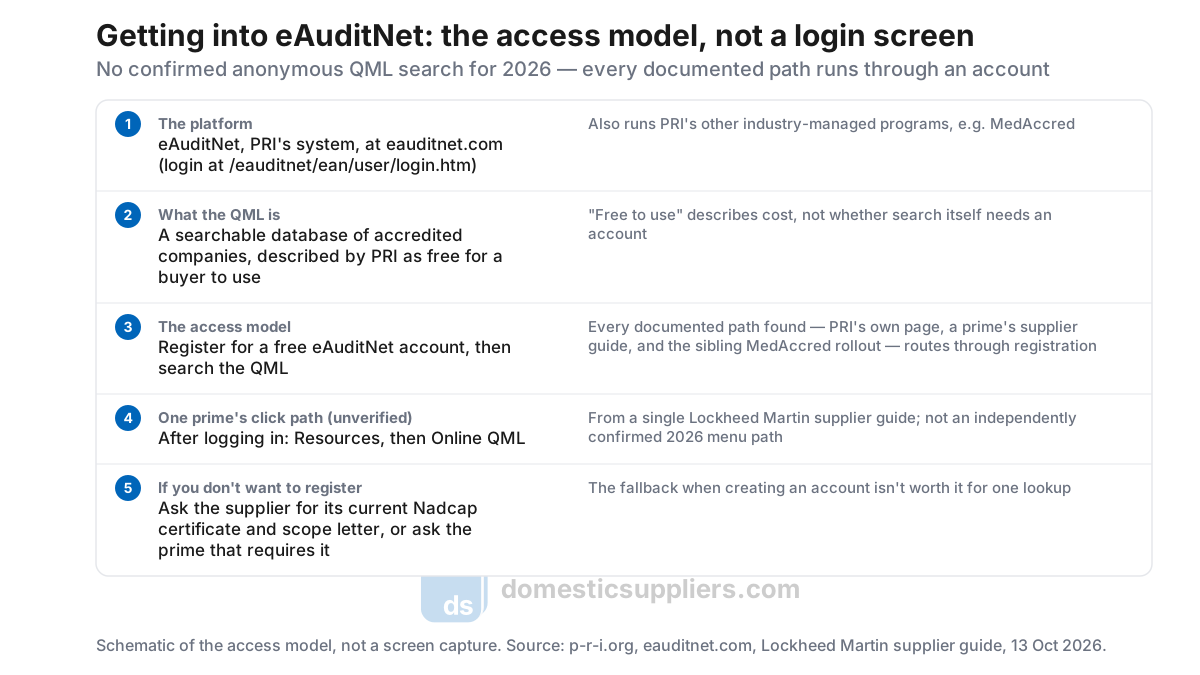
So the practical path: go to eauditnet.com and register, since that appears to be the route to the QML. One prime's supplier guide describes the click path, once logged in, as "Resources" then "Online QML" — that label comes from a single prime's guide, is not independently verified, and may not match what you see. If you'd rather not register at all, two fallbacks don't depend on eAuditNet: ask the supplier for its current Nadcap certificate and scope letter, or ask the prime that requires the accreditation to confirm it on your behalf.
Searching the Qualified Manufacturers List
Once you are inside the QML, the search is built around identifying the right supplier and then confirming the right scope — not just confirming that a name shows up. Search by company name and location, since a supplier can operate more than one site and a listing for one plant does not speak for another.
The step that actually matters is opening the record and checking every scope the supplier holds, not stopping at the first process you see. A listing can show one accredited process prominently while the supplier holds several, or the reverse — a promising name that doesn't carry the process you need at all.
If a name search returns nothing, do not assume the supplier invented the claim. A legal name change, a plant operating under a trading name, or a simple search-term mismatch can all hide a real, current accreditation. Treat a blank result as a reason to ask, not as a verdict.
Commodity codes, and picking the right one
Nadcap organizes accreditation by commodity — a shorthand code for a family of special processes, each with its own audit criteria document and its own task group. Knowing the code for the process you need is what lets you search, and read, the QML correctly, rather than skimming past a scope list full of abbreviations you don't recognize.
| Code | Commodity | Work it covers |
|---|---|---|
| AQS | Aerospace Quality Systems | Quality system elements specific to the aerospace supply chain |
| ASA | Aero Structure Assembly | Assembly of airframe and aerostructure components |
| CP | Chemical Processing | Plating, anodizing, etching, and other chemical treatment of parts |
| CT | Coatings | Application of protective and functional coatings |
| COMP | Composites | Fabrication and processing of composite materials |
| CMSP | Conventional Machining as a Special Process | Machining operations treated as a special process |
| SEAL | Elastomer Seals | Manufacture of elastomeric seals |
| ETG | Electronics | Electronics manufacturing processes |
| FLU | Fluids Distribution | Fluid distribution system components and assembly |
| HT | Heat Treating | Thermal processing of metals to achieve required properties |
| MTL | Materials Testing Laboratories | Laboratory testing of material properties |
| M&I | Measurement & Inspection | Dimensional and physical measurement and inspection processes |
| MMM | Metallic Materials Manufacturing | Production processes for metallic raw materials |
| NMSE | Nonconventional Machining and Surface Enhancement | Non-traditional machining and surface treatment methods |
| NDT | Non-Destructive Testing | Inspection methods that do not damage or alter the part |
| NMMM | Non-Metallic Materials Manufacturing | Production processes for non-metallic raw materials |
| NMMT | Non-Metallic Materials Testing | Laboratory testing of non-metallic material properties |
| SLT | Sealants | Application of sealant materials |
| WLD | Welding | Fusion and resistance welding processes |
A shop rarely holds accreditation across every commodity it performs. A fabricator might carry WLD and HT and nothing else, subcontracting its NDT to a different accredited supplier down the chain. That is normal and compliant — it just means your check has to follow the process to wherever it is actually performed, not assume the supplier's own accreditation covers work it quietly sends elsewhere.
Reading the record: status, scope, and dates
A QML record, as described in a prime's own supplier guide to using the database, carries a consistent set of information: the supplier's name and site location, the scope of accreditation ("show all scopes" reveals every commodity the site holds, not just one), the date and type of the most recent audit, the current accreditation's expiration date, and a standing indicator confirming good standing rather than suspension. That field list comes from a 2019 supplier guide rather than a verified screenshot of the current interface, so treat it as what a record typically carries, not a guaranteed current layout.
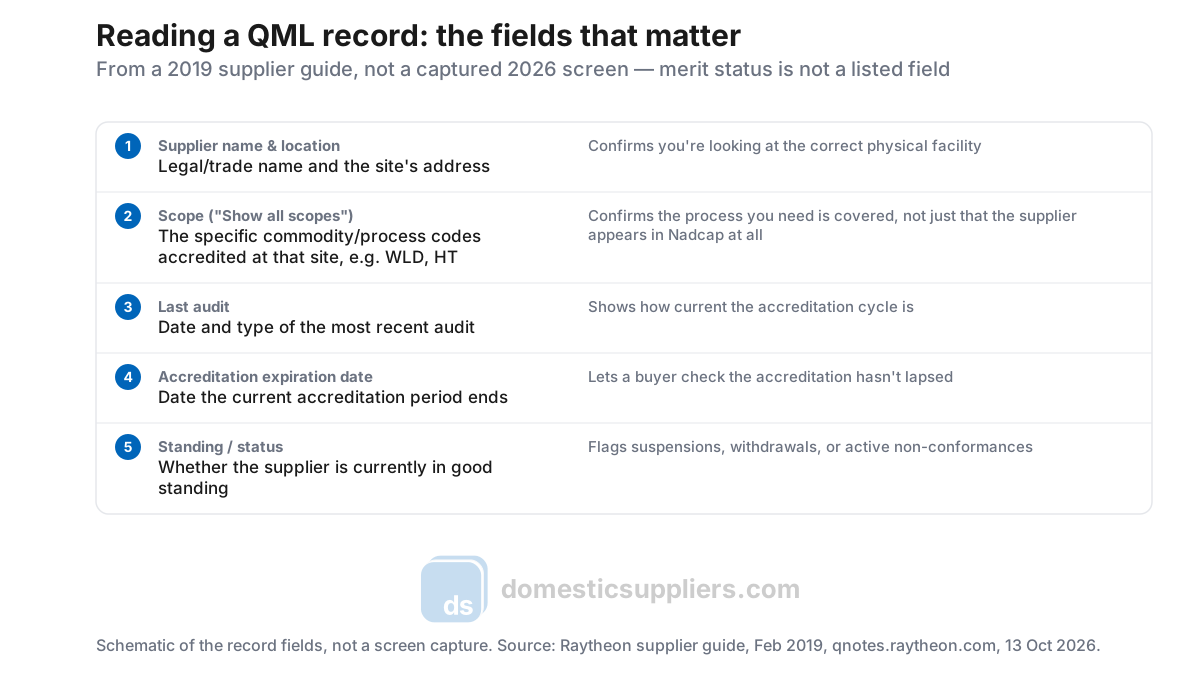
Scope is the field worth slowing down for. "Show all scopes" exists because a supplier can hold several commodities, and a casual glance can miss the one you actually need. Expiration date and standing separate a record that answers your question from one that is technically present but stale or flagged — an accreditation that lapsed eighteen months ago is not the same as a current one.
One thing this record is not confirmed to show as a labeled field: merit status. Within the Nadcap scheme, merit is real — a reward for sustained strong audit performance that extends how often a site is re-audited, moving a supplier from a standard cycle commonly cited at around 12 months (an industry-blog figure, not a primary PRI document) out to an 18-month or 24-month cycle instead. But nothing in this research confirmed that merit appears as its own displayed field on a QML record. If you need a supplier's merit status specifically, ask the supplier or the relevant task group rather than expecting to read it off the record.
Nadcap against AS9100
These two get conflated constantly, and the confusion causes real sourcing mistakes.
| Dimension | Nadcap | AS9100 |
|---|---|---|
| What it certifies | A specific special process at a specific site (e.g., heat treating, chemical processing) | The company's overall quality management system |
| Administered by | PRI (Performance Review Institute) | Certification bodies accredited under the IAQG scheme (not PRI) |
| Prerequisite relationship | Requires the site's QMS to already be certified to AS9100 or equivalent before Nadcap auditing proceeds | Does not require Nadcap; stands alone as a QMS certification |
| Audit focus | Deep technical/process detail — equipment, temperatures, pH, pressures, process conditions | Management-system focus — document control, risk management, customer communication, broad process oversight |
| Can a supplier hold one without the other? | Yes — accredited for a process while its QMS certificate is held under a different standard, or absent | Yes — AS9100-certified with no Nadcap accreditation if it performs no special process needing one |
| Typical prime requirement | Required when the prime's drawing or spec flows down a specific special process | Commonly required as a baseline aerospace QMS credential |
The practical read: one is about the company, the other about the process, and a prime can require both. If a purchase order calls for AS9100 and Nadcap heat treating, checking only one leaves the other requirement unverified. You need both records, not one.
When a supplier is not listed
A blank QML search is not proof a supplier is lying about its accreditation. Entries can lag a recent audit while the task group works through its process, a legal name change, merger, or acquisition can leave an old name search empty while a current accreditation sits under the new one, and a missing process may simply be subcontracted to a different accredited shop rather than absent.
When a search comes up empty or you cannot get past eAuditNet's registration wall, two fallbacks hold up regardless of the reason: ask the supplier directly for its current Nadcap certificate and scope letter, and ask the prime contractor that imposed the requirement to confirm the supplier's standing on your behalf. Both routes exist independently of whatever is or isn't visible in eAuditNet on a given day.
Conclusion
Nadcap accredits a process at a site, not a company, and that distinction is what "how to check nadcap accreditation for a supplier" actually means in practice — find the right commodity code, find the right site, and confirm the scope, expiration, and standing on the record itself rather than trusting the word "Nadcap" alone. eAuditNet's Qualified Manufacturers List is the system of record, run by PRI, and every path to it we could confirm goes through account registration, not an anonymous public search. Register if you're willing to; if not, go to the supplier for its certificate and scope letter, or to the prime that required the accreditation. Keep Nadcap and AS9100 separate the whole time — one audits the process, the other the company, a prime may require both, and neither stands in for the other.