How to Vet a New Machine Shop: 12 Questions to Ask
Most buyers vet a shop by asking whether it can make the part, which is the one question every shop answers yes to. These twelve questions are the ones whose answers separate a shop that can hold your tolerance from one that is willing to try.
Introduction
Ask a machine shop whether it can make your part and you will get a yes. This is not dishonesty. A capable shop says yes because it can, a marginal shop says yes because it wants the work and intends to figure it out, and an unsuitable shop says yes because it plans to send the job somewhere else. All three answers sound the same on the phone.
The questions below are the ones where those three shops give different answers. None of them are gotchas, and a good shop will enjoy most of them, because the questions are recognisably asked by someone who knows what they are buying. The point is not to catch anybody out. It is to replace one unanswerable question with twelve answerable ones.
A note on sequencing before the list. Ask all twelve before the purchase order, not after the first reject. The cost of asking is an hour on a call. The cost of not asking is a late part, a sorted lot, or a tooling bill you did not expect to own.
The Twelve
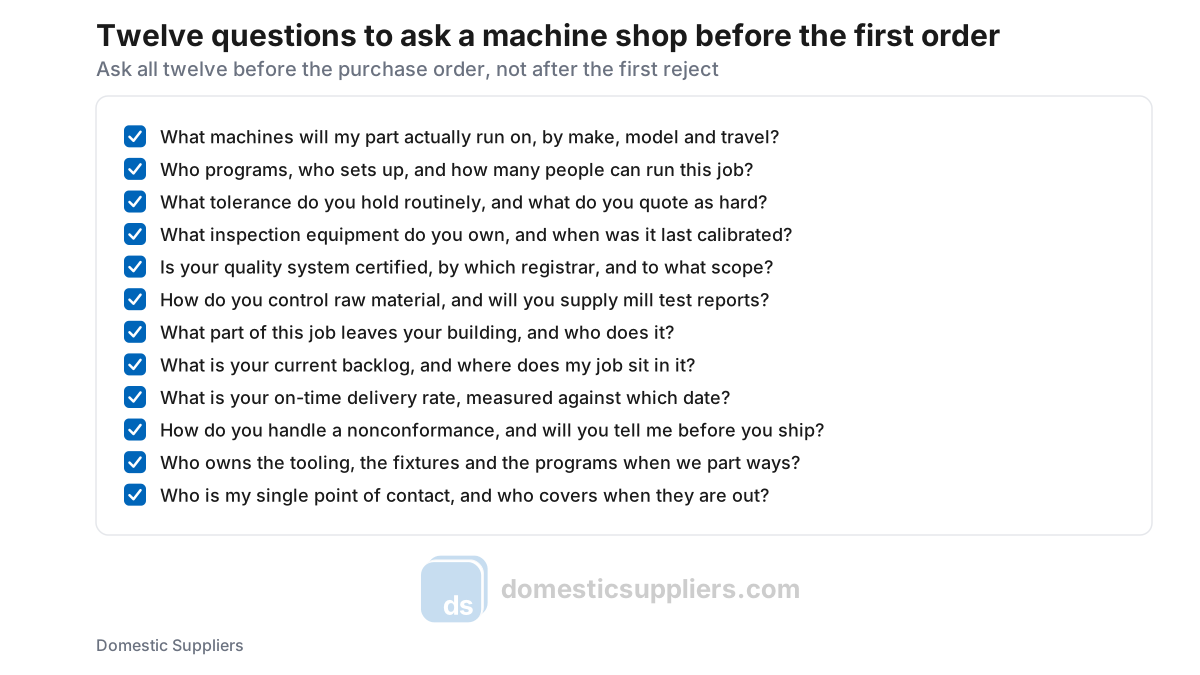
1. What machines will my part actually run on?
Not "what do you have." What will run this job, by make, model and working envelope. A shop with a 40-taper vertical mill and a shop with a pallet-changing horizontal are both CNC machine shops, and they are not interchangeable for your part.
The answer also tells you about redundancy. If the job runs on exactly one machine and that machine goes down, your part stops. That is sometimes fine and always worth knowing.
2. Who programs, who sets up, and how many people can run this job?
Capability in a small shop frequently lives in one person. Ask how many people can set this job up without supervision. The honest answer in a twelve-person shop is often one, or two. That is not disqualifying, but it means your lead time is exposed to one person's holiday, and you should price that risk rather than discover it.
3. What tolerance do you hold routinely, and what do you quote as hard?
This is the single most diagnostic question on the list. A shop that knows its own process will tell you where the drawing gets difficult: this bore, that flatness callout, the concentricity between two features cut in different operations. A shop that says it can hold whatever is on the drawing has either not read the drawing or does not measure its own capability.
Capable shops push back on drawings. It is a good sign, not a bad one.
4. What inspection equipment do you own, and when was it last calibrated?
Ask for the calibration certificate on the one gauge that will actually accept your critical feature. Not the gauge list, the certificate. You want a date, an interval, and traceability to a national standard.
If your part has a feature that needs a CMM and the shop outsources CMM work, that is a real answer and it changes your lead time and your cost. Find out before the first article, not during it.
5. Is your quality system certified, by which registrar, and to what scope?
Three parts, and the third is the one that matters. An ISO 9001 certificate has a scope statement on it, and the scope can exclude the thing you are buying. A certificate covering "machining of components" at the Ohio plant says nothing about the welding cell in Texas.
Verify the certificate at the registrar or the accreditation body rather than accepting the PDF. A certificate is a claim until you have checked it against the register that issued it, and expired and withdrawn certificates circulate for years.
6. How do you control raw material, and will you supply mill test reports?
Material is where traceability is won or lost. Ask how incoming material is received and identified, how it is segregated, and how a finished part traces back to a heat number. Then ask whether they will supply mill test reports with shipment, and whether that costs extra.
If your part has any specification requirement on material, melt source, or certification, the shop needs to be able to flow it to its supplier and get it back. Ask whether they have done that before for anyone.
7. What part of this job leaves your building, and who does it?
Almost every machined part with a finish on it leaves the shop at least once. Heat treat, plating, anodising, passivation, painting, grinding, NDT: these are usually outside processes even at large shops.
You want the names. A shop that will tell you its heat treater and its plater, and offer their certifications, is a shop that manages its subcontractors. A shop that says it handles everything in house is either unusually integrated or not answering the question. Outside processing is also where lead time quietly doubles, because a two-day plating operation is two days of processing and nine days of logistics.
8. What is your current backlog, and where does my job sit in it?
Capacity and load are different things. A shop can have the right machines and no room on them for five weeks. Ask what the backlog looks like in weeks and what their utilisation is running at.
A shop at 60 percent utilisation will take your job and run it. A shop at 98 percent will take your job and run it late. Both will tell you yes.
9. What is your on-time delivery rate, measured against which date?
The qualifier is the whole question. On-time against the customer's requested date and on-time against the shop's own promised date are different numbers, and the second is almost always better. A shop quoting 98 percent on-time against a date it set after your request has told you less than it sounds.
A shop that measures this at all is ahead of most. A shop that cannot say how it measures it does not measure it.
10. How do you handle a nonconformance, and will you tell me before you ship?
Every shop makes bad parts. The question is what happens next. You want to hear about containment, a documented disposition, and a corrective action process with someone's name on it. Above all you want to hear that they will call you before shipping a nonconforming part, rather than shipping it and waiting to see whether you notice.
Ask about the last escape: what it was, what caused it, what changed. A shop that tells you that story candidly is showing you its quality system working. A shop that claims it has never shipped a bad part is telling you it does not track them.
11. Who owns the tooling, the fixtures and the programs?
Settle this before the money moves, because it is the most common unpleasant surprise in the whole relationship. If you pay for a fixture, say in writing that you own it and that it will be released on request. If the shop writes the CNC programs, understand that they will usually consider those theirs, which is defensible and which also means a second-source quote starts from zero.
The same conversation covers your intellectual property going the other way: what happens to your drawings and models, who at the shop can see them, and whether an NDA is in place before you send a model.
12. Who is my single point of contact, and who covers when they are out?
Unglamorous and it will matter more than half the list. You want one name for quoting and expediting, and a named backup. In a shop where the owner quotes everything, the answer is the owner and nobody, which is workable until the week it is not.
Reading the Answers
Collecting twelve answers is not the same as evaluating them. The pattern that distinguishes a capable shop is specificity: machine models rather than capabilities, dates rather than assurances, named subcontractors rather than "in house," and a willingness to name the hard feature on your drawing.
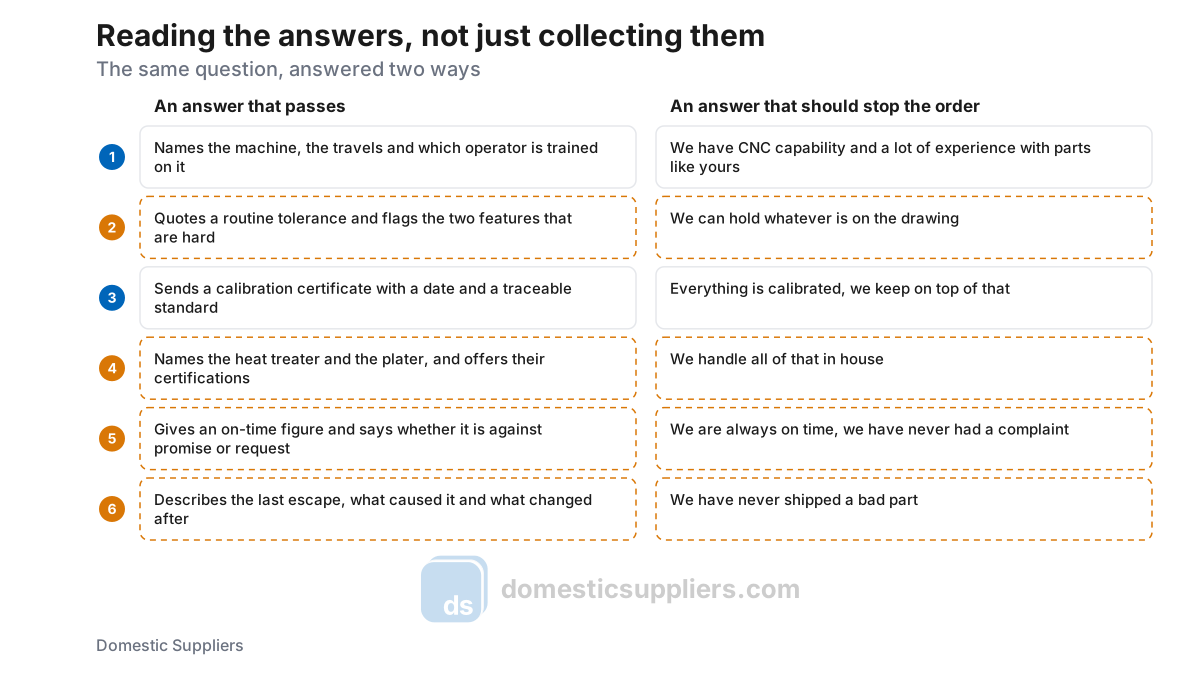
Four of those right-hand answers are worth treating as stop signs rather than weak answers.
"We can hold whatever is on the drawing" means the drawing has not been reviewed. "We handle all of that in house" about plating or heat treat is almost never true and signals that the question was deflected. "We are always on time" means it is not measured. And "we have never shipped a bad part" means escapes are not tracked, which means you will be the tracking system.
What This Does Not Cover
Twelve questions on a call is qualification, not an audit. It does not touch financial stability, which for a small shop taking on a large job is a genuine risk and which you address through trade references and payment history rather than through questions. It does not cover cybersecurity, which matters if you are flowing down defence requirements. And it does not substitute for walking the floor.
If the job is significant, the call gets you to a shortlist and then you go and look. The things you cannot ask about over the phone are whether the operator at the machine is holding the current revision of the drawing, whether the gauges near the inspection bench have current calibration stickers, and whether the nonconforming material area is a controlled cage or a shelf by the door.
Conclusion
Every shop says yes to "can you make this." The twelve questions above are the ones where a capable shop and a hopeful one give different answers, and the difference is almost always specificity: a machine model, a calibration date, a named plater, a measured on-time figure against a stated baseline, and a candid account of the last thing that went wrong. Ask them before the purchase order. Then, for anything that matters, go and see the floor.