Why IATF 16949 Certificates Aren't in IAF CertSearch (and How to Verify Them)
IATF runs its own database and does not publish into CertSearch, so the usual lookup comes back empty and the certificate looks fake. Where it actually lives, and what to ask for.

Introduction
A buyer is vetting a stamping shop. The shop's website lists IATF 16949, the automotive quality standard. The buyer has done this before with ISO 9001 shops: open IAF CertSearch, type the company name, confirm the certificate, move on. So they do the same thing here.
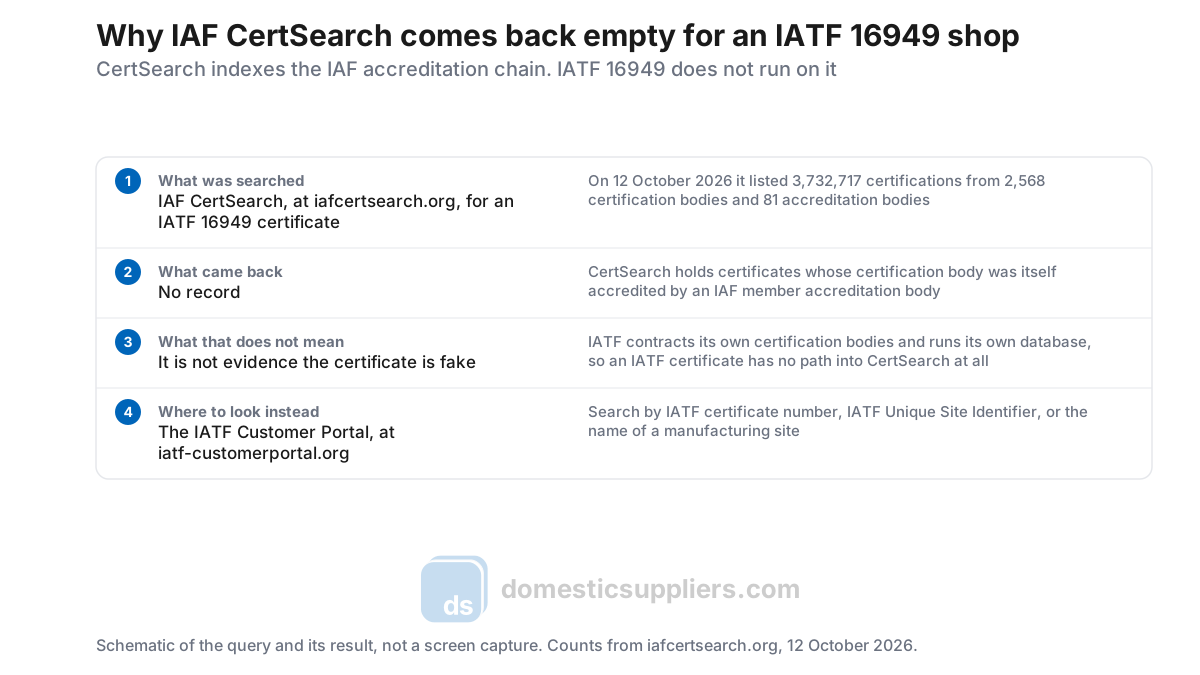
Nothing comes back. No certificate, no certification body, no record at all. The natural conclusion is that the shop is lying about its certification.
That conclusion is wrong. IATF 16949 certificates do not live in IAF CertSearch, and they never have. The standard is real, the certificate can be real, and the database the buyer just checked is simply the wrong database. Learning how to verify an IATF 16949 certificate means learning that it runs on a separate system with its own rules, and then checking the right place.
What IAF CertSearch actually covers
IAF CertSearch describes itself as the exclusive global database for accredited management system certifications. At last check it listed over 3.7 million certifications from more than 2,500 certification bodies, accredited by 81 accreditation bodies worldwide.
That scale is real, but it is also narrower than it sounds. A certificate only lands in CertSearch if the certification body (the organization that audits a company and issues the certificate) was itself accredited by an IAF member accreditation body (the national or regional body that checks certification bodies are competent to do that auditing). CertSearch covers ISO 9001, ISO 14001, ISO 45001, and other standards that run through that same accreditation chain.
That single requirement is the whole story of why the search comes back empty. If a scheme's certification bodies are not accredited by an IAF member in the first place, there is no path for their certificates to ever appear in CertSearch. It is not a gap in the data. It is a different chain entirely, and IATF 16949 runs on it.
Why IATF is governed separately from ISO
ISO 9001 is published and owned by ISO, the International Organization for Standardization. IATF 16949 is owned by the International Automotive Task Force, a group made up of automakers and their trade associations. ISO had no hand in writing it. That difference in ownership is why the two certificates verify in completely different places.
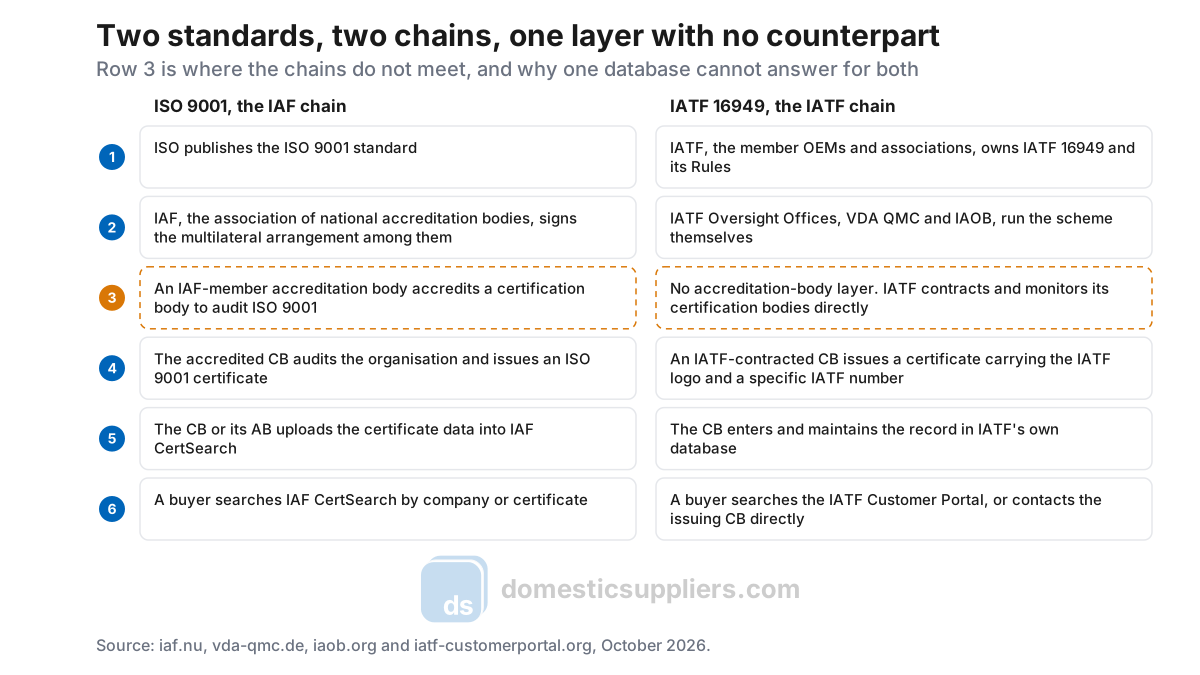
Follow the ISO 9001 chain, step by step. ISO publishes the standard. IAF, the association of national accreditation bodies, sets the rules its members follow. An IAF-member accreditation body accredits individual certification bodies as competent to audit against ISO 9001. An accredited certification body audits a company and issues the certificate. The certification body, or its accreditation body, uploads that certificate into IAF CertSearch. A buyer searches CertSearch and finds it.
Now follow the IATF 16949 chain. IATF, the automakers' group, writes the standard and its Rules document. IATF's own oversight offices — VDA QMC in Europe, IAOB in North America — directly contract and monitor a defined list of certification bodies. There is no IAF-member accreditation body anywhere in that sentence. An IATF-contracted certification body audits the company and issues a certificate carrying the IATF logo and a specific IATF certificate number. That certification body enters the record into IATF's own database, reachable through the IATF Customer Portal at iatf-customerportal.org. A buyer verifies there, or by calling the certification body directly.
Lay the two chains side by side and the missing step jumps out. Chain A has an accreditation body sitting between the standard's owner and the certification body. Chain B skips that layer entirely — IATF appoints and oversees its own certification bodies directly. A certification body can hold both an IAF accreditation for ISO work and an IATF contract for automotive work, and still only one of those two credentials will ever show up in CertSearch. That is the whole divergence. It is not a flaw in either system; it is two separate systems that were never built to feed the same database.
The IATF database and what it exposes
The public tool for checking an IATF 16949 certificate is the IATF Customer Portal, at iatf-customerportal.org. IATF describes it plainly: it exists to verify IATF 16949 automotive quality management certificates and to check which manufacturing sites are currently certified.
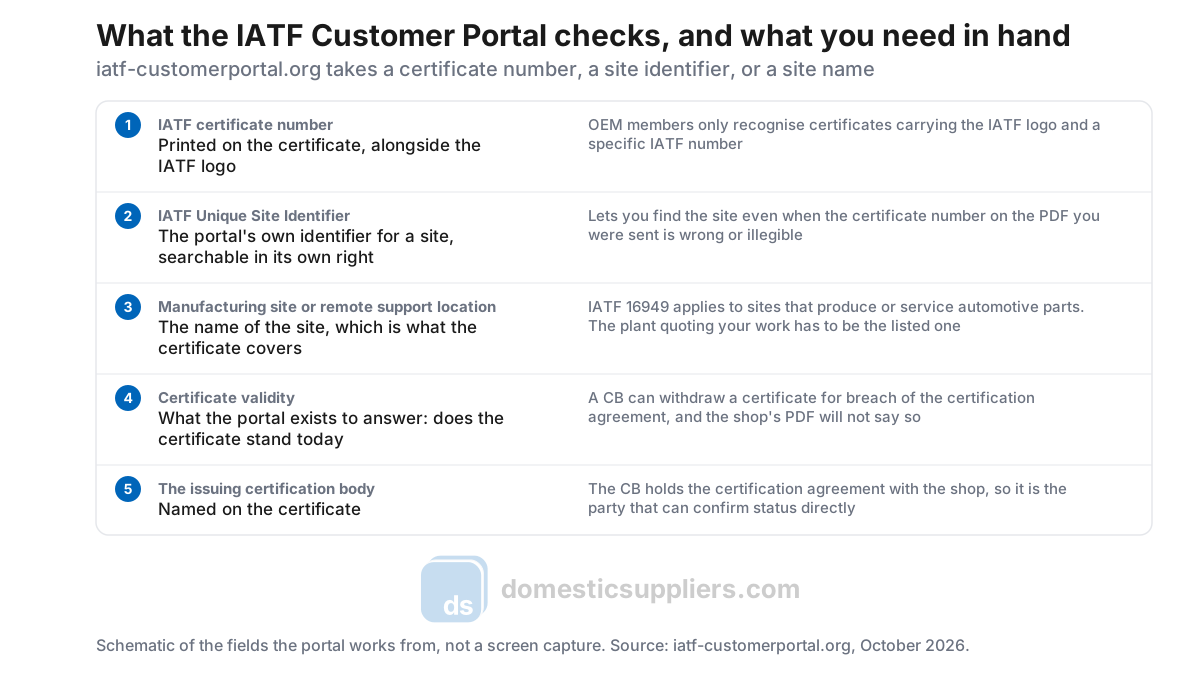
The portal takes three kinds of search input: the IATF certificate number, the IATF Unique Site Identifier (a fixed ID number, often shortened to USI, assigned to a specific manufacturing site rather than to the company as a whole), or the name of a manufacturing site or remote support location. Searching by company name alone is less reliable here than it is on CertSearch, because the record is tied to the site and the certificate, not to a brand name. The IATF Global Oversight site also links to the same certificate validity check for anyone who lands there first.
A record that comes back clean shows the certificate's status, its issuing certification body, and the site it covers. A record that does not come back at all is worth a second look, but on its own it still is not proof of fraud — it might mean the search terms were wrong, the site identifier was typed incorrectly, or the shop supplied the wrong number. The fix is the same either way: go back to the source and get the number straight from the certificate.
Getting the certificate number out of the shop
None of this works without the right identifiers, and those live on the certificate itself, not on a marketing page. Ask the shop for a copy of the current certificate, or at minimum three things off it: the IATF certificate number, the IATF Unique Site Identifier for the specific plant that will build the part, and the name of the certification body that issued it.
That last point matters more than it sounds like it should. IATF's own rules state that OEM members only recognize certificates that carry the IATF logo and a specific IATF number issued by a certification body on IATF's contracted list. A document that looks like a certificate but is missing that number, or was issued by a body not on that list, is not something an automotive OEM will accept, regardless of how legitimate the underlying audit was.
It also matters which site is on the certificate. A company can run five plants and have IATF 16949 at only two of them. The USI ties the certificate to one site, so confirm the plant that will actually produce the part is the plant named on the number being checked, not a sister facility down the road.
Verifying through the certification body
The portal search is the fast path. The certification body is the authoritative one. Certification bodies are the parties holding the actual, legally enforceable certification agreement with the client, which makes them the final word on whether a certificate is current, suspended, or withdrawn.
Picking up the phone or sending an email to the certification body named on the certificate, with the certificate number in hand, settles any doubt the portal search did not. This is also the right move when a search comes back ambiguous rather than clearly negative — a near-match on a site name, a USI that will not resolve, a certification body that no longer appears on a current contracted list.
Certificates do not run forever. Recertification has to happen before the existing certificate expires, and the audit behind it has to fall within three years of the previous recertification audit, with limited tolerance on timing. A certified company that fails to tell its certification body about a relevant change — a new process, a new site, a change in scope — is treated as breaching the certification agreement, and that can lead the certification body to withdraw the certificate and run a special audit. A certification body can confirm all of this in a way a database snapshot cannot.
Reading the scope and its exclusions
Every IATF 16949 certificate carries a scope line describing what the certified site actually does and, sometimes, what it has been allowed to exclude. Reading that line correctly matters as much as finding the certificate in the first place.
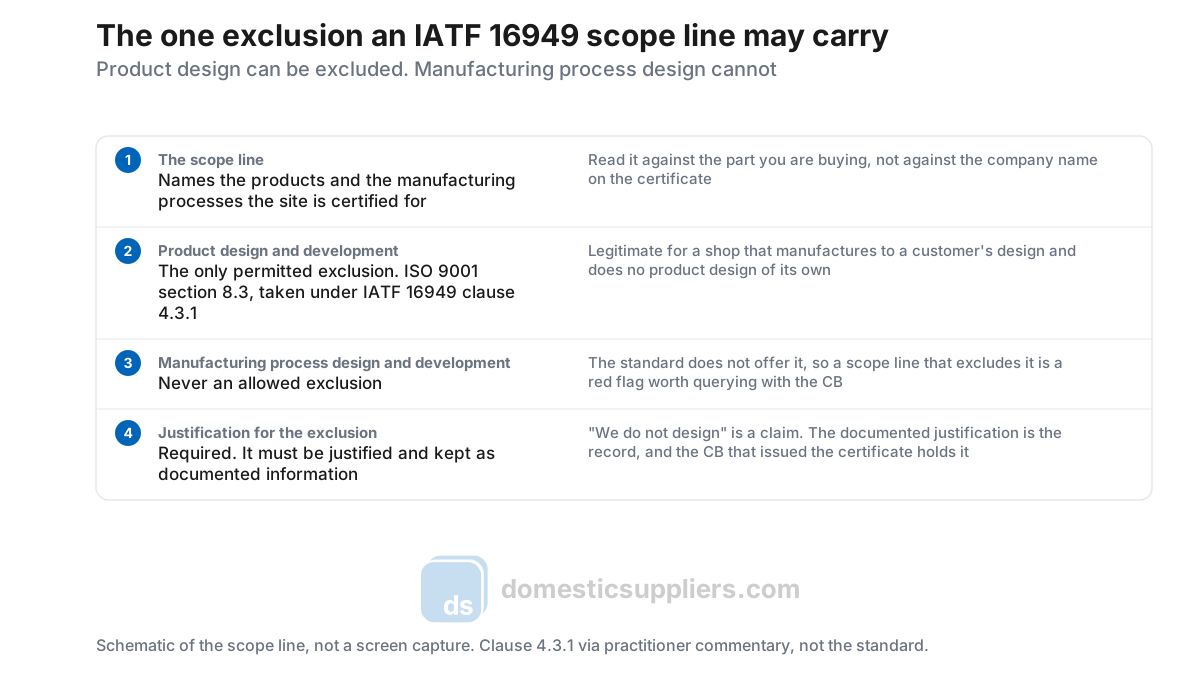
Practitioner commentary on the standard's clause 4.3.1 — the clause has not been checked here against the paywalled standard text itself, so treat this as secondary interpretation rather than a direct quote — describes only one permitted exclusion: the product design and development requirements that ISO 9001 covers in its section 8.3. Even that exclusion has to be justified and documented, not simply assumed. It typically applies to a shop that builds parts to a customer's finished design and does no product design work of its own.
The exclusion that is explicitly not allowed is manufacturing process design and development. A supplier can be excused from designing the part. It cannot be excused from designing how the part gets made — the tooling, the process flow, the controls on the line. If a scope line shows an exclusion for anything other than product design, that is worth raising directly with the certification body before treating the certificate as clean.
IATF 16949 against a plain ISO 9001 certificate
IATF 16949 is not a replacement for ISO 9001. It is written as a supplement that sits on top of it — a company cannot hold IATF 16949 without also meeting every ISO 9001 requirement underneath it. The two are audited together, which is why an automotive plant's certificate implicitly covers both.
The difference is in scope and in what gets added on top. ISO 9001 can apply to almost any organization. IATF 16949 applies specifically to sites that design, produce, or service parts for automotive OEMs — it is not meant for aftermarket-only operations. On top of the baseline ISO 9001 requirements, comparisons from NSF and Smithers point to a consistent set of automotive-specific additions: documented product-safety management across the product's life, named methodologies like APQP, FMEA, SPC, and MSA, required second-party audits of suppliers, formal warranty management, and heavier requirements around risk analysis, contingency planning, and named process-owner responsibility.
| ISO 9001 | IATF 16949 | |
|---|---|---|
| Applies to | Nearly any organization | Automotive parts and service sites (not aftermarket-only) |
| Governed by | ISO / IAF accreditation chain | IATF / OEM oversight chain |
| Verify via | IAF CertSearch | IATF Customer Portal or the issuing certification body |
| Core additions | — | Product-safety management, APQP/FMEA/SPC/MSA, second-party supplier audits, warranty management, added risk and contingency planning |
None of that extra weight shows up as a different verification path by accident. A heavier, OEM-driven standard got an oversight structure that OEMs run directly, instead of one run through the general-purpose accreditation system. That is the tradeoff: more rigor on the shop floor, a different place to look when checking the paperwork.
Conclusion
An empty result in IAF CertSearch tells a buyer exactly one thing: this certificate was not issued through the IAF accreditation chain. It does not tell them the certificate is fake, because IATF 16949 was never supposed to be in that database to begin with.
The reliable path is to pull the certificate number, the site's Unique Site Identifier, and the issuing certification body's name straight off the document, run them through the IATF Customer Portal at iatf-customerportal.org, and call the certification body directly if anything looks off. While reading the certificate, check the scope line for exclusions — only product design can legitimately be missing; manufacturing process design cannot be excluded, ever.
Absence from the wrong database is not evidence of fraud. It is evidence of looking in the wrong place.