Injection Mold Cost: US vs. Offshore Tooling
A mold from China lands at about 40 percent over its invoice once the duty stack is applied, and moving the order to Taiwan only removes half of that. The gap is not what it was.
Introduction
The mold comparison most buyers run has two numbers in it. A domestic quote, an offshore quote, and a gap that looks decisive enough to end the conversation. That comparison has been wrong for a while and in 2026 it is wrong by a margin that is easy to quantify, because the duty on a mold is now a published number rather than an argument.
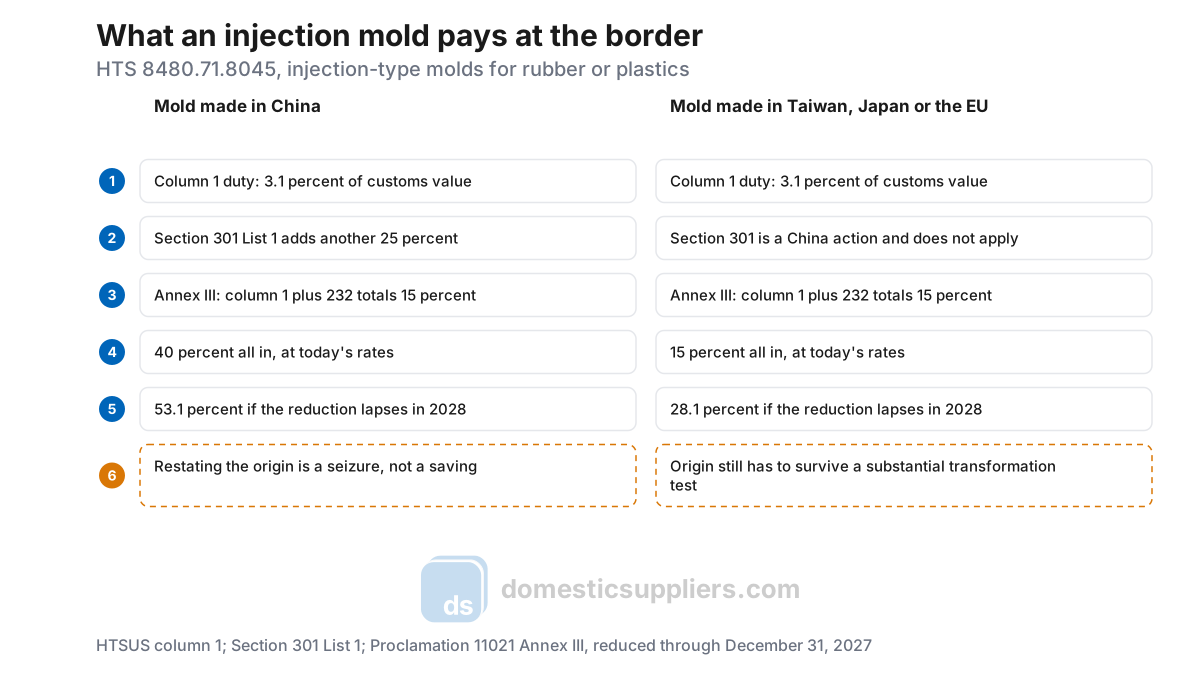
Injection-type molds for rubber or plastics classify in HTS 8480.71.8045. The column 1 rate is 3.1 percent. The mold is also a listed steel derivative under Section 232, which currently puts the combined column 1 and Section 232 duty at 15 percent of customs value. And if it comes from China, Section 301 List 1 adds 25 percent on top. That is roughly 40 percent at the border, before freight, before crating, before the customs broker.
On a $120,000 Chinese mold that is $48,000 of duty, so the tool clears customs at about $168,000 before anything else is added. A large part of the gap you were looking at is now a line on an entry summary rather than a saving. The second thing most buyers get wrong is what happens when they react to that by moving the order to Taiwan or Portugal: Section 301 goes away, Section 232 does not, because Section 232 follows the product rather than the country. The non-China mold still pays 15 percent.
This article works through the duty arithmetic, then through the part of the comparison that duty does not touch, which is what the two quotes actually describe. Most offshore and domestic mold quotes are not quotes for the same mold, and the specification gap is usually worth more than the price gap.
The Duty Stack, Specifically
Three separate authorities touch a mold entry and they behave differently.
The column 1 rate is the ordinary most-favoured-nation duty, 3.1 percent ad valorem for 8480.71.8045, and it applies to every origin that gets normal trade relations treatment. CBP has classified injection molds there repeatedly and the rulings are public.
Section 232 reaches the mold because a mold is a lump of steel with features cut into it, and 8480.71.8045 appears by name on the derivative list. It also appears on Annex III, the temporary reduction list, which through December 31, 2027 holds a listed derivative at a reduced tier instead of the standard 25 percent. For an article whose column 1 rate is below 15 percent, the proclamation sets the sum of the column 1 rate and the additional Section 232 duty at 15 percent ad valorem. So the first 15 percent on a mold is column 1 and Section 232 together, not stacked on each other.
Section 301 is the China action, and injection molds sit on List 1, which has carried an additional 25 percent since July 2018. It stacks on the 15 percent rather than replacing it.
So: 15 percent from most places, 40 percent from China, nothing on a mold built in Ohio. And the reduction is temporary. If Annex III lapses at the end of 2027 without extension, the Section 232 component reverts to 25 percent and the arithmetic becomes 28.1 percent for a non-China mold and 53.1 percent from China. A tool being quoted today for a program that runs into the 2030s is being quoted into that uncertainty.
One more note on the border. If your molder is also offshore, the mold may never be imported at all. It stays at the molding plant and you import parts, which carry their own classification and their own duty. That is a genuinely different calculation and it is the only version of offshore tooling where the mold duty is zero. It also means you no longer have the option of pulling the tool back to a domestic molder in a hurry, which is the trade you are actually making.
What Domestic Capacity Actually Looks Like
Before you decide the domestic option does not exist, it is worth knowing the size of the industry you would be buying from. The BLS Quarterly Census of Employment and Wages counts industrial mold manufacturing separately, as NAICS 333511, and because it is built from unemployment insurance filings it is close to a census rather than a survey.
In 2025 the United States had 1,401 private industrial mold manufacturing establishments employing 30,053 people, with average pay of $71,798 a year. That is a real industry and it is a shrinking one: in 2024 the same count was 1,465 establishments and 31,675 employees, so establishments fell 4.4 percent and employment 5.1 percent in a single year while average weekly pay rose from $1,328 to $1,381.
It is also highly concentrated. Michigan alone has 176 establishments and 4,441 employees, followed by Ohio with 153 and 3,553, Minnesota with 54 and 2,608, Wisconsin with 74 and 1,664, and Indiana with 73 and 1,547. If you are sourcing a domestic tool, five states hold most of the people who can build it, and a shop in that corridor is usually within a day's drive of the molder as well.
What the Two Quotes Describe
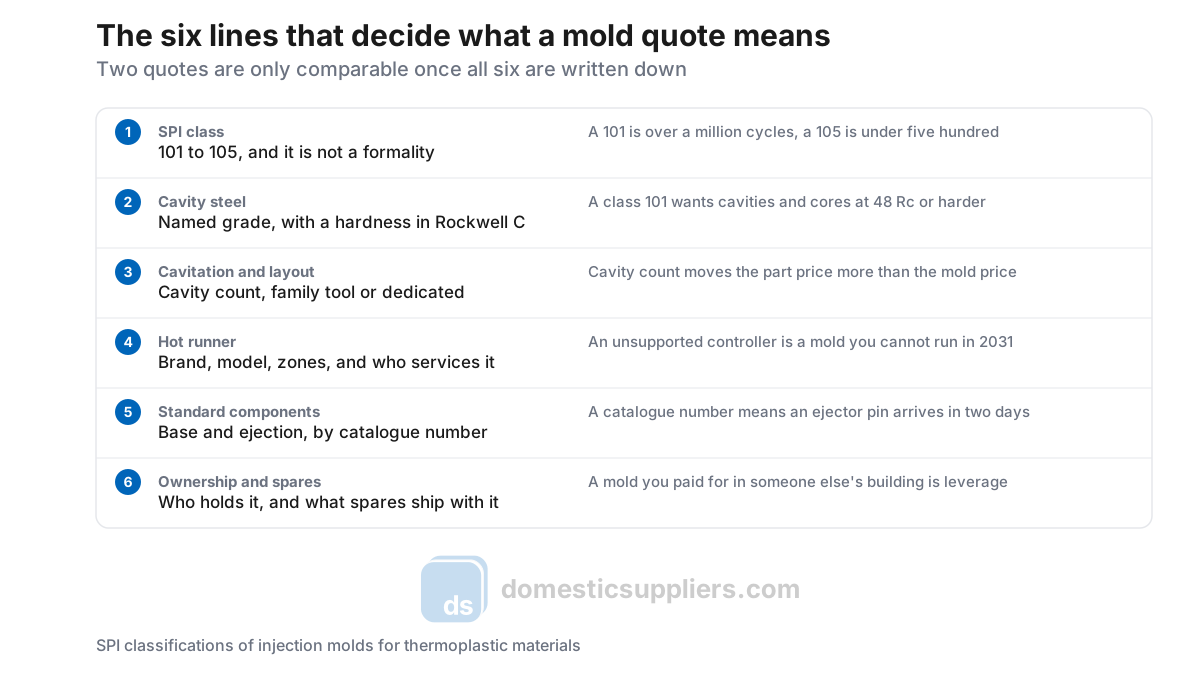
The SPI classifications are the shortest way to stop two quotes describing different objects. Five classes, defined by expected cycles and by construction.
Class 101 is built for over a million cycles, with cavities and cores hardened to at least 48 Rockwell C and a mold base of at least 280 Brinell.
Class 102 is the medium to high volume tool, in the range up to a million cycles.
Class 103 covers medium volume work under 500,000 cycles and relaxes the cosmetic and base requirements.
Class 104 is low volume, under 100,000 cycles.
Class 105 is a prototype tool, under 500 cycles, often aluminum.
Those numbers are expectations about construction, not warranties, and the useful thing about them is that they are a shared vocabulary. A quote that says "Class 101" and a quote that says "hardened tool steel, long life" are not two prices for the same thing, and the second one has told you nothing you can hold anybody to.
Underneath the class, five lines do the real work.
The cavity steel, by grade and hardness. P20 pre-hardened, H13, S7, 420 stainless for anything corrosive, each with a hardness in Rockwell C. A great deal of offshore quoting uses phrases like "P20 equivalent" or a local grade designation, and equivalent is doing a lot of work in that sentence. Ask for the grade by its standard designation and the delivered hardness, and ask for the certificate.
Cavitation. A four-cavity tool and an eight-cavity tool are different capital numbers and very different part prices. Decide cavitation from the program volume and the press you will run it in, not from the tool price, because this is the line where the mold price and the part price pull in opposite directions.
The hot runner. Brand, model, number of zones, and who services it in your time zone. A hot runner from a supplier with no US service presence is a mold that stops for a month when a tip cracks in year four.
Standard components. Mold base, ejector pins, leader pins, springs, all by catalogue number from a recognized supplier. This is the single highest-return line in a mold specification, and it is where offshore tools most often diverge from domestic ones. A pin called out by a DME or Hasco number is a pin your molder orders on Tuesday and fits on Thursday. A proprietary pin cut in a shop 7,000 miles away is a two-month hole in your production schedule.
Ownership, possession and spares. Who owns the tool, where it physically sits, what spare components ship with it on day one, and what happens to it if the relationship ends. The answers belong in the supply agreement rather than the quote, and they are worth more than any single price line on it.
The Cost That Does Not Appear on Either Quote
The thing that actually decides this comparison for most programs is the cost of changing your mind.
A mold is not a finished purchase. It is a tool that will be cut, sampled, measured, adjusted and re-sampled, and then adjusted again when a part feature changes in year two. Each of those iterations has a turnaround, and the turnaround is where the geography lives.
Domestically, a steel-safe change is a conversation on Monday, a cut on Wednesday, and samples the following week. Offshore, the same change is either a shipment of the tool back and forward, which is weeks of ocean each way plus a second import entry, or a change performed remotely and sampled remotely, which means you are accepting parts you have only seen in a report and photographs. Neither is impossible. Both cost time that nobody put on a quote.
Three questions make the real difference visible.
How many sampling iterations are realistic before approval? A tool that samples right the first time is rare. Multiply the iterations by the turnaround and the answer is in weeks, not days.
What happens when engineering changes the part? On a program with an active design, this is not hypothetical. On a stable commodity part it may genuinely never happen, and that is exactly the case where offshore tooling makes the most sense.
Who absorbs a tool failure in year three? A mold that cracks is a production stoppage. The practical question is how fast a qualified mold maker can be looking at it, and the answer is a function of where it is.
When Offshore Still Wins
Plenty of the time, and it is worth being clear about when.
A high-cavitation tool for a stable, high-volume, commodity part, molded offshore, never imported, with a design nobody intends to touch, is a strong case. So is a second source tool for a part already in production, where the design is frozen, the first tool proved the geometry, and the only variable is capital. So is a family of low-class tools for a market test, where a Class 104 that lasts 80,000 shots is exactly the right amount of mold and the time value of being cheap is real.
The case weakens fast on anything with a live design, anything with a regulatory submission attached, anything where the part is a safety or sealing feature, and anything where your molder will need to repair the tool without an export licence conversation.
Making the Two Quotes Comparable
Write the specification once and send the same document to both.
State the SPI class and the expected cycles. Then state the steel grades and hardnesses separately rather than trusting the class to imply them.
Name the standard component catalogue. DME, Hasco, Misumi, Progressive. Say that substitutions require written approval.
Name the hot runner manufacturer and require that it be serviceable in the United States.
Require a mold flow analysis and a sampling plan with named iteration counts, and say who pays for iterations beyond that.
Require dimensional results on first article samples rather than a certificate saying the parts conform. That is the same argument that applies to any first article: the report is the deliverable.
Put ownership, possession, spares and transfer in the supply agreement, including a clause requiring the tool to be released and crated within a stated number of days of a written request.
Then compare landed cost, not invoice. Mold price, plus freight, plus crating, plus duty at the rate for the actual origin, plus the broker, plus your own travel if you intend to witness sampling. And carry a line for the iterations you know you are going to need.
Conclusion
The duty arithmetic has moved the comparison materially: about 40 percent on a mold from China, about 15 percent from most other origins, nothing on a domestic tool, and a scheduled step up at the end of 2027 if the Annex III reduction is not extended. That alone closes a large part of the historic gap on anything but the cheapest tools. What closes the rest is the specification. Two quotes that do not both state an SPI class, a steel grade with a hardness, a cavitation, a named hot runner and catalogue standard components are not two prices for one mold, they are two different molds with one of them described vaguely. Write the specification, price the landed cost, count the iterations, and the decision usually makes itself without anybody having to argue about where the steel came from.