What Counts as "Made in USA"? FTC Rules for Industrial Parts
The FTC sent warning letters in July 2026 to companies selling industrial laser machinery and coordinate measuring machines. The standard they missed is not a percentage, and it is not the same test customs uses.
Introduction
Tariffs have made domestic origin a selling point, and a lot of manufacturers have responded by putting "Made in USA" on a website, a data sheet, or a nameplate without checking what the phrase legally commits them to. The Federal Trade Commission has spent 2026 making the cost of that shortcut visible, and not only to consumer brands. The warning letters it sent in July went to companies selling drums, industrial laser machinery, and coordinate measuring machines.
The standard is not a percentage, it is not the same test U.S. Customs uses to decide how an imported article must be marked, and it is not the Buy American Act. This article covers what the claim actually requires on a manufactured part, how to write a qualified claim that holds up, and what the FTC did about it in 2026.
The Standard Is "All or Virtually All"
An unqualified "Made in USA" claim means the product is all or virtually all made in the United States. That standard comes from the FTC's 1997 Enforcement Policy Statement on U.S. Origin Claims, and it has not moved since.
There is no fixed percentage behind it, and asking for one is the wrong question. The Commission looks at the proportion of total manufacturing cost attributable to U.S. parts and processing, and at how far removed any foreign content is from the finished product. A trace amount of foreign content in a raw material several steps back is treated very differently from an imported subassembly bolted into the final build, even if the two cost the same.
Two tests have to pass at once. The final assembly or processing has to happen in the United States, and all significant processing that goes into the product has to happen here as well. A product assembled domestically from imported major components fails, and it fails on the second test even though the first one passed.
The Made in USA Labeling Rule, 16 CFR Part 323
Since August 13, 2021, the policy statement has been backed by a rule with teeth. The Made in USA Labeling Rule, codified at 16 CFR part 323, makes it an unfair or deceptive act or practice to label a product as made in the United States unless three things are true: final assembly or processing occurs in the United States, all significant processing occurs in the United States, and all or virtually all ingredients or components are made and sourced in the United States.
The rule reaches labels, and it reaches mail order catalogs and online advertising that carry a "Made in USA" label or seal. Claims made in other advertising are still actionable under Section 5 of the FTC Act, so there is no safe channel. The difference the rule makes is remedial: a rule violation supports civil penalties directly, without the FTC first having to obtain an order and then prove it was violated.
The maximum civil penalty is $53,088 per violation. That figure did not move this year. The FTC published a notice on September 15, 2026 confirming that no inflation adjustment would be made for 2026, because the October 2025 CPI-U needed to compute the multiplier was never published, so the 2025 penalty levels carry forward unchanged.
What the FTC Looks At on an Industrial Part
For a machined, fabricated, or assembled industrial product, the analysis usually comes down to a handful of concrete things.
Where the castings, forgings, and bar stock came from. Raw material is far enough back that imported stock does not automatically sink a claim, but it is not irrelevant either, and a product built entirely on imported mill product with domestic machining is a hard claim to defend.
Where the significant subassemblies came from. This is where most failed claims die. An imported motor, controller, linear stage, spindle, encoder, or circuit board assembly is a significant component, and dropping it into a domestically assembled machine does not make the machine all or virtually all domestic.
What share of total manufacturing cost is domestic. Not a threshold, but evidence. If domestic parts and processing are a minority of manufacturing cost, the claim is not close.
Whether the domestic work is substantial. Final assembly, test, and calibration performed here is meaningful work. Unboxing, badging, and shipping is not, and the Commission has treated that pattern as the paradigm case of a false claim for decades.
Qualified Claims Are the Usual Answer
Most manufacturers that cannot make an unqualified claim can make a truthful qualified one, and qualified claims are explicitly permitted. "Made in USA with imported materials," "Assembled in USA from domestic and imported parts," and similar formulations are allowed if they are truthful, not misleading, and substantiated.
Two rules govern writing one. The qualifier has to be as prominent as the claim, in the same place, in type a buyer actually reads. A "Made in USA" banner with the imported-content disclosure in a footnote on another page is not a qualified claim, it is an unqualified claim with a disclaimer hidden behind it. And the qualifier has to describe the real extent of domestic content. "Assembled in USA" specifically means the product's principal assembly took place here and that assembly was substantial, not that the last screw went in domestically.
For capital equipment sold on a quote and a spec sheet rather than a retail label, the practical version is a single origin line in the specification: what is domestic, what is imported, and where final assembly and test happen. It is less marketable than three words, and it is defensible.
"Made in USA" Is Not a Customs Country of Origin
This is the single most common mix-up on the industrial side, and it is dangerous because both answers can be right at the same time.
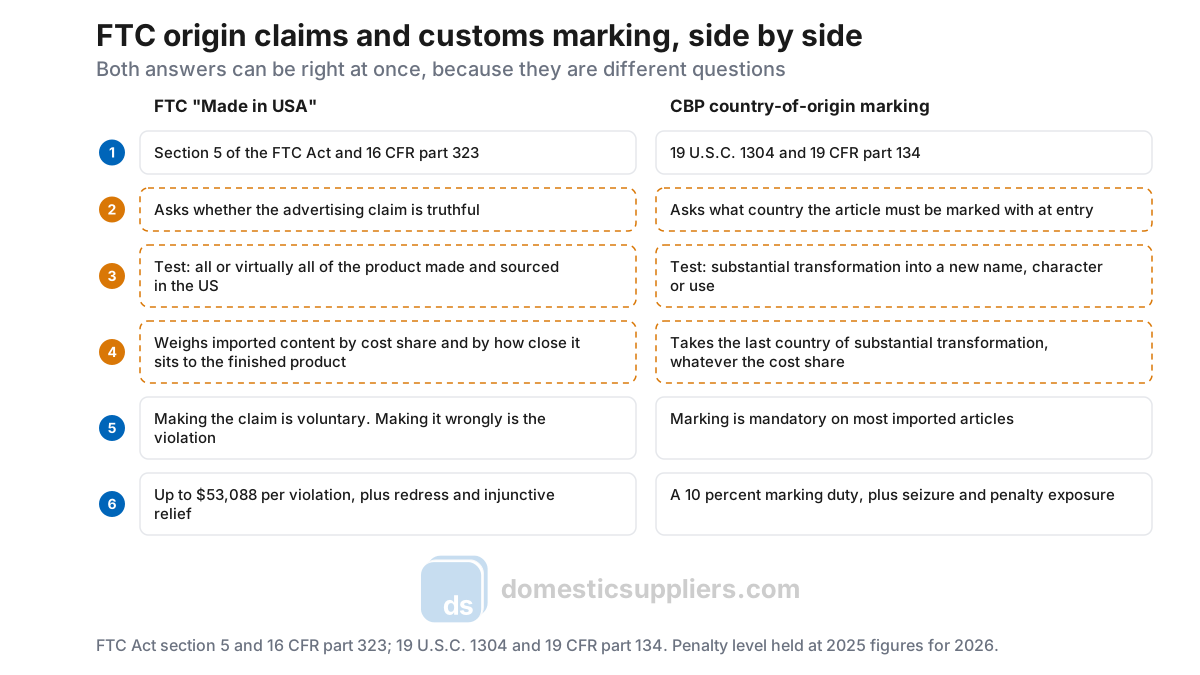
U.S. Customs and Border Protection decides country of origin for marking purposes under 19 U.S.C. 1304 and 19 CFR part 134, using substantial transformation: the country where the article last became a new article with a different name, character, or use. That is a transformation test, and it does not weigh cost shares. A product assembled in the United States from imported components can be substantially transformed here, and therefore have the United States as its country of origin for customs purposes, while still failing the FTC's all-or-virtually-all test by a wide margin.
The two agencies are answering different questions. Customs is answering "what must this article be marked with when it enters." The FTC is answering "is this advertising claim truthful." A customs ruling in your favor is not a defense to an FTC action, and plenty of companies have discovered that the hard way.
And It Is Not the Buy American Act Either
A third test gets dragged into the same conversation. The Buy American Act asks whether a manufactured end product was made in the United States and whether domestic components exceed 65 percent of total component cost for deliveries through 2028. That is a federal procurement rule, it applies to what the government buys, and it runs on a percentage.
The FTC standard applies to what you tell the market, it applies whether or not a government contract exists, and it does not run on a percentage. A part can clear the Buy American Act component test at 70 percent domestic content and still be an unlawful "Made in USA" claim on your website. Two tests, two audiences, two sets of evidence.
What Enforcement Looked Like in 2026
The Commission did not just restate the standard this year.
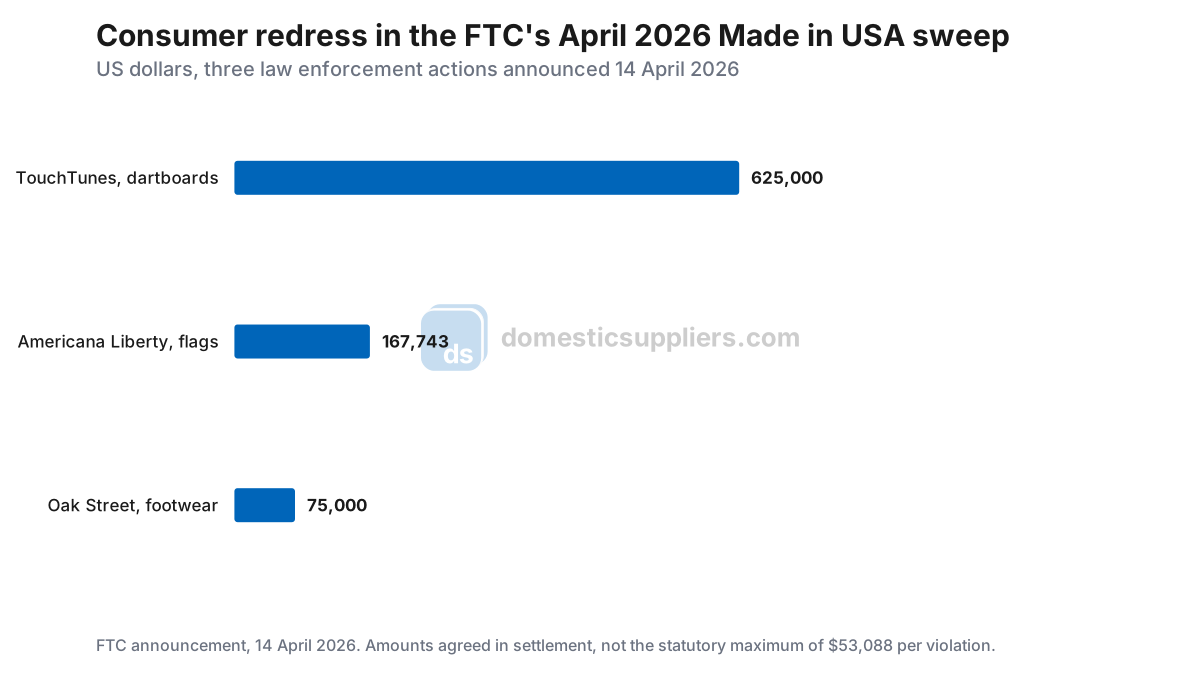
On April 14, 2026, it announced a Made in USA sweep with three law enforcement actions. TouchTunes Music Company agreed to $625,000 in consumer redress over electronic dartboards advertised as made in the USA while containing imported computer chips, cameras, and flatscreen monitors — the largest monetary judgment under the Made in USA Labeling Rule to date. Americana Liberty and Three Nations agreed to $167,743 over flags and patriotic goods marketed as "100% Made in the USA" that were wholly imported or substantially foreign. Oak Street Manufacturing agreed to $75,000 over footwear described as handcrafted entirely in the United States with uppers from the Dominican Republic and outsoles from Brazil. Two further companies received closing letters after agreeing to fix their claims.
Then on July 6, 2026, the FTC sent warning letters to seven companies over apparent "Made in the USA" misrepresentations, and to one company over a "Made in Texas" claim, on products that included drums, industrial laser machinery, coordinate measuring machines, and e-cigarettes. The agency designated July 2026 as "Made in the USA" Month. The letters went to A&F Drum Company, Z-Tech Advanced Technologies, Vtron, Helmel Engineering Products, NebTech, Lucky Bar Holdings, and My Vape Order.
Two of those are industrial metrology and machine tool companies. If you have been reading FTC origin enforcement as a consumer-products problem, that is the detail to take from this year.
Executive Order 14392 and What It Changes
Executive Order 14392, signed March 13, 2026 and titled Ensuring Truthful Advertising of Products Claiming To Be Made in America, directs the FTC chairman to prioritize enforcement where an American-origin claim violates the law, and directs the Commission to consider proposing rules under which an online marketplace's failure to establish procedures for verifying country-of-origin claims could itself be an unfair or deceptive practice. It also sets a procurement consequence: a contractor or vendor found to have misrepresented the American origin of a product sold to the government has those products removed from procurement availability and is referred to the Department of Justice, which may bring a False Claims Act action.
The substantive standard did not change. The enforcement posture did, and the marketplace provision is the one to watch if you sell through a distributor's online catalog, because the verification burden it contemplates lands on somebody, and that somebody will push a substantiation request back down to you.
What to Put in a Supplier Agreement
If you resell or integrate, your exposure runs through your suppliers' claims. Three provisions are worth the ink.
Require a substantiation file, not a statement. The supplier should hold, and produce on request, the bill of materials with country of origin and cost per line, and a description of what processing is performed where. A one-line origin assertion on a packing slip is not substantiation.
Require notice of any change in component sourcing that affects the claim. Origin claims go stale silently. A supplier who moves a subassembly offshore to protect margin under a tariff has changed your claim, and will not think to tell you.
Make the claim language yours to approve. If a supplier's "Made in USA" marking goes onto a product you put your name on, you own the claim in front of the FTC regardless of who printed the label.
Conclusion
"Made in USA," unqualified, means all or virtually all: final assembly here, all significant processing here, and all or virtually all components made and sourced here. It is enforced under 16 CFR part 323 at up to $53,088 per violation, it was enforced against industrial equipment makers this year, and it is a different test from the customs marking rule and from the Buy American Act. If you cannot substantiate the unqualified claim, make a qualified one and make it prominent. It sells slightly less and it does not generate a warning letter.