PPAP Levels 1 to 5: What Each Requires
A PPAP submission level does not change the work you have to do, only which of the eighteen elements you put in the envelope. Nearly every argument about levels starts by missing that.
Introduction
A customer says "we need a Level 3 PPAP" and the shop hears "more work than a Level 2". That reading is wrong, and it is the most expensive misunderstanding in production part approval.
The submission level is a shipping instruction. It says which of the eighteen PPAP elements go in the envelope and which stay in a drawer where the customer can call for them. It does not say which elements you have to produce. With a short list of genuinely conditional exceptions, you produce all of them at every level, and the level decides only what crosses the loading dock.
Hold that straight and the rest stops being mysterious. Level 1 is not a cheap PPAP and Level 5 is not an expensive one. A customer who moves you from Level 3 to Level 1 has reduced their own reading, not your cost. A customer who moves you to Level 5 has not added an element; they have added a visit.
This article covers what the level actually controls, what each of the five is, which elements sit behind all of them, what obliges a submission in the first place, the numbers inside the package, and what to ask for instead when you are buying parts outside automotive and somebody has told you to "get a PPAP".
The Level Is a Shipping Instruction, Not a Scope
The standard is the Production Part Approval Process manual published by the Automotive Industry Action Group. The current edition is the fourth, issued in 2006, with a second printing in 2009. That makes it the oldest of the core tools still in service: advanced product quality planning went to a third edition in March 2024, the control plan was pulled out into a manual of its own at the same time, and statistical process control became a harmonized AIAG and VDA first edition in July 2026. PPAP itself has not moved in twenty years, which is worth knowing before you go looking for a revision that does not exist.
Inside the manual sits a table with eighteen rows, one per element, and five columns, one per level. Every cell carries a code.
- S means submit it to the customer and keep a copy.
- R means retain it at the manufacturing location and make it available on request.
- An asterisk means retain it, and submit it only if the customer asks.
That is the whole mechanism. The level picks a column. The work is the rows.
Two things follow, and both are worth saying out loud to a customer who is asking for a lower level in order to save money.
An R is not a pass. A retained element has to exist, has to be current, and has to be on the table within a day of somebody asking for it. A Level 1 submission with no process FMEA behind it is not a Level 1 submission. It is an unapproved part with a warrant stapled to the front.
The cost lives in the rows. Measurement system analysis, the initial process study, dimensional results taken against a ballooned drawing: those are the expensive items, and the column you are filing under does not change any of them. The difference between Level 1 and Level 3 is postage and review time.
The Five Levels
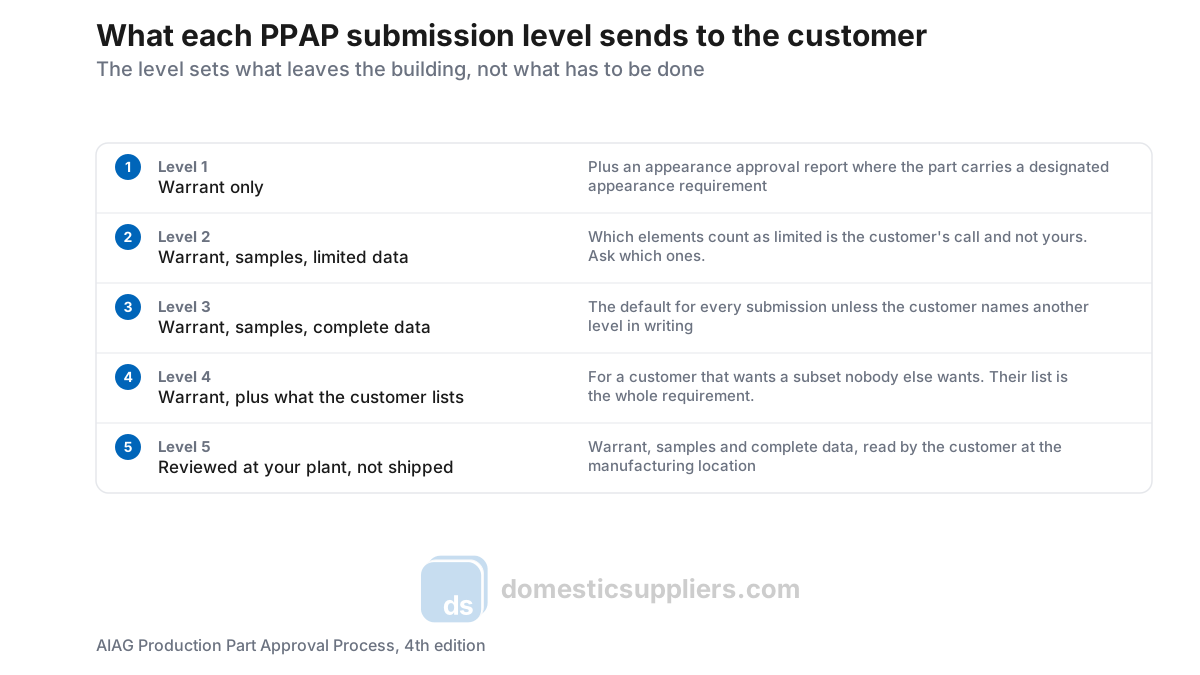
Level 1 is the warrant on its own, plus an appearance approval report where the part has a designated appearance requirement: a color, a grain, a texture, a finish somebody is going to look at and judge. Customers use it for parts they have been buying from you for years, where the history is doing the work the paperwork would otherwise do.
Level 2 is the warrant, product samples and limited supporting data. "Limited" is the word that causes the trouble, because the manual does not define which elements it covers. The customer does. A purchase order that says Level 2 and nothing else has not given you a requirement, it has given you a question, and the answer belongs in writing before anybody starts assembling a package.
Level 3 is the warrant, product samples and complete supporting data. It is the default, and the next section is about why that matters more than it sounds.
Level 4 is the warrant plus whatever the customer lists. It exists for customers whose requirements do not map onto the other four, and the list is the entire requirement. A Level 4 instruction with no attached list means nothing at all, and the correct response is to ask for the list rather than to guess at it.
Level 5 is the same content as Level 3, read at your plant instead of mailed to theirs. Nothing additional is produced. A customer representative sits in your building and reviews the package and the samples at the manufacturing location, which is why it lands on new suppliers, on safety-related parts, and on recoveries after a quality escape. It is not a harder PPAP. It is a PPAP with somebody watching.
Level 3 Is What Silence Means
Level 3 applies to every submission unless an authorized customer representative specifies otherwise. That is the rule, and it is the part shops most often learn the hard way.
A purchase order that calls for PPAP and names no level is a Level 3 purchase order. It is not an invitation to send a warrant and wait to be told. Read silence as the minimum and your first submission comes back rejected, your part approval date slips, and you have burned the time you were trying to save.
In practice customers move off the default in both directions and the pattern is predictable. New part, new supplier, new tooling, or a part carrying safety or regulatory characteristics, and you are at Level 3 or 5. A mature part from a mature supplier with a clean scorecard, and they may drop you to 1 or 2 because they have decided the reading is not worth their time.
That last point is the honest framing of levels. The level is a statement about how much the customer wants to look, and almost nothing about how much you have to do.
The Eighteen Elements Behind Every Column
The elements are easier to hold in four groups than as a numbered list.
What the design says. The design record, which is the drawing or the model. Authorized engineering change documents for anything not yet incorporated into that record. Customer engineering approval, where the customer requires it.
How the process is planned. The design failure mode and effects analysis, where you are design responsible. The process flow diagram. The process FMEA. The control plan.
What the measurement proves. Measurement system analysis. Dimensional results. Records of material and performance test results. Initial process studies. Qualified laboratory documentation.
What physically exists. The appearance approval report, where applicable. Sample production parts. The master sample. Checking aids.
What gets signed. Customer-specific requirements, and the part submission warrant itself.
Two of these are worth drawing out because they have quietly changed underneath the manual.
The control plan is still element seven, but the guidance behind it is no longer where PPAP points. The control plan now has its own AIAG manual, published in March 2024, and if your templates still carry the old appendix structure the content is probably fine and the form is probably dated. Rebuild against the current manual rather than relabelling.
Qualified laboratory documentation is the element that catches shops using an outside lab for a test they cannot run themselves. A laboratory outside your organization has to hold ISO/IEC 17025 accreditation or equivalent, or be approved by the customer, and the scope of that accreditation has to actually cover the test. An accreditation certificate that does not list the test you sent out is a finding waiting to happen.
Dimensional results, element nine, is the one that reads most like the aerospace world's first article inspection, and the discipline is the same: every characteristic on the drawing gets a number and a measured value, which is why a ballooned drawing is worth doing once and keeping.
What Obliges a Submission
A first submission is not the end of it. The manual lists the events that require you to notify the customer and submit again, and most of them are not design changes.
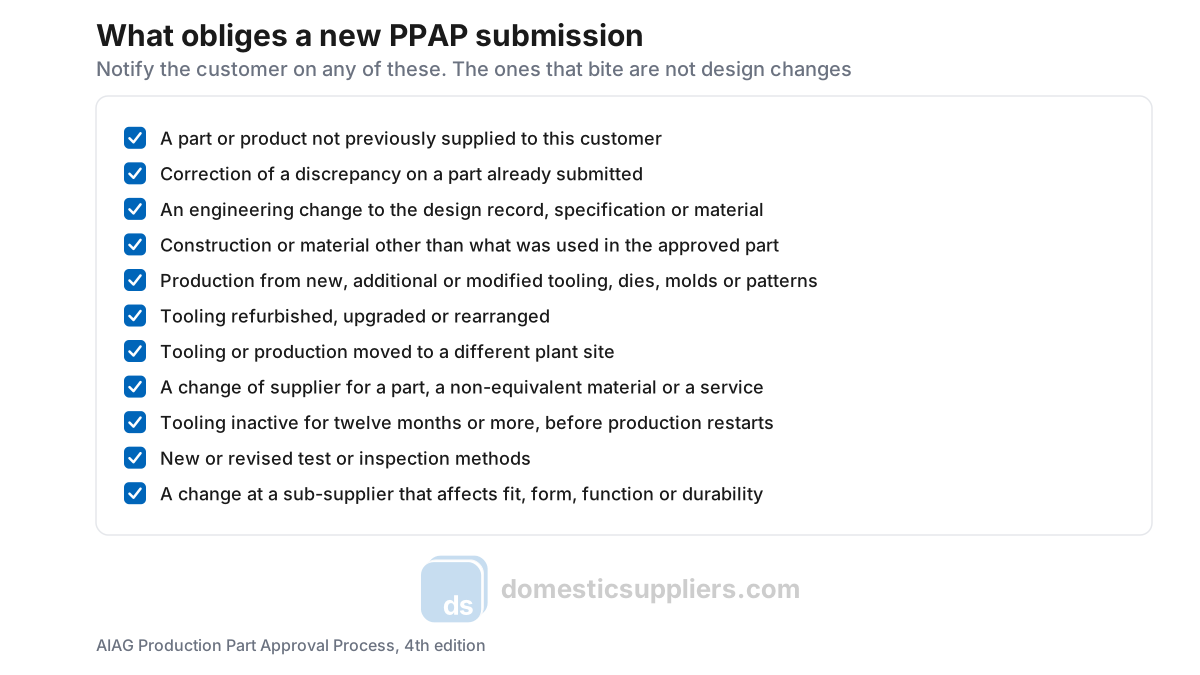
Four of these account for most of the arguments.
Tooling moved to a different plant site. Moving a job between two of your own buildings is a trigger. It does not feel like a change because nothing about the part changed, and that is exactly the reasoning the requirement exists to block.
Tooling refurbished, upgraded or rearranged. A rebuilt die is a different die as far as the standard is concerned.
Twelve months inactive. The clock runs from the end of production to the restart, and a part you have not run since last autumn is already past it.
A change at a sub-supplier. Your plater, your heat treater, your casting source. If the change could affect fit, form, function or durability, it is yours to notify, and the customer will treat it as yours whether or not you knew about it. That is the practical reason IATF 16949 expects you to approve your own suppliers' product before you submit your own part approval: your submission is making a claim about material you did not make.
Worth noting that none of this is a requirement of the standard in the way people usually say. IATF 16949 requires a product and manufacturing approval process conforming to requirements defined by the customer. It does not name PPAP. PPAP is how the industry satisfies the clause, near universally, but the obligation that binds you is the one on the purchase order.
The Numbers Inside the Package
Three figures do most of the real work, and all three are customer-adjustable.
The significant production run. The manual defines it as one to eight hours of production, with a minimum of 300 consecutive parts, made with production tooling, gauging, material, process, operators and environment, at the quoted rate. Customers restate it in their own supplier manuals and most restate it unchanged. Record the date, the time and the actual rate on the warrant: a run that cannot be shown to have been a production run is the quietest way a package fails.
The initial process study. An index above 1.67 meets the acceptance criteria. Between 1.33 and 1.67 may be acceptable, and the manual tells you to contact the customer representative rather than decide for yourself. Below 1.33 does not meet the criteria. Initial studies are normally reported as Ppk, because a brand new process has not run long enough for the stability a Cpk assumes, and where there are fewer than about a hundred measurements or sources of variation nobody has characterized, the honest move is again to ask rather than to publish a number that implies more than it knows.
Multi-stream production. Customer manuals routinely require a separate study per cavity, per mold, per die station or per spindle. One pooled index across eight cavities can look healthy while one cavity is out, which is the whole reason the requirement exists.
One more number, because it gets forgotten the moment approval lands: PPAP records are retained for as long as the part is active plus one calendar year, and customer-specific requirements routinely run far longer than that.
Approved, Interim, Rejected
Three dispositions come back on the warrant.
Approved means the part meets all customer requirements and you may ship against the order.
Rejected means the package, the parts, or both do not, and you resubmit.
Interim approval permits shipment on a limited time or quantity basis, and it is the one that catches people. It is not a soft approval. It is a clock, with a documented corrective action plan attached and an expiry the customer sets, commonly ninety days. Ship past the expiry without a full approval in hand and you are shipping unapproved product, which is a very different conversation from a late PPAP.
If you take interim approval, put the expiry date in the same system that holds your delivery dates. The failure mode is never that somebody decided to ignore it. It is that nobody owned it.
If You Are Buying Outside Automotive
Buyers in aerospace, medical, industrial and defense ask machine shops for "a PPAP" all the time, and the request usually produces either a quote nobody can justify or a package that is not what the buyer wanted.
The reason is the one this article opened with. Outside automotive there is no authorized customer representative, no default level and no customer-specific requirements document, so the two anchors that make PPAP legible are both missing. What is left is an eighteen-element manual written for a production run of hundreds of thousands, applied to an order of fifty parts.
Name the artifacts instead. For most machined and fabricated parts, what the buyer actually wants is a first article inspection report with every characteristic measured, material certifications traceable to the lot, certifications for any special process, and a control plan naming what is checked in production and how often. Three of those four are PPAP elements. Asking for them by name gets you a price in a day instead of a conversation in a week.
If you do want the automotive package, say which level and say it at the request for quote. A full submission is a serious piece of work, and a shop that first hears about it on the purchase order will treat it as a change, correctly.
Conclusion
The submission level is a filing instruction: S for submit, R for retain, an asterisk for retain and send on request. Level 1 is the warrant, Level 2 adds samples and whatever the customer counts as limited data, Level 3 is the complete package and the default when nobody says otherwise, Level 4 is the customer's own list, and Level 5 is Level 3 read at your plant. The eighteen elements sit behind every one of them, and so do the numbers that make them mean something: a run of at least 300 consecutive parts over one to eight hours, an initial process study above 1.67, a separate study per stream. Most resubmissions are triggered by a tooling move, a refurbished die, a twelve month lapse or a change at a sub-supplier rather than by a drawing revision, and interim approval is a deadline rather than a result.