Progressive Stamping Die Cost: A 2026 Guide
A progressive die is priced per station, and station count comes out of the strip layout rather than the part. Settle the layout and you have settled the tooling bill and the part price for a decade.
Introduction
"How much does a progressive die cost" is a question with no answer, in the same way that "how much does a building cost" has no answer, and for the same reason. It is priced by what is in it.
What is in a progressive die is stations. A strip of material advances through the die one pitch at a time, and at each station something happens to it: a pilot hole gets pierced, a slug gets cut, a flange gets bent, an embossment gets coined, and at the last station the part gets cut free of its carrier. Each station is a set of details machined, hardened, ground and fitted, and the die costs roughly what those stations cost to build. A six-station die and an eighteen-station die for superficially similar parts are not two prices for one thing.
Which means the number you are really negotiating is not the price. It is the strip layout: the drawing that decides how many stations the part needs, in what order, at what pitch, running which way through the die. The layout sets the station count, which sets the die price. It sets the pitch and the width, which set the press you need and the scrap you buy for the life of the program. And it sets whether the part can be made at all at the tolerance you asked for. On most programs the layout is settled in about a week by the tool shop's designer, usually with no buyer in the room, and then everything downstream is a consequence of it.
This article is about where the money actually goes: stations, die steel, tonnage, die protection, spares, and in 2026 the duty on an imported die. It will not give you a price per die, because anyone who does is guessing.
What Makes a Station
Stations exist for three reasons and it is worth knowing which is which, because only one of them is negotiable.
Operations the part needs. Every pierce, every form, every coin. These come out of the part geometry and you change them by changing the part.
Operations the process needs. Pilot holes to locate the strip, carrier tabs to hold it together, idle stations to give a form room to happen, and relief cuts so an adjacent feature does not distort. These come out of physics and the designer's judgment, and they are the reason a part with eight features can need fourteen stations.
Operations the tolerance needs. A hole that has to hold position relative to a formed flange may need to be pierced after the form instead of before, which can mean a different station and sometimes a different die. Tolerance is where the quiet cost lives, because a request that sounds like one number on a drawing can add two stations.
Idle stations are the ones buyers push back on and should not. An idle station costs steel and a little machining and almost no fitting, and it is what keeps a form from pulling the strip out of position. A die squeezed to remove idle stations is a die that runs badly for ten years.
The practical consequence is that the single highest-return conversation you can have is a design review of the strip layout with the tool shop before the die is quoted, not after. Ask for the layout as a deliverable, ask why each station exists, and ask which of your tolerances are driving station count. Most part prints have at least one dimension that is expensive and that nobody needs.
Material Chooses the Die Steel
The second cost driver is what you are stamping, and the effect is non-linear.
Die details get hardened into the high fifties and low sixties Rockwell C, and the grade depends on what is going to abrade them. A2 and D2 cover a great deal of conventional work. M2 and the powder metallurgy grades go in where the wear is severe. Carbide goes where the volume is high enough to justify grinding it, and it costs several times a tool steel detail to make and far more to repair.
What has changed this decade is the material being stamped. Advanced high strength steels do two things to a die at once: they raise the force needed to cut and form, and they wear the cutting edges faster at any given force. A die designed for mild steel and then asked to run an AHSS grade is a die that will shed edges, and the fix is usually a different steel in the critical details rather than a different die.
So the first line of any die specification is not the die at all. It is the strip: grade, thickness, temper, tensile range, surface condition and coating. A galvanized or galvannealed coating changes the galling behavior and often the lubricant. A tensile range quoted as a minimum with no maximum is a trap, because the shop builds for the material it was told about and a high-side coil shows up eighteen months later.
Material prices then do the rest. BLS producer price indexes have steel mill products up 27.6 percent in the year to September 2026. That is the input to both your part and your die, and it is the reason die quotes have validity windows now.
Tonnage Is Arithmetic, and It Decides the Press
The force a die needs is not a mystery and you can estimate it before anybody quotes.
Cutting force is the perimeter being cut, times the material thickness, times the shear strength of the material. Add the forming forces, the stripping force, and whatever the nitrogen or spring system contributes, and you have the tonnage. The common rule of thumb for shear strength is around 80 percent of ultimate tensile for mild steel, which is close enough for sizing a press and nowhere near close enough to design with.
Two things follow.
Tonnage is the gate on which shops can quote your part. A die needing 400 tons cannot run in a 250 ton press, and a shop's press list is a harder constraint than its skill. Shut height, bed size, stroke length and strokes per minute matter the same way. If your die is being built for a press you do not own, the die quote and the press availability have to be settled at the same time.
Tonnage scales faster than part size. Double the cut perimeter and the force doubles. Move to a material with 50 percent more tensile and the force goes up again. The combination of a bigger part and a stronger steel moves you into a press class the shop may not have, which is how an apparently modest design change turns into a sourcing problem.
Die Protection, and the Price of Not Buying It
A progressive die fails in one specific way: a part does not eject, the strip feeds anyway, and the next stroke closes the press on two parts' worth of steel. The result ranges from a chipped punch to a cracked die shoe.
Die protection is a set of sensors watching that the strip advanced, that the part ejected, that the slug did not pull, that the die is empty before the ram comes down, wired to a controller that stops the press mid-stroke. It is ordinary technology and it is routinely value-engineered out of a quote because it has no effect on whether the first sample part is good.
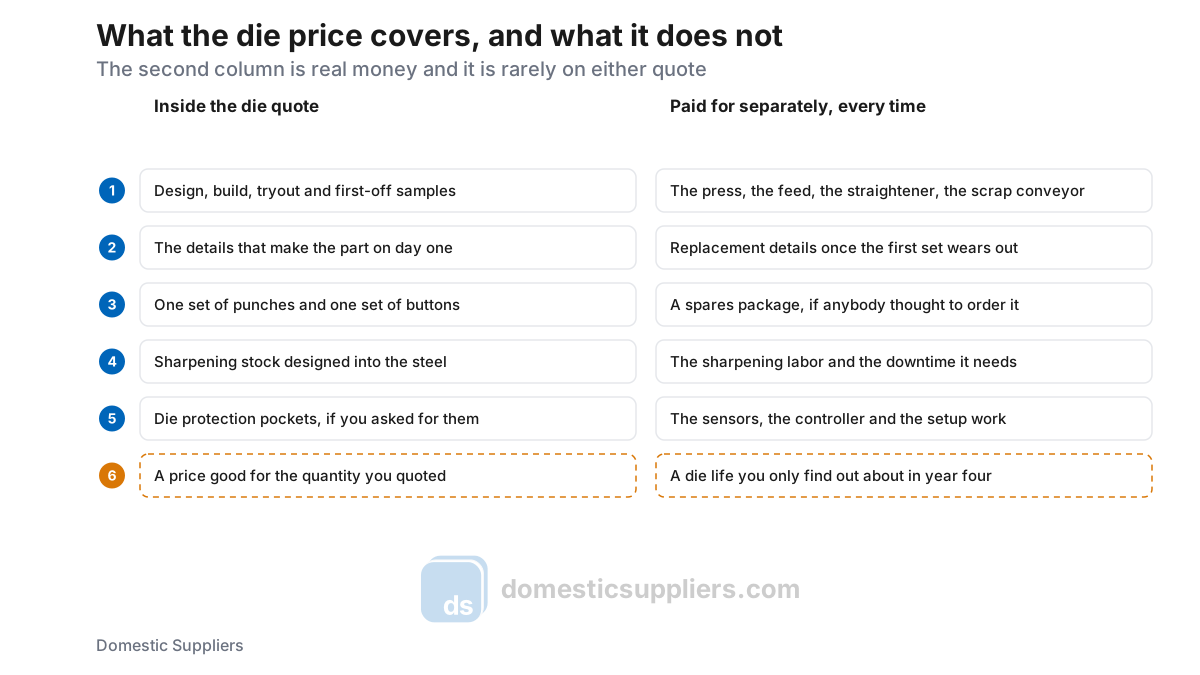
The important detail is that the pockets, mounting and wiring routes for sensors have to be machined into the die while it is being built. Retrofitting them later means taking the die apart. So the decision is made once, at quote, and the cheap version of that decision is permanent.
Ask for die protection to be quoted as a separate line rather than assumed in or out. Then it is a decision rather than a discovery.
The Spares Nobody Budgets
A die quote usually includes one set of working details. That is the set that will be in the die on day one and it is not the set you will be running in year three.
Perishable details are the punches, buttons and inserts that wear or chip. They are consumables with a long lead time if they were never ordered, and a short one if the shop has the prints and the material on the shelf.
Sharpening stock is designed into the die: how many times a detail can be ground back before it has to be replaced, which is a design decision, not a maintenance one. Ask what the sharpening allowance is and how many sharpenings the design anticipates.
The detail drawings and the CAD are the thing that lets a second shop make a replacement punch when the original builder is busy or gone. Who owns them belongs in the supply agreement, along with who holds the die and what happens on termination.
Order a spares package with the die. It is cheaper to make a second punch while the first one is set up than to make it alone eighteen months later, and the comparison between two die quotes is not meaningful unless both include one.
Who Builds These
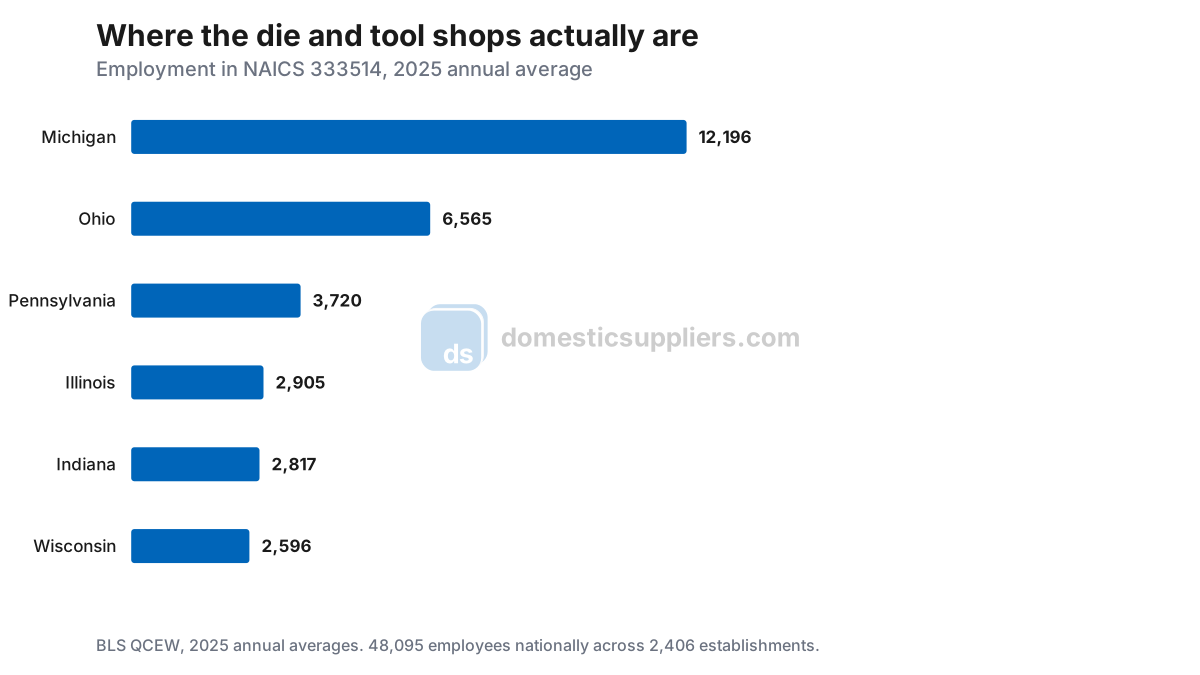
The BLS Quarterly Census of Employment and Wages counts this trade as NAICS 333514, special die and tool, die set, jig and fixture manufacturing. In 2025 there were 2,406 private establishments employing 48,095 people, with average pay of $76,478 a year, or $1,471 a week.
That weekly figure is the highest of any of the fabrication trades. Machine shops averaged $1,369 a week in the same year, sheet metal fabricators $1,366, industrial mold makers $1,381. Die and tool makers are the best paid people in the supply chain, which is a reasonable proxy for how hard the skill is to replace.
It is also the most concentrated. Michigan alone holds 483 establishments and 12,196 employees, a quarter of national employment. Ohio has 6,565, Pennsylvania 3,720, Illinois 2,905, Indiana 2,817 and Wisconsin 2,596. Six states hold most of the capability, and if you are sourcing a die outside that corridor you are usually sourcing from a shop that is good at something adjacent.
And the industry is contracting. Establishments fell from 2,506 to 2,406 between 2024 and 2025 and employment fell from 50,581 to 48,095, a 4.9 percent drop in one year, while average weekly pay rose 3.2 percent. Fewer shops, fewer people, higher wages. That is the market a die quote comes out of.
Importing a Die in 2026
If the quote you are comparing is from overseas, the border now does a lot of the arguing for you.
Dies for pressing, stamping and punching classify in HTS 8207.30.60, with a column 1 rate of 2.9 percent. Metal-forming dies at 8207.30.6062 also appear by name on Annex III, the temporary reduction list for Section 232 steel and aluminum derivatives. For a listed derivative whose column 1 rate is below 15 percent, the proclamation sets the sum of the column 1 rate and the additional Section 232 duty at 15 percent of customs value, and that reduction runs to December 31, 2027. Section 301 then adds 25 percent on a die of Chinese origin.
So a die from China lands at roughly 40 percent over its invoice, a die from Taiwan, Japan or the EU at roughly 15 percent, and a die built in Michigan at nothing. If the Annex III reduction lapses at the end of 2027, the Section 232 component steps up to 25 percent and the arithmetic worsens on both imported routes. It is the same stack that now applies to injection molds, and it has moved a lot of tooling decisions that used to be settled on invoice price alone.
Which Way Prices Have Moved
Two producer price indexes bracket the question. The index for special die and tool manufacturing rose 4.8 percent in the year to September 2026 and is up about 39 percent since January 2020. The index for metal stamping outside automotive rose 3.5 percent over the same twelve months.
Both are well behind steel mill products at 27.6 percent for the year. Tool shops are absorbing material inflation they cannot pass through at the same rate, which is the same squeeze visible in sheet metal fabrication and for the same reason: the input is a commodity and the output is a quoted job with a lead time measured in months.
For a buyer, two habits follow. Treat a die quote's validity window as real rather than as an opening position. And when a shop proposes a material substitution in the die details, ask whether it is a cost decision or a wear decision, because those are the same conversation from opposite ends.
Making Two Quotes Comparable
Send both shops the same package and require the same deliverables.
The strip specification, with grade, thickness, tensile range including a maximum, coating and lubricant.
The strip layout as a deliverable, reviewed with you before the build starts, with station count and pitch stated.
Die steel by grade and hardness for the critical details, not "hardened tool steel".
Press parameters: required tonnage, shut height, bed size, stroke, strokes per minute, and which press the die is being built for by name.
Die protection as a separate line, including the pockets and wiring whether or not you buy the sensors now.
A spares package, enumerated, with the detail drawings and who owns them.
Tryout and sample terms: how many tryout iterations are included, who pays beyond that, and whether dimensional results are supplied or just a statement of conformance.
Then compare the total, landed, for your actual volume, including duty at the rate for the real origin. The headline die price is the one number on the quote the shop has the most freedom to construct, and on a progressive die it is also the one that matters least over the program's life.
Conclusion
A progressive die costs what its stations cost, and its stations come out of a strip layout you are entitled to see before you buy. The material being stamped sets the die steel and, through tonnage, the press. Die protection has to be designed in and cannot be retrofitted cheaply. Spares are an order you place with the die or an emergency you handle in year three. The people who build these are the best paid trade in the supply chain, concentrated in six states, and there are fewer of them every year. And since 2026 an imported die carries roughly 15 percent in duty from most origins and roughly 40 percent from China. Ask for the layout, specify the steel, price the spares, and the question of what a progressive die costs turns into a question you can actually answer.