How to Replace a Chinese Supplier With a US Manufacturer After 2026 Tariffs
Requalification, tooling transfer, and a second source running in parallel. The order those happen in, and how to keep a line fed while the supplier changes underneath it.
Introduction
The arithmetic on a Chinese part moved three times in 2026. On 20 February the Supreme Court ruled the President cannot use the International Emergency Economic Powers Act to impose tariffs, zeroing the IEEPA duties on China. A 10% global Section 122 tariff filled the gap until midnight on 23 July; a new Section 301 action took effect the next morning. And since 6 April, Section 232 duties on steel, aluminium and copper apply to full customs value, not just metal content.
The short version. A Chinese part of steel, aluminium or copper pays its normal HTS duty, plus its 2018 Section 301 rate, plus Section 232 — and not the new 12.5% forced-labor duty, because Chapter 99 heading 9903.05.90 carves it out. A part that is not a metal article, a moulded plastic housing say, pays its normal duty, plus its 2018 Section 301 rate, plus the 12.5%, and no Section 232. The two are close to mutually exclusive here, so do not stack them.
Most guidance on how to switch from a Chinese supplier to a US manufacturer stops at comparing two quotes. This piece sequences the rest: landed cost, the document and tooling audit, tool release, requalification, dual sourcing and bridge stock.
Price the switch on landed cost, not unit price
Landed cost is everything you pay to get one good part onto your dock: unit price, duty, fees, freight and the cost of money in transit. Unit price is the smallest part of the gap.
Start with the stack. The normal duty — the column 1 or NTR rate — depends on the 10-digit classification and must be looked up per line at hts.usitc.gov. The 2018 Section 301 rates run 7.5% on List 4A and 25% on Lists 1 to 3. The 2026 forced-labor action sits at heading 9903.05.31 and adds 12.5% on goods of China, effective 24 July 2026, at 91 FR 47318. Section 232 is a tiered schedule keyed to the Chapter 99 heading, not one rate. The band is 10% to 50%, and a Chinese metal article or derivative falls into 9903.82.02, the catch-all heading at 50% of full customs value. Lower tiers exist, but the de minimis relief for articles under 15% metal by weight does not reach Chapters 72, 73, 74 or 76.
Then the rest. The Merchandise Processing Fee is 0.3464% of entered value on a formal entry, between $34.58 and $670.86, effective 1 October 2026. The Harbor Maintenance Fee is 0.125% of cargo value on vessel arrivals, with no cap; air does not pay it. Freight is a live market: Drewry's World Container Index assessed Shanghai to Los Angeles at $7,624 per 40ft on 8 October 2026, so carry a spot rate's date with it. Broker fees, drayage and inland freight have no published rate; use your own invoices.
Drawback refunds up to 99% of eligible duty on goods later exported or destroyed. Section 301 duties qualify, including the forced-labor duty; Section 232 duties do not. And it only pays a buyer who exports or destroys — sell domestically and you get nothing back.
The table below is a worked example, not a published result: a machined carbon steel bracket, Shanghai to Los Angeles, classified as a steel article under 9903.82.02 and on 2018 Section 301 List 1, 60,000 units a year, 12,000 per 40ft container. Both unit prices are invented; substitute your own.
| Line item | China supplier | US supplier | Basis |
|---|---|---|---|
| Unit price, FOB / ex-works | $12.40 | $17.50 | Assumption — illustrative only |
| Column 1 (NTR) HTS duty | not estimated | — | Part-specific; look up the 10-digit line |
| Section 301, 2018 List 1 at 25% | $3.10 | — | Published rate |
| Section 301 forced labor, 12.5% | $0.00 | — | Carved out by 9903.05.90 for metal articles |
| Section 232 at 50% of customs value | $6.20 | — | Published tier; 9903.82.02, eff. 6 Apr 2026 |
| IEEPA | $0.00 | — | Struck down 20 Feb 2026 |
| Section 122 | $0.00 | — | Expired 23 Jul 2026 |
| MPF at 0.3464% | $0.043 | — | Published rate; $515.44 per entry, under the cap |
| HMF at 0.125% | $0.016 | — | Published rate; ocean only, no cap |
| Ocean freight, 40ft | $0.64 | — | $7,624 per container, Drewry WCI 8 Oct 2026 |
| Broker and entry fee | your figure | — | Assumption — no published rate |
| Drayage and inland freight | your figure | your figure | Assumption — no published rate |
| Carrying cost in transit | your figure | your figure | Assumption — cost of capital x value x days / 365 |
| Drawback credit | $0.00 | — | Domestic sale; 232 not eligible in any case |
| Known lines, per part | $22.40 | $17.50 | Excludes column 1 duty and all buyer figures |
The total moves with classification; two parts that look identical on a drawing can pay different stacks. Watch the calendar: 178 Section 301 exclusions, 164 general and 14 for solar manufacturing equipment, expire on 10 November 2026. Each is granted at a specific 10-digit line and product description, and no new request process is open.
Audit what you actually own: drawings, specs, tooling
Before you send a single RFQ, find out what you can legally and practically hand a new shop. Most failed transitions fail here, quietly, months in.
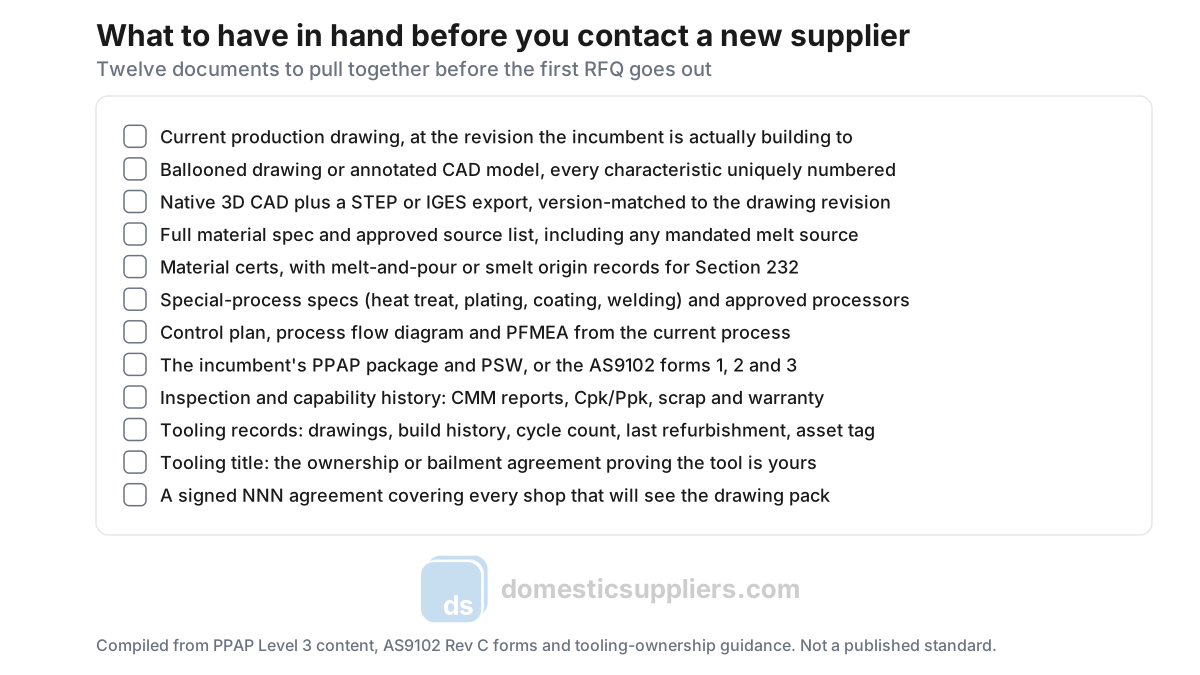
The question is not whether a drawing exists. It is whether the revision in your system is the one your incumbent is actually building to — get that confirmed in writing. The same goes for the native CAD and its neutral STEP or IGES export, the material and process specs with their approved sources, the current Control Plan and PFMEA, and the incumbent's part-approval package, PPAP or AS9102, with its capability and scrap history. For Section 232 you also need melt-and-pour origin records for steel and smelt or cast origin for aluminium.
Work the list below before you talk to anyone. Each gap is a question you would otherwise meet at first article.
Tooling ownership and the transfer problem
Title and possession differ, and only one is in your building. Many Chinese factories assume they own tooling they built on their premises, and holding a tool hostage is a recognised, recurring pattern. An ownership agreement is what proves otherwise.
The mechanism that works is bailment: someone holding your property without owning it. A clause stating the mould is buyer property held in bailment keeps the tool off the factory's asset sheet under Chinese law, and an asset tag carrying your name and asset number strengthens the claim if the factory fails. The agreement should also bar pledging, transferring, scrapping or lending the tool, and carry liquidated damages — a pre-agreed sum if the tool is not returned on request.
If a supplier refuses to release a mould, your leverage is contractual, not physical. Two honest gaps: no published figure exists for Chinese export formalities or crating, and none for the condition a transferred tool arrives in. Plan for the crate, the export paperwork and an inspection on arrival.
Qualification, first article, and PPAP
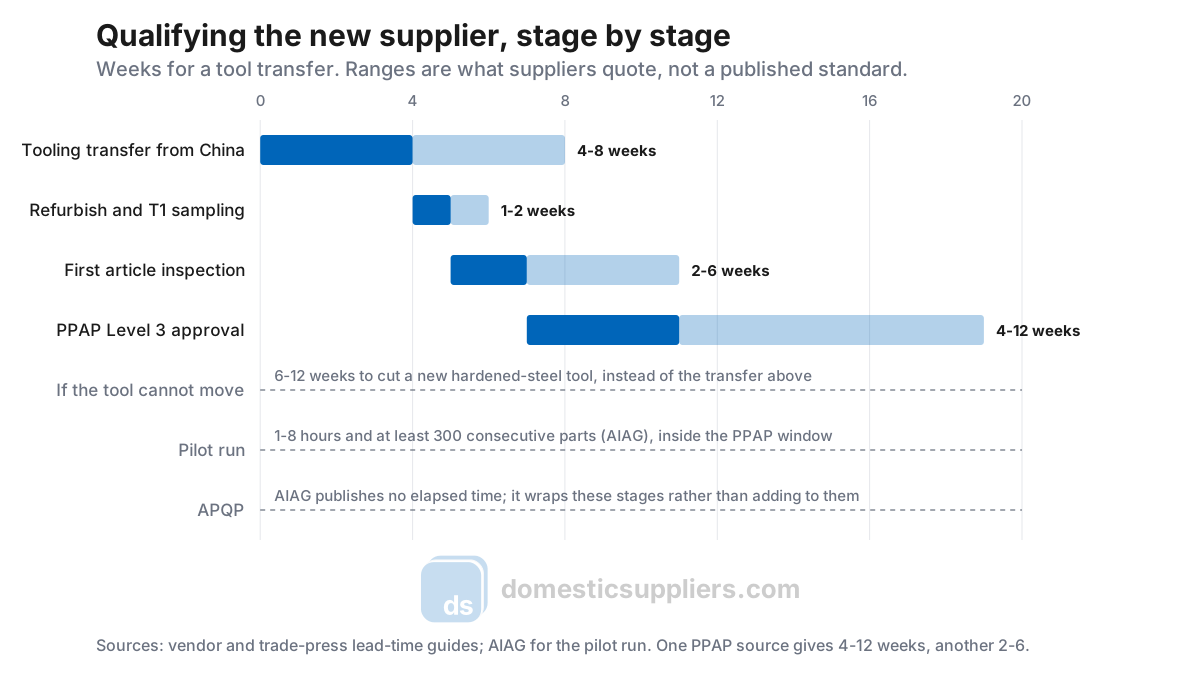
A first article inspection, or FAI, proves one part from the new process meets every characteristic on the drawing. In aerospace that is AS9102, Rev C published 2023 — three forms covering the part number, its materials and special processes, and every dimension and note, balloon-numbered. A change of manufacturing location triggers a new FAI, and a supplier switch is exactly that. Vendor sources put a full FAI cycle at 2 to 6 weeks; SAE publishes no elapsed time.
PPAP, the Production Part Approval Process, proves the process repeats. Level 3 is the normal default for a new supplier on an existing part: a Part Submission Warrant, samples, and a data package across 18 elements. Practice guides put Level 3 at 4 to 12 weeks, roughly 1 to 3 weeks of supplier preparation plus 1 to 4 weeks of customer review. Sources vary; another gives 2 to 6 weeks. AIAG publishes no duration for PPAP or APQP — it specifies content, not calendar time — so treat APQP as a wrapper across the other stages rather than a dated block.
One stage has a standards-body number: AIAG defines the significant production run as one to eight hours from final production tooling, totalling at least 300 consecutive parts unless the customer says otherwise. Run at Rate, the timed run at target cycle time, comes after PPAP approval.
Tooling is the other long pole. Transferring an existing tool is typically quoted at 4 to 8 weeks where the documentation is in place, plus 1 to 2 weeks for refurbishment and T1 sampling — the first parts off the tool — inside a vendor-reported 12 to 24 week window. Cutting a new hardened steel tool instead, if the old one cannot move, is quoted at 6 to 12 weeks. Both are supplier-published ranges, not standards.
The sequence below marks which stages have a sourced duration and which do not.
Running both sources in parallel
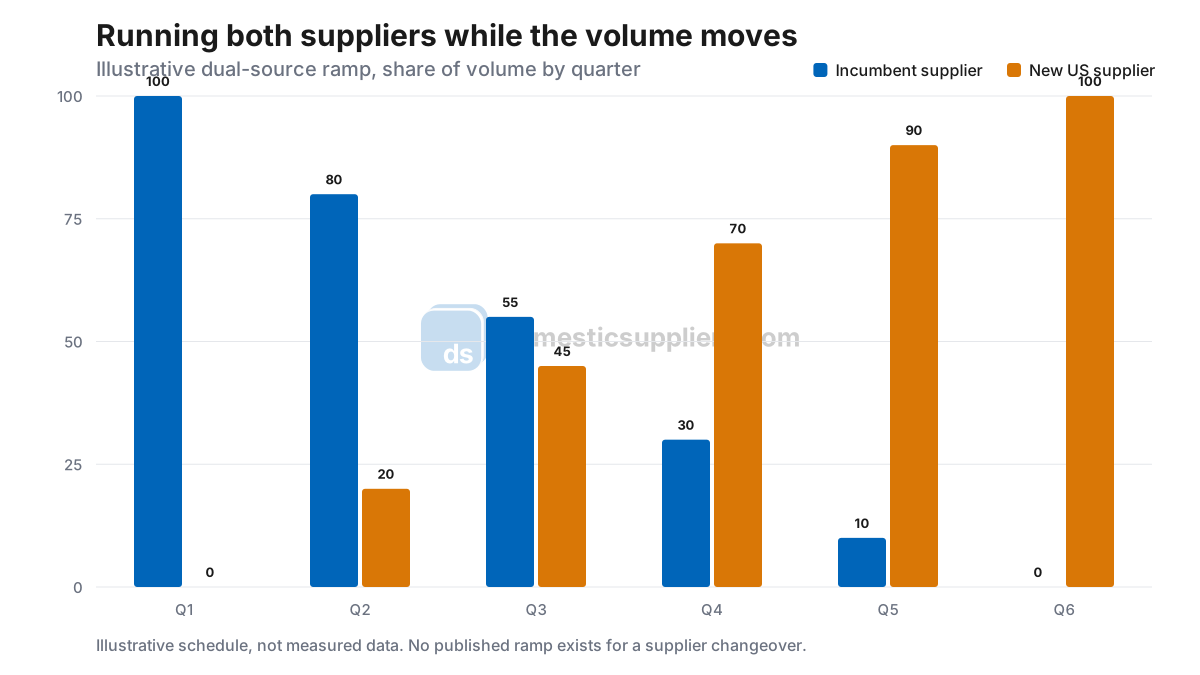
Dual sourcing means keeping two qualified suppliers on the same part number at once. Through a transition it is what lets you fail safely.
You do not switch in one step because the failure modes are invisible at sample stage. A tool that ran for years in one plant can miss on gate location, cooling or press tonnage in another, and capability that holds over 300 parts can drift over a shift.
So shift volume in steps, tied to evidence rather than dates. The new shop starts small after PPAP approval, enough to keep the process warm. Raise its share once a witnessed Run at Rate confirms the rate, and again once you have scrap and dimensional history across several lots. Keep the incumbent where you can ramp it back up.
Bridging inventory through the changeover
Bridge stock is inventory you build deliberately to cover the window where the old supplier has stopped and the new one is not yet approved.
No sourced formula exists for sizing it, so treat any tidy coefficient as invented. The defensible structure is remaining qualification time at the new supplier, plus one replenishment lead time from the incumbent including ocean transit, plus an allowance for a rejected first article and a second pilot run, times your demand rate.
Transit is the one input with usable guidance. Forwarders report Shanghai to Los Angeles at 14 to 18 days port to port, and Shanghai to the East Coast at 30 to 40 days via Panama; air runs 3 to 7 business days airport to airport. Those are typical forwarder ranges, not published schedules. For the transfer window itself, trade press suggests a six-week safety stock build normally fits the schedule — which covers the transfer, not the whole qualification.
Intellectual property and the handover
A transition is when your drawing pack leaves the building, going to shops with no contract with you yet. A US-style NDA usually does not work in China, because it only prohibits disclosure. It does nothing if the factory tells nobody and simply uses your design to build and sell its own version. The real risk is that your supplier becomes your competitor.
An NNN agreement — non-disclosure, non-use, non-circumvention — is drafted for Chinese manufacturing and meant to be enforced in Chinese courts. Non-use stops them using your information outside the agreed scope; non-circumvention stops them going around you to your customers or suppliers. For it to be enforceable the Chinese text controls and Chinese courts have jurisdiction. China's trade secrets regulation, effective 1 June 2026, does not replace the contract.
Control the drawings as tightly as the paper. The common failure is not sophisticated theft; it is designs going out before anything is signed, which is what happens when a buyer shops one pack to five shops. Sign first, then send only what each shop needs to quote. What registering a patent or design in China buys you is outside what we researched — ask IP counsel.
When not to switch
Sometimes the numbers do not clear. No published figure exists for the US versus China unit cost gap; it is part-specific, and no statistical agency publishes one. The wage level is sourced: US manufacturing average hourly earnings were $36.92 in September 2026, $39.08 in durable goods, per BLS Table B-3. Vendor sources report Chinese CNC shops pricing 30% to 50% below comparable North American ones — attribute that to the vendors, because no agency figure backs it.
The tariff arithmetic varies more than people expect. A steel article at 25% Section 301 plus 50% Section 232 is a different case from a plastic moulding on List 4A at 7.5% plus the 12.5% forced-labor duty. The second may not move enough to pay for new tooling, a requalification and a bridge build.
Then there are parts you should not move because the risk sits elsewhere: a tool with no ownership documentation and a supplier with no reason to cooperate, a special process with one approved processor, or a programme too close to launch to absorb a failed first article.
Conclusion
The order is what people get wrong. Classify the part and build the real landed cost first, because it gates everything after. Audit your drawings, specs and tooling title, and sign NNN agreements before any drawing pack leaves. Then RFQ, build bridge stock while the tool moves, run FAI and PPAP, and shift volume against evidence rather than dates. Keep the incumbent shipping until the new source has lot history, not samples.