Reshoring Statistics 2026
The numbers behind the headline, where each one is collected, and which of them count announcements rather than production that has started.
Introduction
Two numbers about US manufacturing reshoring are circulating in 2026, and both are wrong in the same way: each one reports an announcement as if it were a completed hire. Anyone compiling us reshoring statistics 2026 jobs and companies for a sourcing case needs to know which figures survive contact with the source report, because two of the most-repeated ones do not.
The first is "244,000 reshored jobs in 2025." That number is real, but it belongs to 2024, not 2025. The Reshoring Initiative's own report, the same one that produced the 244,000 figure, projects 2025 at 173,316 announced jobs, roughly 174,000, a 29 percent drop from the year before. The projection is annualized from a single quarter of data and excludes tariff-contingent deals that had not yet firmed up when the report was written, which is exactly why it is fragile, and exactly why the 244,000 figure keeps getting repeated past its expiration date.
The second is a sector number. Coverage citing "68,700 computers and electronics jobs in 2024" is quoting the 2025 projection, not the 2024 actual. The real 2024 figure for that sector is 86,127, more than a third of the year's total on its own.
This article works through where both numbers actually come from, what they measure, and the sectors and states behind them. One discipline runs through all of it: every figure below counts an announcement, not a job that exists on a factory floor. The distance between the two is the point of the article.
Where the headline numbers come from
Most of the figures here trace back to one organization, the Reshoring Initiative, a nonprofit that tracks public announcements of reshoring and foreign direct investment into US manufacturing. Reshoring means a US-headquartered company moving production it already does elsewhere back onto US soil. Foreign direct investment, FDI, means a foreign-headquartered company building or investing in production inside the United States. The Reshoring Initiative's headline totals combine both.
A second source, the Bureau of Labor Statistics' Current Employment Statistics program, measures something different: actual, seasonally adjusted manufacturing payroll employment, net of hiring, firing, automation, and plant closures. State and sector detail round out the picture, drawn from the Reshoring Initiative's own annual report, state economic development offices, and trade press recaps that do not always carry the original year or caveats forward.
| Source | What it measures | How often it updates |
|---|---|---|
| Reshoring Initiative Annual Report | Announced reshoring + FDI jobs, by case, sector, and state | Annually, with a Q1-based projection published for the current year |
| BLS Current Employment Statistics (via FRED, series MANEMP) | Actual, seasonally adjusted US manufacturing payroll employment | Monthly |
| State economic development offices and governor's press releases | Self-reported state-level reshoring or investment announcements | As announcements occur, irregular |
| Trade press and secondary recaps (e.g., American Machinist, Newsweek) | Restatements of Reshoring Initiative figures, sometimes without the original year attached | As published, irregular |
The mismatch between the first row and the last row is how a 2025 press release ends up quoting a 2024 number, and how a 2025 projection ends up quoted as a 2024 actual. Every figure below is labeled with which row it came from.
Announced jobs against jobs that exist
The Reshoring Initiative's own count of announced jobs has grown unevenly since 2010, when it tracked 11,000 announced reshoring and FDI jobs for the year. A secondary reprint of the organization's year-by-year figures, published by Colvin Friedman and checked here against the primary report only for 2010 and 2024, puts the figure at roughly 160,000 in 2020, 260,000 in 2021, 364,000 in 2022, and 287,000 in 2023, ahead of a confirmed 2024 actual of 244,940. The report's own 2025 figure, annualized from Q1 data only, is 173,316, a projection, not a final count, and not one that should be read as directly comparable to the firmer years around it until the full year is reported.
None of those numbers are jobs that exist today. They are announcements: a company states an intention to reshore or invest, and the case is logged the day the announcement is made, whether or not the plant ever breaks ground. The Bureau of Labor Statistics' manufacturing payroll count works on a different basis entirely. It is a monthly headcount, seasonally adjusted, covering all US manufacturing employment, with hiring, firing, automation, exports, and closures all netted together into one number. In September 2026, that count stood at 12,652,000, roughly flat to slightly down from a 2022 peak near 12.9 million, even as the Reshoring Initiative logged hundreds of thousands of newly announced jobs across those same years.
That is not a contradiction. The two series measure different universes and neither confirms nor denies the other: one counts a subset of announcements tracked by a single organization, the other counts net employment across the entire sector regardless of cause. Putting them on one axis without that caveat attached invites exactly the misreading this article opened with, so any version of that comparison should carry the caveat alongside it, not as a footnote.
Reshoring, nearshoring, and foreign direct investment
"Reshoring" and "nearshoring" get used interchangeably in casual conversation, but they describe different moves. Reshoring means a US company brings production it already does abroad back onto US soil. Nearshoring means shifting that production to a nearby country, typically Mexico or Canada, rather than back to the United States itself. The Reshoring Initiative's headline figures do not include nearshoring at all; a company that shifts a supply chain from China to Mexico does not appear in these numbers, no matter the size of the shift.
Foreign direct investment is a third category, and it is not reshoring in the strict sense, because the investing company is not bringing back anything it already had on US soil. The Reshoring Initiative bundles reshoring and FDI together in its headline totals anyway, because both result in the same outcome from a sourcing standpoint: new manufacturing capacity announced inside the country.
The mix between the two is not fixed from year to year. In 2024, reshoring by US-headquartered companies accounted for 156,973 of the year's 244,940 announced jobs, 64 percent, against 87,968 from FDI, 36 percent. The Reshoring Initiative described this as reshoring outpacing FDI "by the largest margin on record" that year. A reader comparing two years of headline totals without checking the reshoring-versus-FDI split underneath them is comparing two different blends without realizing it.
Which industries actually moved
The 2024 Annual Report's sector table is the most granular breakdown available, and it is also where the second widely repeated error originates. The "68,700 computers and electronics jobs" figure that circulates as a 2024 number is not a 2024 number at all; it is the 2025 projected figure for that sector, 68,675, pulled from the same table that lists the 2024 actual alongside a Q1-annualized 2025 projection. The real 2024 actual for computer and electronic products is 86,127 jobs, 35 percent of the year's total and the largest single sector by a wide margin.
Electrical equipment, which includes EV batteries and components, was second at 75,900 jobs, 31 percent. Transportation equipment, covering automotive and EV platform suppliers, followed well behind at 21,970. Chemicals came in close to that at 21,349. The next tier of sectors — machinery, primary metal products, fabricated metal products, food and beverage, medical equipment and supplies, and nonmetallic mineral products — each landed in the low single-digit thousands. Seventeen sectors in total sum to the year's 244,940 announced jobs; the chart below ranks the ten largest.
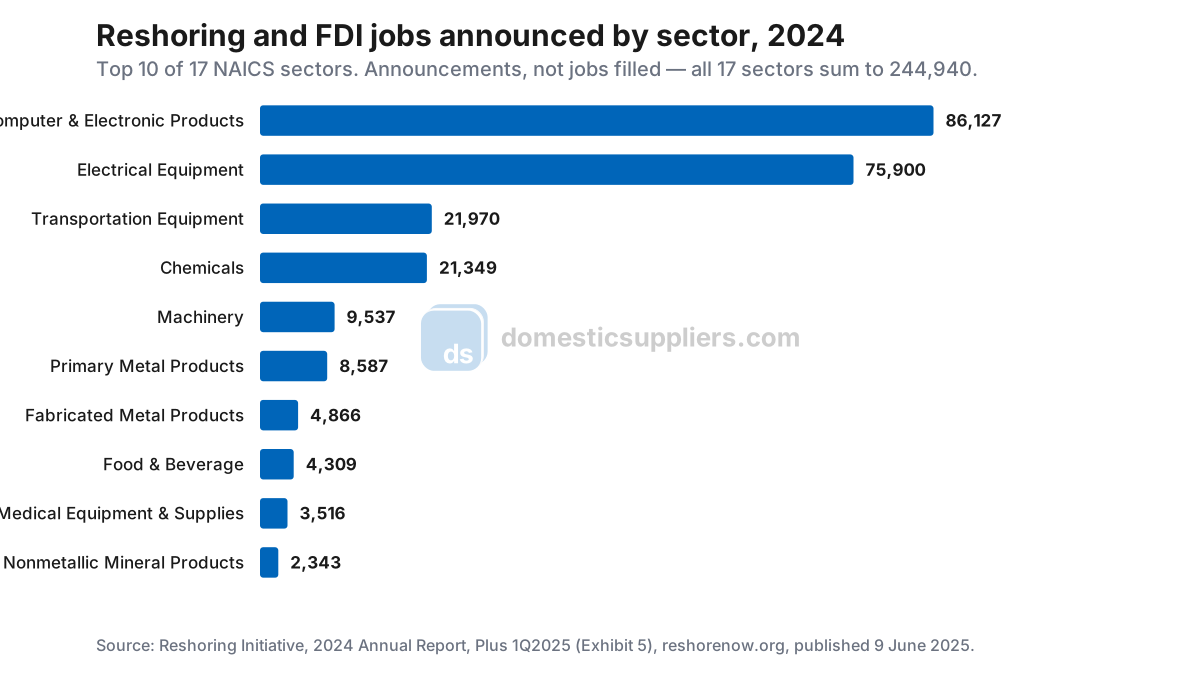
As with the national total, these are counts of announced jobs by sector, not completed hires. A sector at the top of this list is a sector attracting announcements, which is a different claim than a sector adding headcount.
Which states gained the most
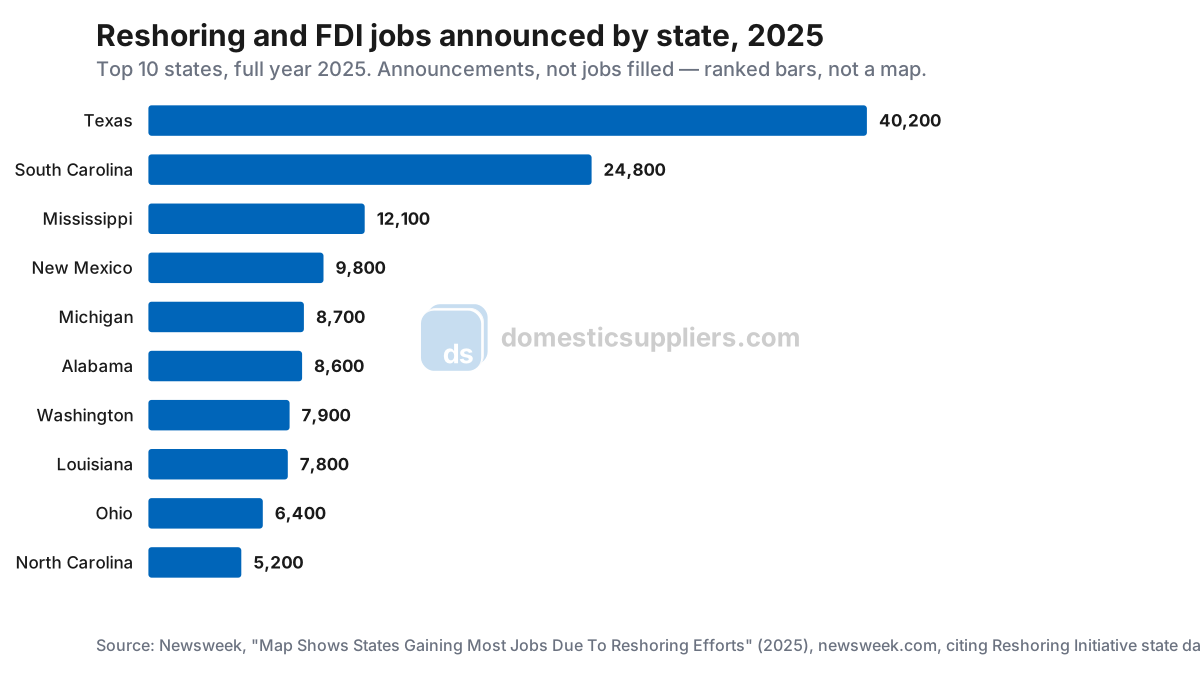
State-level figures are harder to pin down than the national total, because they get reported inconsistently across years and outlets. The cleanest breakdown available is a single-year, single-source table: a Reshoring Initiative state-level count for 2025, reported by Newsweek, covering the ten states with the most announced reshoring and FDI jobs that year. Texas led by a wide margin at roughly 40,200 announced jobs, followed by South Carolina at about 24,800. The next eight — Mississippi (12,100), New Mexico (9,800), Michigan (8,700), Alabama (8,600), Washington (7,900), Louisiana (7,800), Ohio (6,400), and North Carolina (5,200) — rounded out the top ten.
There is no map here. A horizontal bar chart below ranks the same ten states from highest to lowest announced total, which carries the same ordering a map would show without implying a level of geographic precision the underlying data does not have. These figures are 2025 announcements from a single secondary report of the Reshoring Initiative's data, not a multi-year or audited state series, and they should be cited as such.
What the 2026 tariff rounds changed
2026 brought three tariff actions that are commonly assumed to have driven a wave of new reshoring announcements. The Supreme Court issued its IEEPA ruling on February 20, resolving the legal challenge to the tariff authority the administration had been using. A Section 232 tariff expansion took effect April 6. A new Section 301 forced-labor duty took effect July 24, following a presidential memorandum issued July 23 and published in the Federal Register on July 28.
What cannot be shown here is how announcement activity actually moved around those three dates. The Reshoring Initiative does not publish a quarterly announcement series, and no quarterly 2026 count was located for this article. The only 2025 figure available is the full-year projection discussed above, 173,316, published before any of the 2026 tariff actions took effect, which rules it out as evidence either way. Readers citing a causal link between a specific 2026 tariff date and a jump in reshoring announcements should treat that link as unverified until the Reshoring Initiative publishes a report covering the full 2026 year, including all three actions.
What the data does not capture
An announcement is not a plant. The Reshoring Initiative logs a case the moment a company announces an intention to reshore or invest, and there is no public mechanism, from the Reshoring Initiative or elsewhere, tracking which announced projects actually broke ground, which were delayed or downsized, and which were quietly cancelled. A company can appear in a given year's total and never produce a single finished unit in the United States.
There is also a double-counting risk running through this kind of data. State economic development offices, individual company press releases, and the Reshoring Initiative's own case count can each report the same project. Added together across sources, as happens in some secondary coverage, the same plant can inflate a combined total more than once.
The Reshoring Initiative's own cumulative claim, over 2 million announced jobs since 2010, of which an estimated 1.7 million have been "filled," is worth flagging for what it is: a self-reported estimate from the organization doing the counting, not an independently audited figure. It may be directionally reasonable. It has not been verified against an outside dataset in the material available for this article, and no outside source doing that verification was found either.
How to use these numbers in a sourcing case
Three checks make these numbers usable rather than misleading. First, check the year. The 244,000 figure is 2024, not 2025; the actual 2025 figure, 173,316, is a projection annualized from one quarter and will move once the full year is reported. A document citing "244,000 in 2025" has not gone back to the primary report.
Second, check whether a number is an announcement or an employment count. Reshoring Initiative totals, sector breakdowns, and state tables all count announced jobs, not jobs that currently exist. BLS payroll figures count actual employment, but net of everything else happening across manufacturing, not reshoring specifically. Neither should be cited as evidence for or against the other.
Third, check which components are bundled together. Reshoring headline totals usually include FDI as well, and the mix between the two shifts from year to year. A sourcing case built on a state or sector total should note whether that total is reshoring alone, FDI alone, or both combined, because the companies and risk profiles behind each differ.
A reshoring announcement is a useful early signal that a sector or state is attracting manufacturing investment. It is not evidence that production, or supply, has actually shifted yet.
Conclusion
The headline reshoring numbers for 2026 are less settled than they look. The widely repeated 244,000-for-2025 figure is last year's number, not this year's; the honest 2025 figure is a fragile, partial-year projection of 173,316. The widely repeated 68,700-for-electronics figure is next year's projection, not last year's actual of 86,127. Both errors run in the same direction: reading a prior year's actual, or a future year's projection, as if it were a settled count for the year actually being discussed.
The underlying discipline is simple. These are announcements, tracked by one nonprofit using its own methodology, with no public check on how many of them turn into production. That does not make the numbers useless. It makes them exactly as useful as any other leading indicator: informative about direction and location, silent about whether the jobs ever arrive.