RFQ Template for Machined and Fabricated Parts
Quotes that come back a month apart and 300 percent apart are almost never a story about the shops. They are a story about the RFQ. Here is what belongs in one, what every blank costs you, and a template you can paste.
Introduction
Send the same part to five machine shops and you will get five numbers that do not belong on the same page. One quotes 1,200 dollars, one quotes 4,400, two come back with questions, and the fifth never answers. The instinct is to conclude that the market is irrational, or that three of the five are trying it on.
Usually neither is true. What has happened is that the RFQ left enough blank that each shop filled the gaps differently, and you are now comparing five different jobs that happen to share a drawing. One quoted the tightest tolerance on the print because nothing told it which features mattered. One assumed a single batch, one assumed a release schedule. Two included a first article inspection and three did not.
A good RFQ is not a longer RFQ. It is one that removes the assumptions, so that the differences between the numbers that come back are differences between the shops rather than differences between their guesses. This article covers what belongs in the packet, what each omission actually costs, and ends with a template you can paste into an email.
What an RFQ Is Actually For
It is worth being precise about the goal, because it is not "get the lowest price."
The goal is comparability. You want a set of quotes that differ only in the things you are trying to measure: the shop's efficiency, its process choice, its overhead, its appetite for the work. Everything else should be held constant by the document. A quote that is low because the shop assumed no inspection report and commercial material is not a low quote, it is a different quote, and you will discover that at first article or at receiving.
The secondary goal is self-selection. A well-specified RFQ lets a shop that is wrong for the job decline quickly, which is worth more to you than a reluctant quote padded for risk. Shops price uncertainty. If your packet is vague, the competent ones add contingency and the number comes back high, while the ones who do not notice the risk come back low. Vagueness systematically selects against the shops you want.
The Packet
Send everything at once. An RFQ that arrives in three emails over two days gets opened three times and quoted once, badly.
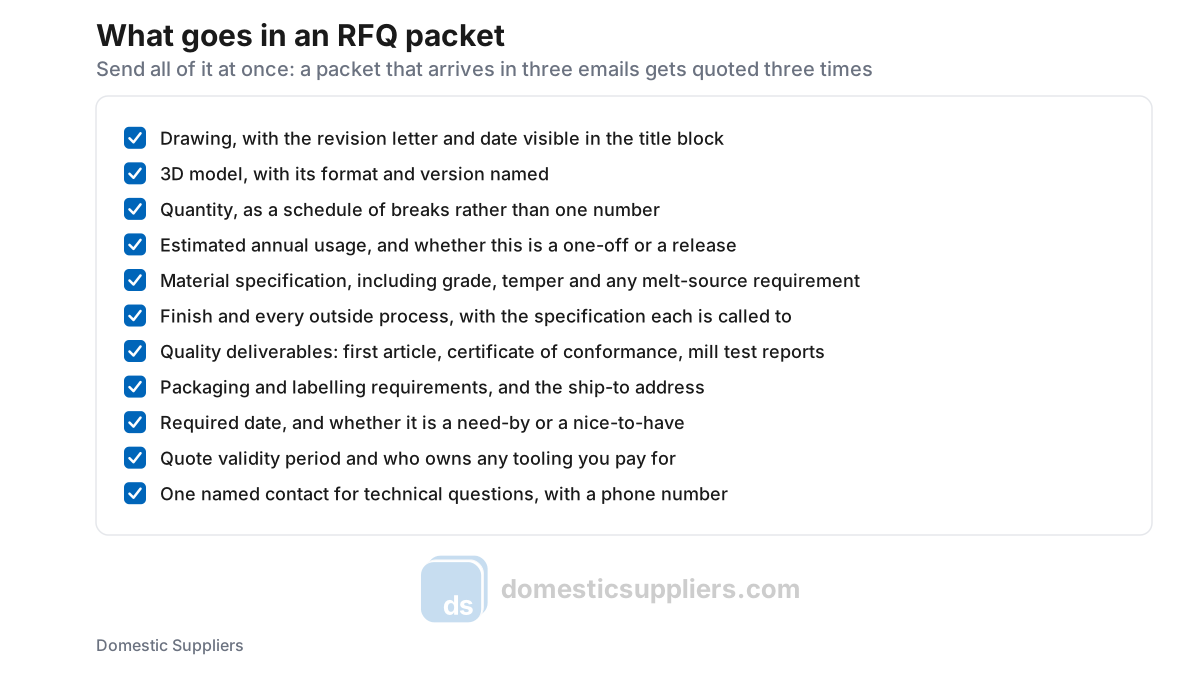
Two items on that list get left off more than the rest, and both are cheap to include.
The first is the named contact with a phone number. A quoter with a question will email it if that is all they have, and your reply arrives in four hours, and the quote slips a day. A quoter who can ring someone resolves it in two minutes. Shops quote the jobs they can get answers on first.
The second is the 3D model alongside the drawing, with the format named. A STEP file is the common currency and most shops will take one. Sending a native file from a package they do not own, or a model with no drawing to carry the tolerances and notes, both produce the same result: a phone call, or a guess.
Quantity Is the Number That Moves the Price
If you change one thing about how you write RFQs, change this. Ask for a schedule of quantity breaks rather than a price for the number you happen to want today.
Machining cost splits into setup and run. Setup is programming, fixturing, tool selection, and first-piece approval, and it is roughly fixed per batch. Run time is per piece. At quantity 1 the setup is the entire cost of the part. At quantity 500 it is a rounding error and you are buying cycle time and material. A single quantity tells you the price at one point on that curve and nothing about its shape.
Ask for breaks at, say, 1, 10, 25, 100 and 250. It costs the shop very little to quote them, because once the job is estimated the breaks fall out of the same model. What it buys you is the ability to see where the price actually falls off, which is frequently not where you expected, and to make an informed decision about carrying inventory against paying setup repeatedly.
Separately from the breaks, state the estimated annual usage and say whether this is a one-off, a repeat you expect to release against, or a prototype that may go to production. A shop that knows 2,000 a year are coming behind this order of 50 will quote the 50 differently, and will think harder about fixturing that pays back over the year. Do not inflate this number to get a better price. You will get the price and then the lead time of a shop that tooled for volume that never came, and you will have burned the relationship.
Material, Tolerance, Finish
These three are where most of the ambiguity in a machining RFQ lives.
Material. Name the grade and the condition, not just the family. "Aluminium" is not a specification. 6061-T6 is. 304 and 316 stainless behave differently in the cut and cost differently to buy. If a specification requires domestic melt, or a particular mill certification, or restricts the source, say so in the RFQ rather than at the purchase order, because it changes who can quote at all and it changes the material cost materially. Also say whether you are supplying the material or the shop is.
Tolerance. The most useful sentence you can put in an RFQ is which features are critical and which are not. Shops quote the risk they can see on the drawing, and a print with no guidance reads as "all of this matters," which gets priced defensively. Flag the two or three dimensions that actually control fit or function. If the rest can live at a general profile tolerance, say that. This is also the moment to invite pushback: ask the shop to tell you if any callout is difficult or expensive, and whether a small change would take significant cost out. The good ones will answer, and that answer is worth more than the quote.
Finish and outside processes. Name every operation that happens after the metal is cut, and the specification each is called to. Anodise is not a spec; Type II Class 2 to a named standard, in a stated colour, is. Passivation, plating, heat treat, black oxide, painting and NDT are almost always subcontracted, which means they carry both cost and calendar. A shop that knows the full routing quotes a real lead time. A shop that discovers the plating requirement after award quotes you a revision.
Quality Deliverables, and What They Cost
Paperwork is work. Every document you want produced is hours somebody has to charge for, and if you do not name them at RFQ they are not in the number.
Decide and state whether you need a first article inspection, and if so to what standard. A full AS9102 first article with a dimensional report against a ballooned drawing is a serious piece of work on a part with sixty features, and it is a completely different undertaking from a shop sending you a few measurements on a sheet. Both are legitimate; they are not the same price.
Say whether you need a certificate of conformance, whether you need mill test reports passed through for the raw material, and whether you need certifications from the outside processors. If the part is going into a regulated or defence program with flow-down requirements, state them in the RFQ, because they constrain which shops and which subcontractors can take the work.
And state the sampling expectation for production lots. "Inspect per your standard practice" means you have delegated the decision and agreed to pay whatever that costs, which may be more or less than you wanted.
Commercial Terms People Forget
Three lines that take thirty seconds and prevent most of the unpleasant conversations later.
Quote validity. Ask how long the price holds. Material moves, and a quote from six weeks ago may not be honoured. Thirty days is a normal answer; what matters is that it is stated rather than assumed.
Tooling and fixture ownership. If you are paying for a fixture, a gauge or a mould, say in the RFQ who owns it and that it will be released on request. This is the single most common dispute in a machining relationship and it is entirely preventable with one sentence at quote time. Programs are a separate question, and shops usually consider those theirs; know that going in rather than discovering it when you want a second source.
Confidentiality. If the model is sensitive, get the NDA signed before the packet goes out, not after the quotes come back.
The Omissions That Make Quotes Non-Comparable
Every blank in an RFQ is a decision you have handed to the person quoting, and they will decide in the way that makes their number look reasonable.
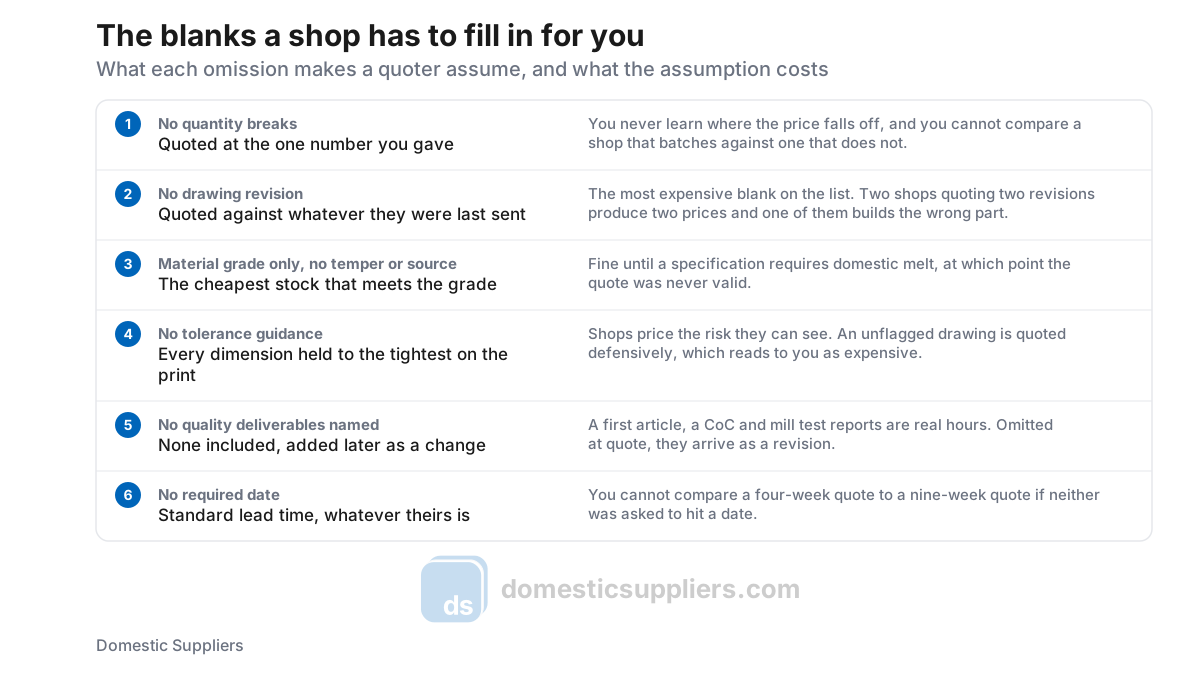
The revision blank deserves its own warning. Sending a drawing without a visible revision letter and date, or sending "the latest" to a shop that already has an older one on file, is how two suppliers end up building two different parts from what everybody believed was one drawing. Put the revision in the file name, in the title block, and in the body of the email. It is three redundant mentions of one letter and it has prevented more scrap than any other habit on this list.
A Template You Can Paste
Keep it to one screen. Anything longer gets skimmed.
Subject: RFQ — [part number] rev [X] — [your company]
Part: [part number], revision [X], dated [date]. Drawing and STEP attached.
Description: [one line: what it is and what it does]
Quantity: Please quote price breaks at 1 / 10 / 25 / 100 / 250. Estimated annual usage is [N]. This is a [one-off / prototype that may go to production / repeat release].
Material: [grade and condition, e.g. 6061-T6 aluminium]. [Supplied by you / supplied by us]. [Any melt source or certification requirement.]
Critical features: [list the two or three dimensions that control fit or function]. All other dimensions per the general tolerance block. Please tell us if any callout is difficult or costly, and whether a change would take significant cost out.
Finish and outside processes: [each operation and the specification it is called to, or "none"].
Quality deliverables: [first article to standard X / dimensional report / none]. [Certificate of conformance required or not.] [Mill test reports required or not.]
Packaging and delivery: [packaging and labelling requirements]. Ship to [address]. Required on dock by [date]; tell us the earliest you can do if that date is not achievable.
Commercial: Please state quote validity, lead time in working days from purchase order, and payment terms. Any tooling or fixtures we pay for remain our property and will be released on request.
Questions: [name], [phone], [email]. Please call rather than email if anything is unclear.
Response requested by: [date]
What Not to Do
Do not send the same RFQ to fifteen shops. Quoting is unpaid work that takes a competent estimator a couple of hours on a real part, and shops learn quickly which customers are shopping and which are buying. Five is plenty, three is often enough, and telling them roughly how many others are quoting is a courtesy that gets you taken seriously.
Do not use a target price as an opening move. It caps your downside at the number you named and tells the shop you have already decided what this is worth. If you genuinely have a budget constraint, say so after the first round, framed as a design-to-cost conversation.
Do not leave out the required date because you think it will inflate the price. A date is a constraint like any other, and shops that cannot meet it will say so, which is the outcome you wanted.
And do not treat the lowest number as the answer without reading what it includes. The gap between the cheapest and the second cheapest quote is frequently the inspection report.
Conclusion
The spread in a set of quotes is mostly a measurement of how much you left to the imagination. Send one packet with the revision stated three times, quantity as a schedule of breaks rather than a single number, material named to grade and condition, two or three critical features flagged, every outside process listed with its specification, the quality paperwork spelled out, and a date and a phone number. Then the numbers that come back are about the shops, which is the only thing you were trying to find out.