Section 232 and 301 Tariffs: What They Mean for Sourcing
The Supreme Court struck down the IEEPA tariffs in February, Section 232 was restructured onto full customs value in April, and 178 Section 301 exclusions expire on November 9. Here is what survives, and what it does to a quote.
Introduction
Two tariff authorities now set the floor under most industrial sourcing decisions, and they are not interchangeable. Section 232 reaches a product wherever it comes from. Section 301 reaches a country across the products on its lists. A part can be hit by one, the other, both, or neither, and the answer depends on the tariff code and the origin, not on how the part feels.
The ground moved three times this year. The Supreme Court invalidated the IEEPA tariffs in February, which removed the reciprocal and trafficking duties from the stack. Section 232 on metals was restructured in April to apply to full customs value rather than declared metal content, which raised the effective rate on a large population of parts that were barely affected before. And the Section 301 action on China was formally continued on October 8, with 178 product exclusions set to lapse three weeks from now. This article sets out where each authority stands as of today and what to do with that when you are quoting.
Two Statutes, Two Different Questions
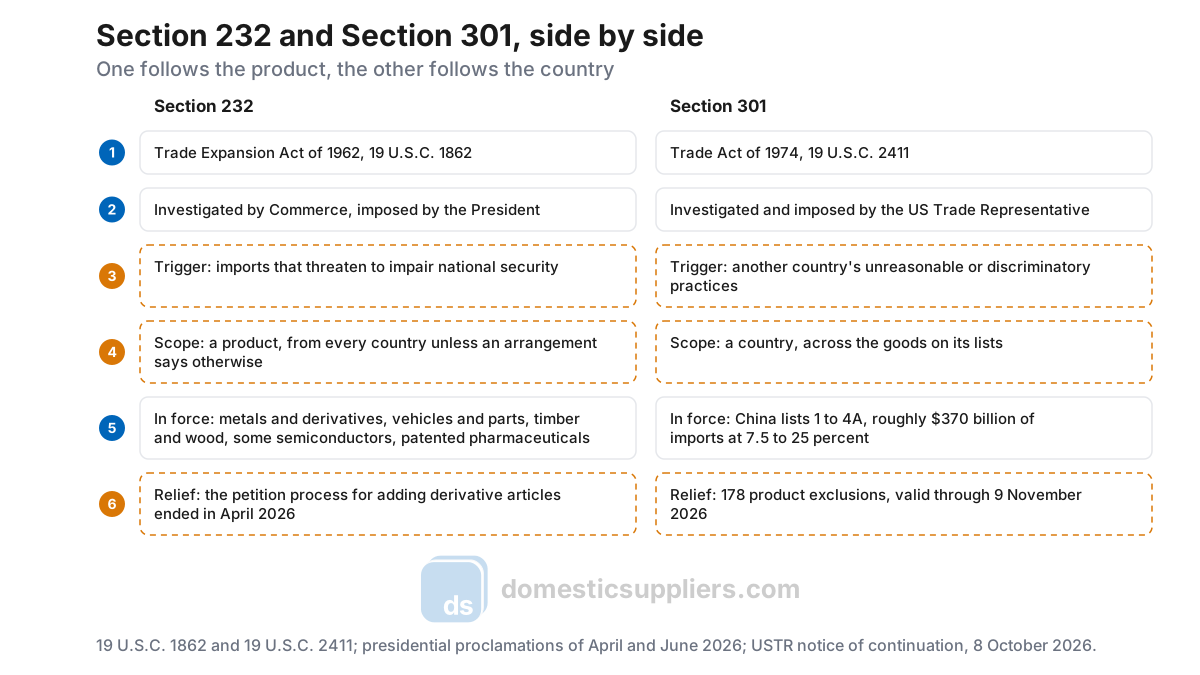
Section 232 comes from the Trade Expansion Act of 1962, codified at 19 U.S.C. 1862. The Commerce Department investigates whether imports of a particular article threaten to impair national security, and the President decides what to do about it. The output is product-based. Once an article is in scope, the duty applies to imports of that article from essentially everywhere, except where a specific arrangement says otherwise.
Section 301 comes from the Trade Act of 1974, codified at 19 U.S.C. 2411. The U.S. Trade Representative investigates whether a foreign country's acts, policies, or practices are unreasonable or discriminatory and burden U.S. commerce, and USTR imposes the response. The output is country-based. The duty applies to listed goods from that country, and the identical good from a third country is unaffected.
That difference drives everything downstream. A Section 301 problem can sometimes be solved by moving the work to another country. A Section 232 problem usually cannot, because the duty follows the product, and the only real escape is domestic supply or a change to the article itself.
What Section 232 Covers Right Now
The list is considerably longer than steel and aluminum, which is where most buyers' mental model stopped.
In force as of this month: steel, aluminum, and copper and hundreds of derivative articles made from them; passenger vehicles and light trucks and key parts at 25 percent; medium and heavy duty vehicles, their parts, and buses, added in November 2025; timber, lumber, and derivative wood products since October 14, 2025, at rates between 10 and 25 percent depending on origin and classification; wood furniture and kitchen cabinets; a narrow set of advanced semiconductors at 25 percent since January 15, 2026; and patented pharmaceuticals.
Investigations are open on industrial machinery and robotics, critical minerals, commercial aircraft, polysilicon, unmanned aircraft systems, wind turbines, personal protective equipment, and anthracite coal. An open investigation is not a tariff, and it is not a reason to re-source anything. It is a reason to know your tariff codes before the proclamation lands, because the window between proclamation and effective date is typically short.
The April 2026 Restructuring Changed the Arithmetic
Until this spring, the duty on a derivative article applied only to the declared value of the steel or aluminum content inside it. A $400 assembly with $30 of steel in it paid 50 percent on $30. That is no longer how it works.
Effective April 6, 2026, Section 232 duties on covered metal articles and derivatives apply to the full customs value of the article, regardless of metal content. The same $400 assembly, if it is a listed derivative, now pays its rate on $400. For parts with modest metal content and high value added, that is not an incremental change, it is a different order of magnitude.
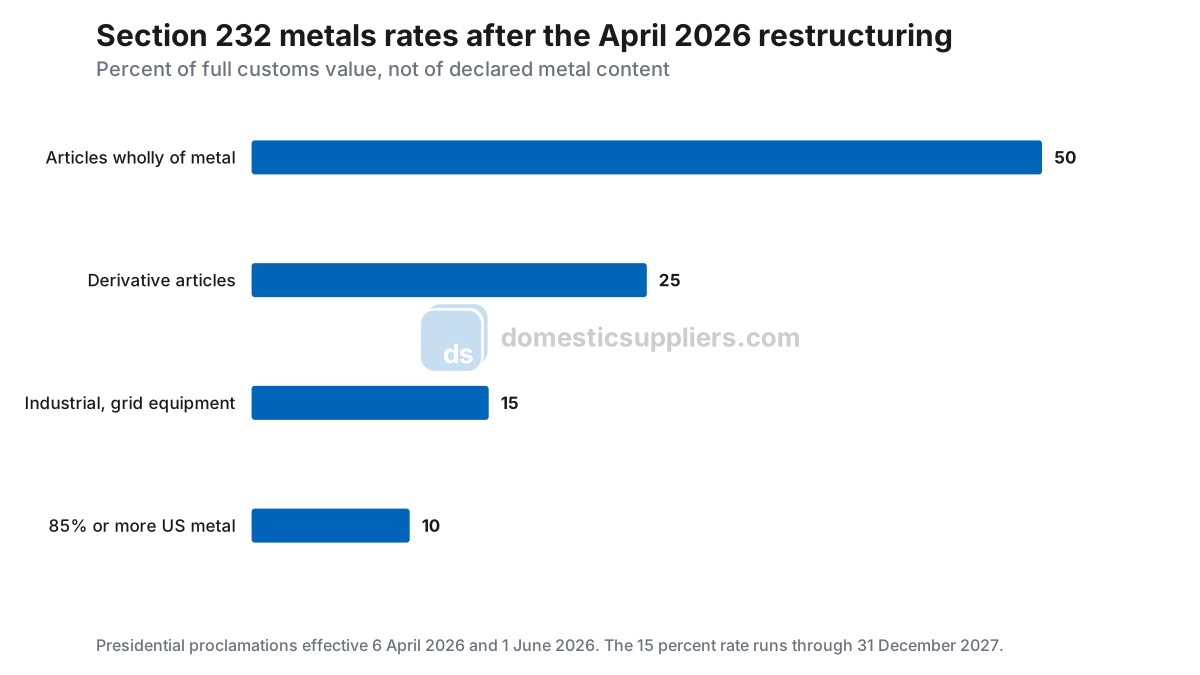
The rate structure that goes with it has four steps, plus an exclusion:
- 50 percent on articles made entirely or almost entirely of steel, aluminum, or copper — mill product, in other words.
- 25 percent on derivative articles substantially composed of those metals.
- 15 percent, transitional through December 31, 2027, on metal-intensive industrial equipment and electrical grid equipment.
- 10 percent on derivative articles made entirely with U.S.-melted and poured steel or U.S.-smelted and cast aluminum. The June 1, 2026 proclamation lowered the qualifying U.S.-content threshold for this rate from 95 percent to 85 percent.
- No Section 232 metals duty at all on articles classified outside Harmonized Tariff Schedule chapters 72, 73, 74, and 76 whose aggregate steel, aluminum, and copper content is 15 percent or less of the article by weight.
The rates do not stack across metals. An article that is a listed derivative under more than one of the three metal actions pays one rate, not two or three.
Two consequences follow for buyers, and both are paperwork.
The first is that the 10 percent rate is now reachable. An 85 percent U.S.-content threshold is a real target for a fabricator buying domestic mill product, where 95 percent frequently was not. If your supplier is already buying U.S.-melted steel, the difference between 25 percent and 10 percent on full customs value is worth the effort of documenting it.
The second is that melt and pour reporting is no longer optional in practice. Steel entries require the countries of melt and pour, aluminum entries require smelt and cast. For copper articles under the listed HTS codes, primary country of smelt and country of cast reporting took effect July 30, 2026, and ACE began rejecting entries missing that data on September 14, 2026. A supplier who cannot tell you where the metal was melted is a supplier whose entries will be rejected, and your parts will sit.
A note on the relief path: the April 2 proclamation eliminated the public petition process for adding new products to the scope of these tariffs. Commerce can still add articles on its own initiative, and proposed additions were circulating as recently as August 2026. What has gone away is the inclusions window that let a domestic producer petition articles in and let importers comment. If you were planning to argue your part out of scope through that process, it is not there.
Section 301, and the November 9 Exclusion Cliff
The China Section 301 tariffs are the older of the two regimes and the more stable. Lists 1 through 4A cover roughly $370 billion of imports at rates between 7.5 and 25 percent. Certain goods raised in the 2024 four-year review carry much higher rates, including electric vehicles at 100 percent.
The tariffs did not lapse at their four-year anniversaries of July 6 and August 23. USTR issued a formal notice of continuation on October 8, 2026, published in the Federal Register as document 2026-20510, after receiving requests to continue them from a range of domestic industries in response to a May 2026 notice of possible termination. A statutory four-year review follows, with a separate notice inviting comment on the effectiveness of the actions and possible modifications.
The live issue is the exclusions. There are 178 product exclusions currently in effect, covering solar manufacturing equipment, machinery components, plastic films, electric motors, certain medical devices, and certain fabrics and vehicle components. They are valid through November 9, 2026, and as of early October no extension had been published.
If any part you buy enters under an exclusion, that is the date to have on a calendar right now. The downside case is not a modest cost increase. An excluded line goes from zero Section 301 duty to its list rate, which for most of these is 25 percent, on a specific date, with no transition. Check the exclusion numbers on your entries, confirm with your broker which of your lines rely on one, and price both outcomes before you commit to a Q1 purchase order.
What the Supreme Court Took Off the Table
On February 20, 2026, the Supreme Court held 6-3 in Learning Resources v. Trump and Trump v. V.O.S. Selections that the International Emergency Economic Powers Act does not authorize the President to impose tariffs. That invalidated the reciprocal tariffs first imposed in April 2025 and the trafficking and immigration tariffs. An executive order revoking the IEEPA tariff orders followed, and collection stopped.
Two things matter about that for sourcing.
The ruling did not touch Section 232, Section 301, or Section 122. Those rest on different statutes with their own procedural requirements, and the Court's reasoning about IEEPA does not reach them. Anyone treating the decision as the end of tariff exposure has misread it, and the April and June Section 232 proclamations that came after it are the proof.
Importers that paid IEEPA duties may be owed refunds, but the mechanics are being worked out through CBP's post-entry procedures and are expected to be slow. If a supplier quoted you a price that included IEEPA duties and is now holding a refund claim, that is a conversation about the quote, and it is worth having before they bank it.
What This Means for a Quote
Price the duty, not the tariff headline. The question is never "are there tariffs on this." It is: what is the HTS classification, what is the country of origin, is that classification on a Section 232 list, is it on a Section 301 list for that origin, and is the Section 232 duty now assessed on full customs value. Those five answers produce a number. Nothing short of them does.
Re-check parts you cleared last year. The April change from metal content to full customs value means a part that carried a trivial Section 232 cost in 2025 can carry a material one now with no change to the part, the supplier, or the code.
Treat domestic metal as a documented input, not an assumption. The 10 percent rate exists, the threshold came down to 85 percent, and claiming it requires melt and pour evidence your supplier either has or does not.
And separate the two authorities when you plan around them. Moving an assembly from China to Vietnam addresses Section 301. It does nothing about Section 232 on the steel in it. Shops that moved work in 2025 expecting both problems to go away discovered the second half of that in April.
Conclusion
Section 232 follows the product, Section 301 follows the country, and as of October 2026 both are in force while the IEEPA layer that sat on top of them is gone. The restructuring in April moved the metals duty onto full customs value and opened a 10 percent rate for parts made with 85 percent U.S. metal. The nearest deadline is November 9, when 178 Section 301 exclusions expire unless USTR acts. Pull your tariff codes, find out which of your lines sit behind an exclusion, and get melt and pour documentation from anyone selling you a metal part.