Sheet Metal Fabrication Cost: What Drives US Quotes
The laser is the cheap part. In sheet metal the price is set at the press brake, by the number of setups rather than the number of bends, and by a thickness callout most drawings get wrong.
Introduction
Most engineers optimize a sheet metal part by looking at its outline. Fewer holes, a tighter nest, a simpler profile. All of that is work aimed at the one operation in the shop that is fast, repeatable and comparatively cheap, which is the laser.
The money is at the press brake. Cutting is a program and a cycle time, and the machine does not care whether your profile has twelve features or forty. Bending is setup-bound: the operator loads a punch and die, sets backgauge positions, bends a first piece, measures it, adjusts, and only then starts producing. A part with six bends that all run in one tooling setup is a different cost from a part with six bends needing three setups, and nothing on the drawing says which one you have designed.
The second thing that goes wrong is upstream of all of it. A drawing that calls out "16 gauge" has not specified a thickness. Sixteen gauge is 0.0598 inches in carbon steel under the Manufacturers' Standard Gauge, 0.0625 inches in stainless under the US Standard gauge, and 0.0508 inches in aluminum under Brown and Sharpe. Those are three different materials that will bend to three different dimensions, and a drawing that leaves the choice to the shop has handed away the one input every other number depends on.
This article walks the real drivers in the order a quote gets built: material and yield, thickness, forming, joining, hardware and finish, then tolerances. It also covers what has happened to prices, because the input side of this industry has moved violently and the output side has not kept up.
Who You Are Buying From
The industry is bigger and more fragmented than most buyers assume. The BLS Quarterly Census of Employment and Wages, which is built from unemployment insurance filings rather than a sample, counted 4,512 private sheet metal work manufacturing establishments in 2025, employing 115,263 people, with average pay of $71,024 a year, or $1,366 a week.
That last figure is worth a moment next to the machining article: machine shops averaged $1,369 a week in the same year. Sheet metal fabrication and precision machining pay their people within three dollars a week of each other nationally. Whatever makes a fabricated bracket cheaper than a machined one, it is not cheap labour. It is that forming moves metal instead of removing it, and that the equipment is amortized over far more parts per hour.
Material Is a Yield Problem
The quote line that says "material" is not the price per pound multiplied by the weight of your part. It is the price per sheet multiplied by the number of sheets your parts consume, and the gap between those two numbers is nesting yield.
Fabricators buy in standard sheet sizes, most commonly 48 by 96 inches and 60 by 120. Your part is nested into that rectangle alongside other parts, with a web between them and a skeleton around the edge. A part that nests at 80 percent yield and a part that nests at 55 percent yield cost the same per pound of finished part and very different amounts per piece, because somebody is paying for the skeleton either way.
Three practical consequences.
Dimensions near a sheet boundary are expensive. A part at 25 by 49 inches gets one per half sheet where a part at 24 by 48 gets two. An inch of design change can halve the material cost, and nobody will tell you unless you ask.
Quantity changes yield. Nesting is more efficient on a larger run, which is part of why the price per piece drops with quantity even when nothing else about the job changes.
Grain direction is a constraint on nesting. If your print calls out bend direction relative to grain, which it should on anything with a tight inside radius in aluminum, the nester has lost a degree of freedom and your yield drops.
Material also carries the tariff. Section 232 duties run at 50 percent on articles made entirely or almost entirely of steel, aluminum or copper, which is mill product, applied to full customs value. Your fabricator's coil and sheet buying sits directly under that, and it is the main reason material escalation clauses and seven-day quote validity windows have become normal in this industry.
Gauge Is Not a Unit
Gauge numbers are a weight convention left over from the wire drawing trade, and there are three separate tables in common use.
Carbon steel follows the Manufacturers' Standard Gauge, which is anchored to a weight of 41.82 pounds per square foot per inch of thickness. Stainless follows the US Standard gauge. Aluminium follows Brown and Sharpe. Galvanised sheet has a table of its own again, thicker at the same gauge number because the zinc coating is counted in the weight.
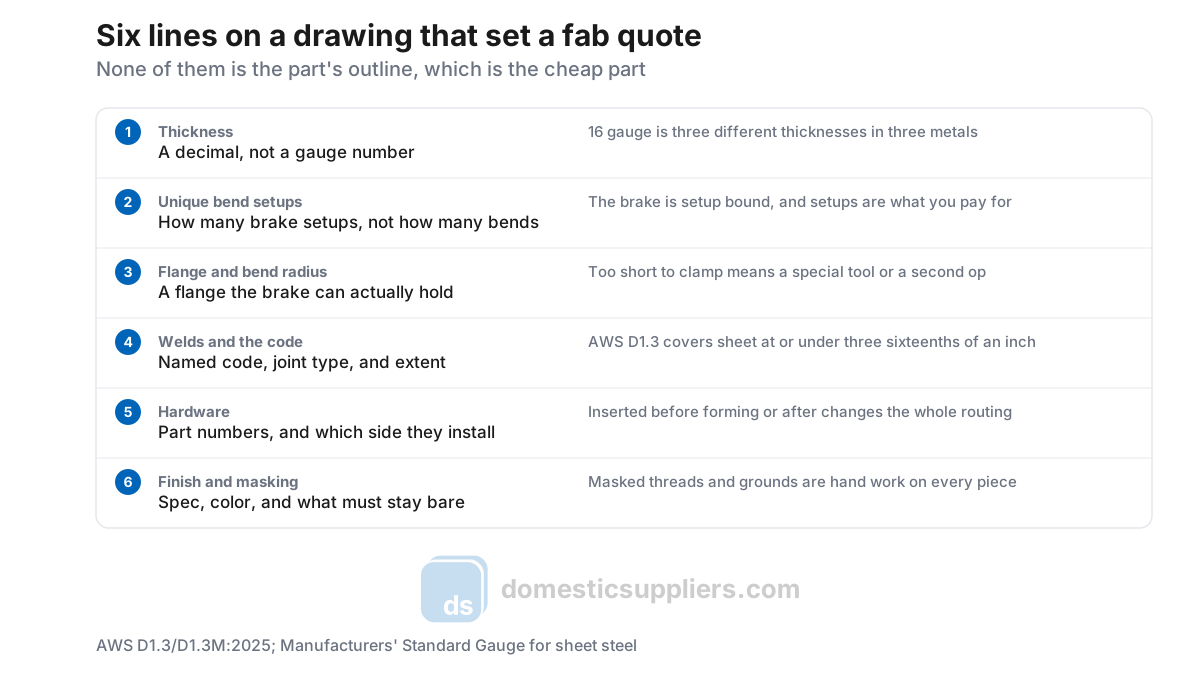
So 16 gauge means 0.0598, 0.0625 or 0.0508 inches depending on a material you may not have specified on the same drawing. The differences are small in absolute terms and large in consequence: bend allowance, minimum flange, inside radius, spring back and whether a self-clinching fastener will hold all scale with actual thickness.
Call out the decimal, with the gauge in parentheses if your shop floor thinks in gauges. Call out the alloy and temper for aluminum, not just "aluminum": 5052-H32 forms and 6061-T6 cracks at the same bend radius, and that is not a tolerance question, it is whether the part exists.
The Press Brake Sets the Price
Every bend has a tooling requirement: a punch with a particular tip radius and angle, a die with a particular vee opening, and a backgauge position. Bends that share tooling run in one setup. Bends that do not, do not.
Count setups, not bends. Four bends at the same radius in the same material, all reachable without flipping the part into a different tool, are one setup. Four bends where one is a tighter radius, one needs a gooseneck punch to clear a previously formed flange, and one is longer than the first station's tooling, are three or four setups and roughly that multiple of the forming cost on a short run.
Keep inside radii consistent. A single inside bend radius across the whole part is the single cheapest design decision available in sheet metal. Different radii mean different punches.
Respect minimum flange length. The flange has to be long enough to sit on the die and be held while it forms. The usable minimum is a function of the die vee opening, which is itself a function of material thickness, so a short flange in thick material is the combination that fails. A flange the brake cannot hold means a special tool, a tab that gets cut off later, or a second operation, and all three are priced.
Watch bend sequence and collisions. A part that has to be formed in an order where a later bend swings a formed flange into the ram is a part that needs a gooseneck or cannot be made as drawn. This is the failure mode that turns a quote into a phone call, and the phone call into two weeks.
Do not dimension from bend to bend. Tolerances stack across bends. Dimension everything from one datum face, and put the tolerance where the function is rather than on every feature equally.
Welds, and the Code Nobody Named
If the part is welded, the drawing has to say to what.
AWS D1.3/D1.3M, Structural Welding Code for Sheet Steel, current edition 2025, covers arc welding of structural sheet and strip steels, including cold formed members, at or under three sixteenths of an inch in nominal thickness. Above that you are in D1.1 territory. Aluminium is D1.2. Aerospace is D17.1.
A print that says "weld all around" with no code, no joint type and no size has specified neither the process nor the acceptance criteria, and the shop will quote the cheapest reading of it. The cost differences are real: a continuous weld is several times a stitched weld; a weld requiring a certified procedure and a qualified welder to a named code is more again; a weld that has to be ground flush and blended is hand labour per piece forever.
Three cheap decisions. Specify stitch rather than continuous wherever the function allows it. Specify weld size rather than leaving it to the symbol's default. And say explicitly where cosmetic blending is required and, more importantly, where it is not.
Hardware, Finish and the Hidden Hand Work
Self-clinching fasteners are inserted, not threaded, and the insertion operation is cheap. What is not cheap is the routing question: hardware installed before forming is a press operation on a flat blank, and hardware installed after forming may need a different machine, a longer throat, or a person. Call out the part number, the sheet it installs into, and which side, and let the shop sequence it.
Finishing is where a quote quietly doubles. Powder coat is cheap per square foot and expensive per handling. The cost is in racking, masking and inspection, not in the powder. Every masked hole, every thread that must stay clear, every grounding pad that must stay bare, and every surface with a cosmetic requirement is hand work repeated on each piece.
So the finish callout deserves as much attention as the geometry. Name the specification and the color. State the acceptable surface for non-cosmetic faces. Say which features must be masked and which merely must not be clogged, because those are different instructions and only one of them is expensive. And if the part will never be seen, say so on the drawing, because in the absence of a statement the shop has to assume it will be.
Tolerances That Earn Their Keep
Sheet metal tolerances are not machining tolerances, and applying a machining default block to a formed part is the most common way to add cost without adding function.
Flat pattern features, meaning hole positions and edges on the blank before forming, hold tightly because they are cut in one operation off one datum. Formed dimensions, meaning anything measured across a bend, accumulate the bend allowance error, spring back and the gauge variation of the incoming material. Asking for the same tolerance on both is asking for a secondary operation.
The productive approach is to tolerance by function. Put the tight tolerance on the hole pattern that mates with something, leave the overall formed envelope open, and say which face is the datum. If one across-bend dimension genuinely has to hold, say so and accept that the shop may add a fixture or a check step for it. A drawing with one hard dimension and the rest open is cheaper and more likely to work than a drawing with everything at the same moderately tight value.
What Has Happened to Prices
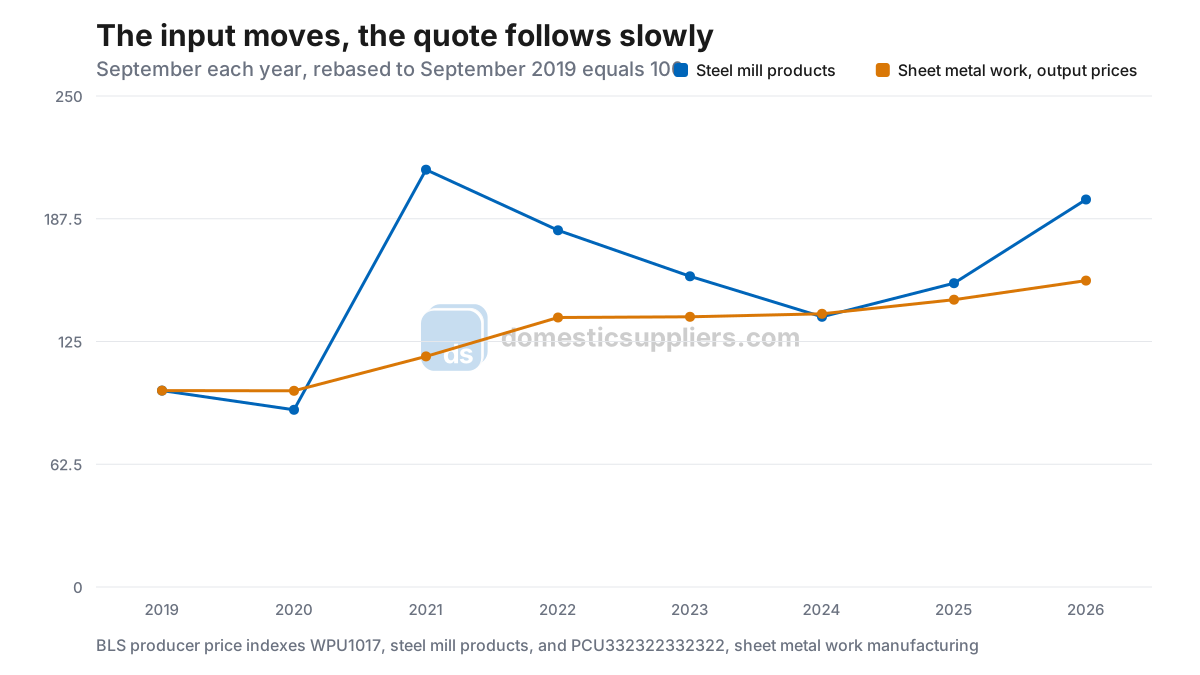
Two producer price indexes tell the story. Steel mill products, the input, and sheet metal work manufacturing, the output.
In the year to September 2026, steel mill product prices rose 27.6 percent. Over the same twelve months, sheet metal fabricators' own output prices rose 6.7 percent. Measured from September 2019, the input is up 97 percent and the output is up 56 percent.
Three things follow from that chart, and all of them show up in how you should handle a quote.
Quote validity has shortened for a reason. A fabricator holding a 30-day price on a job with 60 percent material content is taking a position on steel. Expect seven to fifteen days, and do not read it as a negotiating tactic.
Material escalation clauses are now normal. The honest version names an index and a threshold rather than leaving the adjustment to the supplier's judgment. Ask which index, and ask for the clause to run both ways.
Lowest price on a material-heavy part is the least durable advantage in this industry. A shop that beat its competitors by buying well in a soft quarter is not structurally cheaper. On a long program, the shop that nests better and forms in fewer setups is.
Conclusion
A sheet metal quote is four numbers in a trench coat: material consumed rather than material in the part, cutting time, forming setups, and everything that is done by hand afterwards. The drawing controls three of them and usually only tries to control the outline. Specify a decimal thickness with an alloy and temper rather than a gauge number. Keep one inside radius and count the brake setups your geometry forces. Name a welding code and the weld extent. Say which surfaces are cosmetic and which are not. Tolerance by function and dimension from one datum. Then expect a short quote validity, because with steel mill products up 27.6 percent in a year and fabricators' own prices up 6.7, the person quoting you is carrying a risk that has nothing to do with your part.