Thomasnet Alternatives for Finding US Manufacturers
Paid placement decides who appears first. What the free options index, what each one misses, and how to search by capability instead of by advertiser.

Introduction
Thomasnet is usually the first result, and it looks like the whole internet of US manufacturers in one place. Then you start calling the top few names and nothing lines up with what you asked for, and you start wondering whether the order on the page means anything at all.
It doesn't mean capability fit. It means advertising spend. That single fact is the reason people search for free alternatives to Thomasnet for finding US manufacturers, and it's the reason this piece exists.
The useful question isn't "which directory is cheaper to appear in." It's "what does each source actually hold, and what can none of them hold no matter how much a supplier pays." That second question has a clean answer, and it applies to every directory in this piece, including ours.
How Thomasnet placement actually works
A basic Thomasnet listing is free. Whether a buyer ever sees it is not.
Thomas runs a program called Sponsored Listings, and the mechanics are published on Thomas's own business pages, not inferred from how the site behaves. Paying suppliers get placement at the top of buyer search results across more than 80,000 categories. Billing is pay-per-click — Thomas calls it performance-based — so a supplier pays when a buyer clicks into its profile, not simply for being listed. Paying profiles also get RFQs routed to them directly, and analytics that identify which buyers viewed the listing, down to company name.
None of that is a guess about Thomas's business model. It's what the program pages say the program does. A figure that circulates for what premium placement costs — a range of roughly $7,000 to $50,000 a year — comes from third-party review sites rather than Thomas's own price sheet, and two of those reviews independently land in the same range, so treat the number as indicative rather than official.
Put plainly: the order of a Thomasnet results page tells you who bought placement and who is paying per click right now. It does not tell you who can hold your tolerance.
IQS Directory and GlobalSpec, also known as Engineering360, use the same category-browse layout and the same supplier-pays-for-visibility business model. But neither one has a published program page describing how its ranking works, the way Thomas does. Their paid placement is a reasonable inference from how directory businesses make money — it is not confirmed the way Thomasnet's is. That distinction matters if you're deciding how much weight to put on any one listing's position.
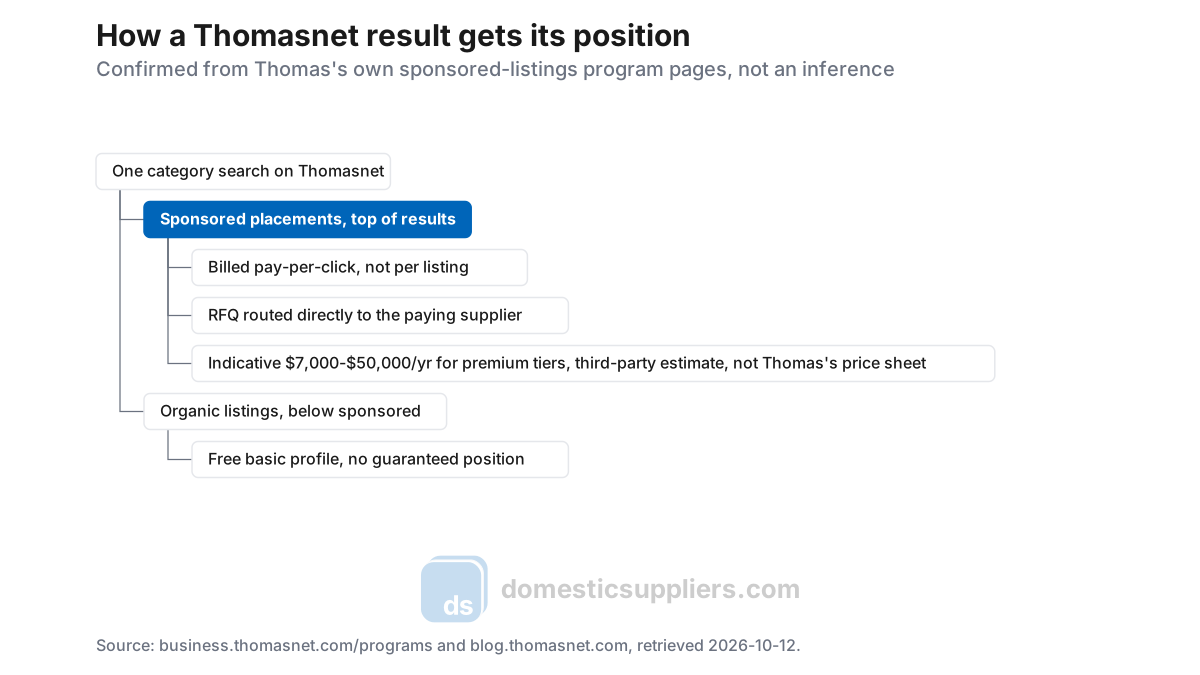
The diagram above marks what a sponsored slot actually buys: a position, not a verdict.
What a free directory can and cannot index
Here's the gap that explains most of the frustration with directories generally, Thomasnet included. Capability data is the specific, operational information that tells you whether a shop can do your job — the tolerance it holds on aluminum, its equipment list, how much capacity it has free this quarter. No public dataset collects that. Not a federal database, not a certification registry, not a free directory, not a paid one.
What does exist, and exists for free, is company data. That includes NAICS — the North American Industry Classification System, a code a company chooses for itself when it registers with the federal government, describing its primary line of business — and PSC, a Product and Service Code assigned by a contracting officer to describe the actual item bought on one line of a federal contract. Company data also includes award history, certification scope, and a registered street address. All of that is published somewhere, searchable, and free.
That's why federal sources and certification registers consistently beat commercial directories once the question turns to capability. They're not better at capability data — nobody is. They're better at the company facts that let you narrow a list before you ever pick up the phone. The table below lines up the sources in this piece against what each one actually holds.
| Source | What it holds | Capability data | Certifications | Cost | Ranked by |
|---|---|---|---|---|---|
| Thomasnet | Self-written profiles, ~80,000 categories | No (self-declared only) | Self-declared, unverified | Free listing; $7k–$50k/yr for sponsored placement | Paid placement + pay-per-click (confirmed) |
| IQS Directory | Category-organized listings | No | Self-declared | Assumed paid (unverified) | Inferred pay-to-rank |
| GlobalSpec / Engineering360 | Parts/specs plus supplier profiles | Partial (catalog specs, not custom capability) | Self-declared | Assumed paid (unverified) | Inferred pay-to-rank |
| SAM.gov | Entity registration, self-selected NAICS | No | No | Free | Unranked |
| USAspending | Award/delivery history by PSC | Indirect (via PSC of delivered part) | No | Free | Unranked, evidence-based |
| DLA DIBBS | Solicitations and NSNs, not companies | No (demand-side only) | No | Free | Not applicable |
| NIST MEP locator | Center contact per state | No (human referral) | No | Free | Not applicable |
| CONNEX Maryland/DC | Manufacturer capability and capacity records | Yes (self-declared, capability search) | Partial | Free to MD/DC firms | Unranked |
| Trade association directories | Member company list | No | No | Free to browse; dues to join | Membership order, not rank |
Read it as a map of what each source is for, not a leaderboard. No single row covers the whole job.
Federal sources: SAM.gov, DLA, and USAspending
SAM.gov, the System for Award Management, is the mandatory registration for any company that wants federal work. Its entity record holds a legal name, an address, a size classification, and the NAICS codes the company chose for itself. That last part matters: nothing checks whether those codes are accurate, so a shop can list codes for work it would like to win rather than work it actually runs. Registration is free, so presence in SAM.gov by itself is close to zero signal about capability.
USAspending.gov is different in kind, not just in content. It records every federal contract transaction, searchable by PSC, and a PSC on an award was assigned by a contracting officer to describe a part that was actually delivered — not claimed by the supplier about itself. That makes USAspending the one free source in this piece where the index reflects a third party's record of a completed delivery rather than a company's description of itself. It won't tell you about current capacity, and commercial-only shops that never touch federal work simply don't appear, but what it does show is evidence, not a pitch.
DLA DIBBS, the Defense Logistics Agency's bid board, posts solicitations, not companies. Each one carries a National Stock Number whose first four digits are a Federal Supply Class. DIBBS won't hand you a supplier list, but it gives you the exact vocabulary — the FSC — to carry into USAspending and find out who has actually delivered something like your part.
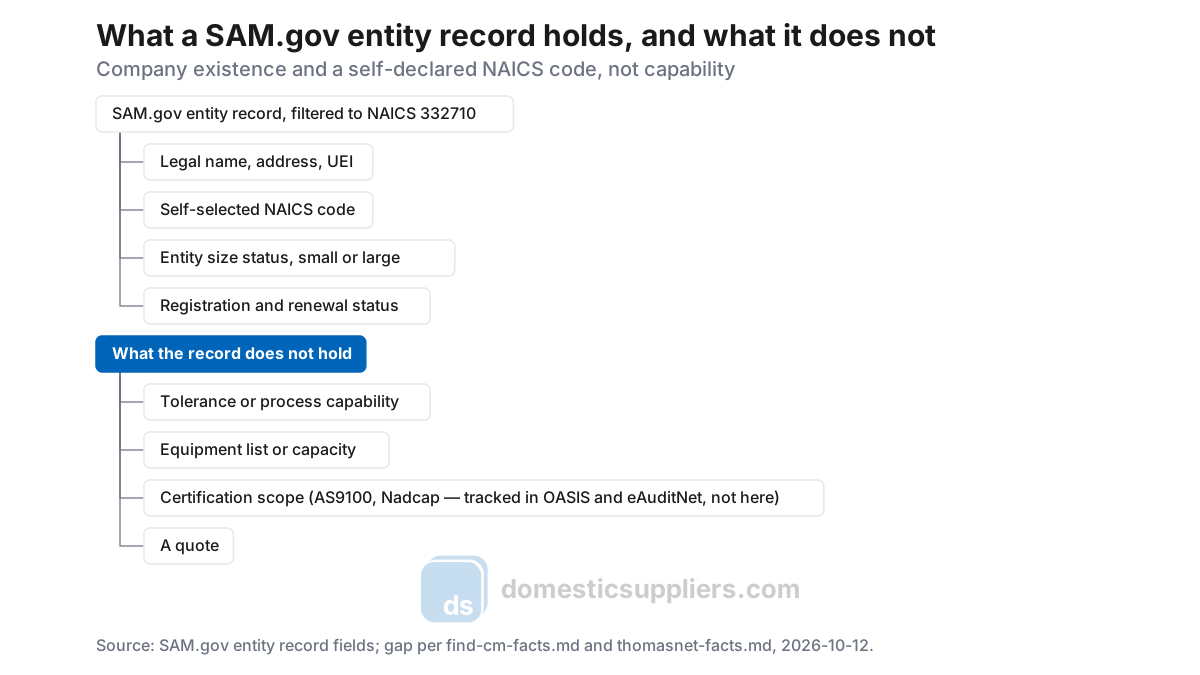
The diagram above shows the shape of that search: a NAICS filter against a self-selected field, which is exactly why it needs the PSC cross-check that follows it.
Trade association and state directories
NIST's Manufacturing Extension Partnership runs one center per state plus Puerto Rico — 51 centers in total. The locator doesn't function as a company directory at all; it connects you to a human advisor who refers you into the local supply base. That's a different kind of value than a search result, and it's worth using precisely because a person, not an algorithm, is making the call.
One state program goes further. CONNEX Maryland/DC, run by Maryland's MEP center, is a searchable capability and capacity directory — free to manufacturers in Maryland and DC — and it's the one example in this piece of a state-affiliated tool that actually indexes capability rather than just company existence. CONNEX-style directories operate in other states too, but only the Maryland instance was verified here, so treat it as an example of what this type of tool looks like, not a promise that your state runs an equivalent one.
Trade association directories — NTMA for machining, PMA for metal forming, AMT for machine tool builders, FMA for fabrication, NADCA for die casting — publish their own membership totals, and those totals are self-published claims about the association's own membership, not independently counted. Their directories are free to browse but gated by dues to join, and listing in one means a company paid dues, not that it was vetted for capability.
Searching by capability instead of by name
The practical move is to let the source decide what kind of answer you get. USAspending by PSC gives you evidence that a company delivered something like your part — a far stronger signal than a self-declared NAICS code, because a contracting officer assigned it after the fact rather than a supplier picking it in advance. SAM.gov by NAICS gives you the broadest free list of registered companies, with the caveat that the codes are aspirational as often as they're accurate.
Certifications narrow the field a different way. AS9100 and Nadcap are the two that are genuinely self-checkable, through IAQG's OASIS database and the Performance Review Institute's eAuditNet — and Nadcap is the rarer kind, accrediting a specific process like heat treating or welding rather than a whole management system. ISO 9001 and IATF 16949 have no equivalent public registry; verifying those means contacting the certification body named on the certificate, not trusting a badge on a profile page.
None of this reaches capability data directly. What it does is filter a long list down to companies with real, checkable facts attached — a delivered part, a current certificate — before you spend time on outreach.
Where every directory falls short
Every source in this piece is thin in the same place. SAM.gov's NAICS codes are self-selected and often aspirational. Association directories show only dues-paying members, which is a minority of any trade. Thomasnet, IQS, and GlobalSpec profiles are self-written, can go stale, and rank by advertising spend rather than fit. USAspending and DIBBS have no visibility into commercial-only work and lag behind current activity. Quoting marketplaces like Xometry hide supplier identity by design — you get a price, not a company you can call.
Counts are worth treating with the same suspicion. Thomasnet's claim of more than 500,000 suppliers, and every association's membership total, are self-published figures about their own platforms. The one number in this space that comes from a regulatory filing rather than marketing copy is Xometry's: 4,996 active suppliers as of December 31, 2025, reported in its 10-K. That's not a bigger number than Thomasnet's — it's a differently sourced one, and the difference is worth knowing before you repeat either figure.
Our own directory, domesticsuppliers.com, has the same shape of limit as the rest. It indexes 4,741 machine shops against a Census count of 17,156 nationally, which makes it one way to find companies, not a capability check, and not a claim to completeness. It's one source among the several in this piece, nothing more.
Building one shortlist across several sources
No single source here replaces Thomasnet outright, because no single source holds everything Thomasnet's category browsing makes it feel like it holds. The way around that is to run several sources in sequence, each one narrowing the last.
Start with USAspending filtered by PSC, which narrows the field to companies with proven delivery of something like your part — this drops everyone who only claims the capability. Run the resulting names through SAM.gov to confirm registration, address, and size status. Check certification registries — OASIS for AS9100, eAuditNet for Nadcap — against that set to filter for a current, verifiable scope rather than a self-declared badge. Add a state or MEP capability directory, such as CONNEX Maryland/DC, or a relevant trade association directory, for capacity detail and a local contact who can actually answer a question. The step no directory replaces is the last one: direct outreach to whatever shortlist survives all of that, because a tolerance, a capacity number, or a real quote only ever comes from a conversation.
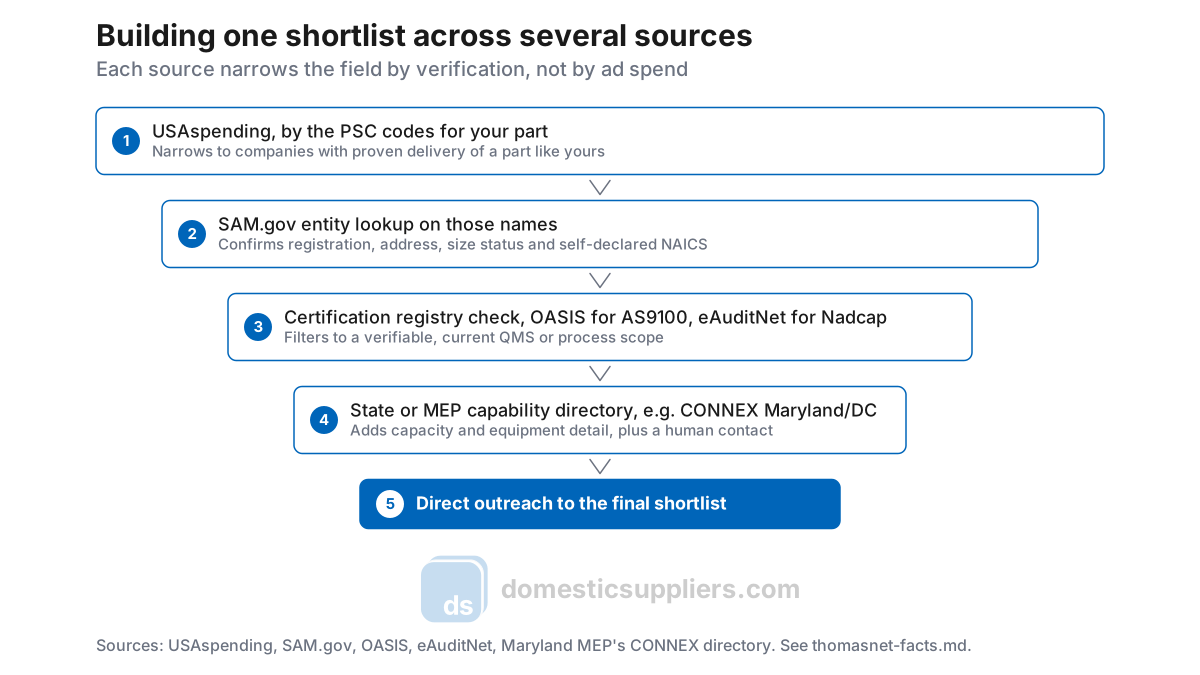
The diagram above lays that sequence out as a funnel — wide at the federal evidence, narrow by the time you're on the phone.
Conclusion
Thomasnet's placement is sold, and now it's confirmed exactly how: sponsored slots, pay-per-click, RFQs routed to whoever paid. IQS and GlobalSpec probably work the same way, but that's still an inference, not a published fact, and the difference is worth keeping straight. The deeper issue isn't any one directory's business model, though. It's that capability — the thing you actually need to know — isn't published anywhere, free or paid. Company facts are. Use the federal sources and certification registers for those facts, use a directory or two for leads, and reserve judgment on capability for the one source that always has it: the supplier, on the phone, answering your actual question.